

India may attack Pakistan to divert attention from domestic woes — Qureshi 

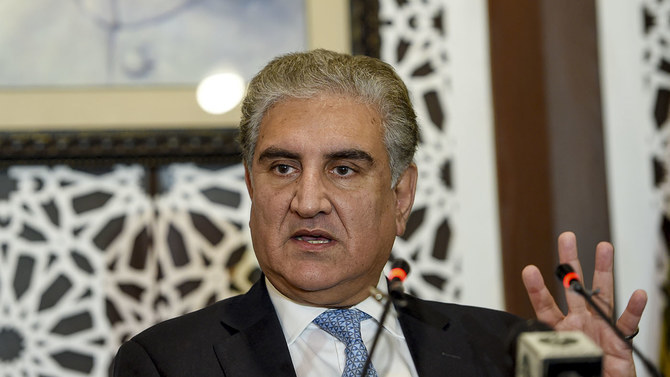
Pakistan’s Foreign Minister Shah Mahmood Qureshi. (AFP/ File Photo)
Short Url
Updated 11 February 2020
Follow

India may attack Pakistan to divert attention from domestic woes — Qureshi 

  • Says he has written to world bodies warning of an Indian false flag operation
  • Claims India’s Kashmir move caused $2 bn economic losses to Jammu and Kashmir 

KARACHI: Pakistan Foreign Minister Shah Mahmood Qureshi said on Monday that the Indian government of Prime Minister Narendra Modi may launch false flag operations to attack Pakistan in order to divert attention from the domestic economic and political turmoil.

Addressing the Federation of Pakistan Chambers of Commerce and Industry (FPCCI) in Karach, Qureshi said that he has written to world bodies expressing serious concerns in this regard.

“I have written seven letters to the secretary-general of United Nations and president of the Security Council and in all the seven letters, I have expressed my concerns,” he said. 

“I fear that to divert the attention from the internal problems they (Indian government) can play Pulwama like drama again and, through false flag operation, can target Pakistan,” the minister remarked.

In February 2019, a convoy of vehicles carrying security personnel was attacked with vehicle-borne explosives in the Pulwama district of Indian-administered Jammu and Kashmir, which resulted in the death of 40 security personnel.

Though Pakistan denies any involvement, India insists that Pakistan based elements were involved in the attack. 
Qureshi said that Modi’s Bharatiya Janata Party (BJP) was losing mandate which was evident from the recent result of polls held in three Indian states. “That may be the impact of cruel policies being towed in Kashmir and a result of controversial citizen laws, NRC (National Register of Citizens),” he said. “Entire India is facing protests,” he added.

Indian government’s policies have affected the economy of Jammu and Kashmir as the territory remains under a security lockdown since August 5, 2019, when BJP revoked the special status of the disputed region.

“In six months, as per their (Indian) economic experts, the valley alone has suffered minimum economic losses worth $2 billion,” he said. “Around 400,000 people have lost jobs and the trend is continuing. Many young people who had availed loans to start businesses are about to default.”

Talking about the bilateral economic relations with China, the foreign minister said that Pakistan will sign an agreement with Beijing for cooperation in agriculture research where the focus will be on production capacity enhancement for exportable surplus.

“In the first phase of China Pakistan Economic Corridor (CPEC), our prime focus was on energy and now our priorities in the second phase of CPEC are industrialization and transfer of technology,” Qureshi said.

Pakistan is currently struggling to enhance its exports and looking for new markets. 

“The world takes those countries seriously that are financially stable which is why I am here so that we can forge partnership to establish contacts with other countries through economic diplomacy,” Qureshi said.

Mian Anjum Nisar, president of the FPCCI, later addressing the ceremony stressed on trade diplomacy to enhance exports from Pakistan. He also called for reducing the cost of doing business to make the country competitive with global players.



Pakistan, global crypto exchange discuss modernizing digital payments, creating job prospects 

Updated 05 December 2025
Follow

Pakistan, global crypto exchange discuss modernizing digital payments, creating job prospects 

  • Pakistani officials, Binance team discuss coordination between Islamabad, local banks and global exchanges
  • Pakistan has attempted to tap into growing crypto market to curb illicit transactions, improve oversight

ISLAMABAD: Pakistan’s finance officials and the team of a global cryptocurrency exchange on Friday held discussions aimed at modernizing the country’s digital payments system and building local talent pipelines to meet rising demand for blockchain and Web3 skills, the finance ministry said.

The development took place during a high-level meeting between Finance Minister Muhammad Aurangzeb, Pakistan Virtual Assets Regulatory Authority (PVARA) Chairman Bilal bin Saqib, domestic bank presidents and a Binance team led by Global CEO Richard Teng. The meeting was held to advance work on Pakistan’s National Digital Asset Framework, a regulatory setup to govern Pakistan’s digital assets.

Pakistan has been moving to regulate its fast-growing crypto and digital assets market by bringing virtual asset service providers (VASPs) under a formal licensing regime. Officials say the push is aimed at curbing illicit transactions, improving oversight, and encouraging innovation in blockchain-based financial services.

“Participants reviewed opportunities to modernize Pakistan’s digital payments landscape, noting that blockchain-based systems could significantly reduce costs from the country’s $38 billion annual remittance flows,” the finance ministry said in a statement. 

“Discussions also emphasized building local talent pipelines to meet rising global demand for blockchain and Web3 skills, creating high-value employment prospects for Pakistani youth.”

Blockchain is a type of digital database that is shared, transparent and tamper-resistant. Instead of being stored on one computer, the data is kept on a distributed network of computers, making it very hard to alter or hack.

Web3 refers to the next generation of the Internet built using blockchain, focusing on giving users more control over their data, identity and digital assets rather than big tech companies controlling it.

Participants of the meeting also discussed sovereign debt tokenization, which is the process of converting a country’s debt such as government bonds, into digital tokens on a blockchain, the ministry said. 

Aurangzeb called for close coordination between the government, domestic banks and global exchanges to modernize Pakistan’s payment landscape.

Participants of the meeting also discussed considering a “time-bound amnesty” to encourage users to move assets onto regulated platforms, stressing the need for stronger verifications and a risk-mitigation system.

Pakistan has attempted in recent months to tap into the country’s growing crypto market, crack down on money laundering and terror financing, and promote responsible innovation — a move analysts say could bring an estimated $25 billion in virtual assets into the tax net.

In September, Islamabad invited international crypto exchanges and other VASPs to apply for licenses to operate in the country, a step aimed at formalizing and regulating its fast-growing digital market.