

Edhi Foundation awaits official permission to rescue Pakistanis from China

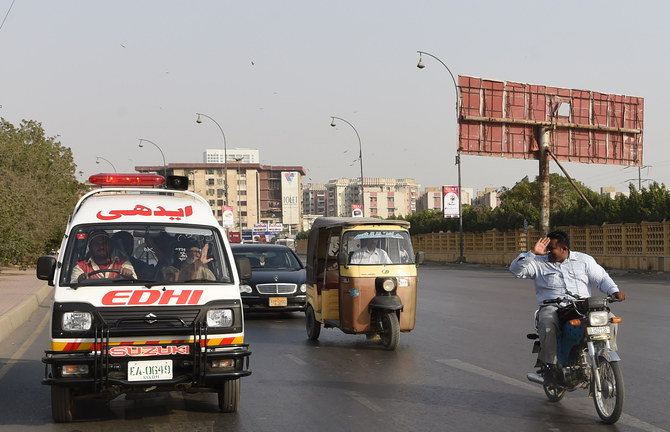
In this photograph taken on February 15, 2016, a Pakistani motorcyclist (R) pays his respects to Abdul Sattar Edhi (2nd L), the head of Edhi Foundation, as he travels to his his office in the port city of Karachi. (AFP)
Short Url
Updated 15 March 2020
Follow

Edhi Foundation awaits official permission to rescue Pakistanis from China

  • Edhi Foundation says awaiting govt go-ahead to bring back four from coronavirus-hit areas
  • Letter from those stranded in Wuhan paints a dismal picture of the deadly outbreak

KARACHI: Prompted by calls for help by three Pakistani students stuck in China’s Wuhan city, the epicenter of the deadly coronavirus outbreak, the country’s major charity group told Arab News on Monday that it was waiting for an official go-ahead to bring them home.

“We are awaiting the government’s response to our request, which was prompted by appeals from Pakistani students stuck in Wuhan city,” Faisal Edhi, the managing trustee of the Edhi Foundation said.

Earlier on Saturday, in a letter to Foreign Minister Shah Mehmood Qureshi, Edhi had sought permission to help evacuate the Pakistani students from the affected areas.

“[The] coronavirus is spreading in China very fast….. Pakistani students in Wuhan, China are in our contact and we want to evacuate these students from China,” excerpts from the letter read, adding that the students were “mentally disturbed and in stress”.

He further requested the foreign minister to help identify areas “where the students [will be] quarantined until the coronavirus [is tested] negative.” 

“Upon your permission, we will contact the airlines and arrange chartered flights to evacuate them at the earliest,” Edhi wrote, adding that several countries, including India, had already evacuated their citizens. 

The Foreign Office did not respond to queries when contacted by Arab News. 

However, Special Assistant to Prime Minister (SAPM) on National Health Services, Dr. Zafar Mirza, tweeted on Sunday that the issue is being discussed at the highest level and a decision will be taken, considering all factors involved.

“210/ My very dear students in China & ur respectable family members, v r intensely discussing the situation @ highest level & will make the bst decision in view of all factors with ref to devastating #coronavirus potential global pandemic. Rest assured you are our own & we care!” he tweeted.

Dr. Mirza also shared a response from the China mission in Pakistan which said that the students are “well protected.”

“We have full understanding of the situation of the Pakistani students in Wuhan and Hubei Province. China will care about you as our own. Things are getting better, and please rest assured you are well protected,” the statement read.

Muslim Qadir, one of the three students, who appealed to the Edhi Foundation for help told Arab News when by WhatsApp that the situation in Wuhan city was not good. 

“Everywhere, roads are close and [we] are afraid to go down around to take something. We are in rooms from January 21. We are afraid that our government is not taking any serious action. [It seems] like we are not citizens of Pakistan,” Qadir said, urging the government to allow the Edhi Foundation to evacuate more than 2,000 students.

In their letter to the Edhi group, which was last week, the students added that “there is silence and fear ruling all over the city” of 11 million people.

“...The epidemic is continuously affecting every citizen’s home. After January 22, the entire city of Wuhan has been locked down. Other countries rushed to evacuate their students,” they wrote, adding that on contacting the Pakistani Embassy in Beijing, they were asked to register online.

“We were given some [phone] numbers that started closing or getting busy a few days later,” they said.


Pakistan reaffirms commitment to clamp down on informal sector to encourage investment

Updated 6 sec ago
Follow

Pakistan reaffirms commitment to clamp down on informal sector to encourage investment

  • Nestlé delegation briefs Finance Minister Muhammad Aurangzeb on localization, efficiency enhancements in Pakistan
  • Improved compliance, transparency, strengthened tax ecosystem central to economic recovery, stresses finance minister

KARACHI: Pakistan’s Finance Minister Muhammad Aurangzeb reaffirmed the government’s commitment to clamp down on the informal sector on Monday, the Finance Division said, citing transparency and a strengthened tax ecosystem as central to the country’s economic recovery. 

Pakistan’s government has cracked down on smuggled items and tightened enforcement in poorly taxed sectors, such as tobacco, in recent months as it pushes ahead with its efforts to maximize tax collection by discouraging the formal sector. Informal sector comprises businesses that operate outside the tax net, avoid registration and as a result, neglect regulatory oversight and violate quality, safety or labor standards. 

Aurangzeb met a delegation from Nestlé Pakistan at the Finance Division, where the two sides discussed the multinational’s efforts to strengthen its operations in the country through localization, portfolio adjustments and efficiency enhancements. 

“Emphasizing the government’s resolve to clamp down on the informal sector, an effort that has already begun yielding visible results in multiple industries, the finance minister noted that improved compliance, transparency and a strengthened tax ecosystem are central to Pakistan’s economic recovery,” the Finance Division said in a statement. 

Nestlé Pakistan Chief Executive Officer Jason Avancena provided an overview of the organization’s operations, claiming it had strengthened them through localization, portfolio adjustments, advanced automation, efficiency enhancements and continued innovation across product categories. 

Avancena said Nestlé is implementing solar and biomass energy systems, digital dashboards, environmentally improved packaging, and supply-chain automation in Pakistan. The delegation highlighted that Nestlé’s localization efforts have materially strengthened its resilience. 

“They noted that through sustained efforts to localize raw materials and reconfigure product portfolios, Nestlé Pakistan has reduced its import volumes by nearly half over the past three years from around $150 million to approximately $76–80 million, thereby minimizing exposure to foreign-exchange pressures and deepening integration with Pakistan’s agricultural and manufacturing base,” the Finance Division said. 

Aurangzeb commended the multinational for its efforts and underscored the government’s intention to facilitate greater formalization and enhanced tax equity across the food and beverages sector. He noted that informal players have “rapidly expanded” their market share by operating outside the tax net in sectors such as food and beverages. 

The delegation also discussed export performance, including the company’s presence in markets such as the United States, Canada, the Gulf, and the United Kingdom, sharing insights into challenges related to regional trade, particularly the Afghanistan corridor. 

Aurangzeb advised Nestlé to explore logistics partnerships to expand access to Central Asian markets, reiterating that Islamabad remains committed to enabling export-oriented industry growth.