

Banks lose foreign reserves as Pak rupee offers big returns: experts

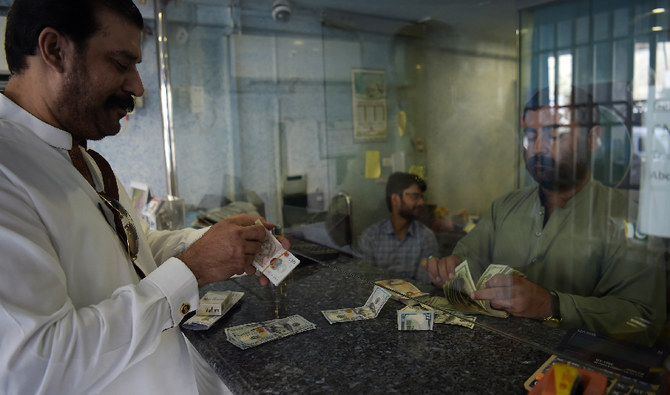
A Pakistani man purchases foreign currency at a currency exchange shop in Islamabad on October 9, 2018. (AFP)
Short Url
Updated 09 February 2020
Follow

Banks lose foreign reserves as Pak rupee offers big returns: experts

  • Commercial bank forex deposits decline by 13.4 percent to $6.4 billion by end January 2020, SBP
  • Rupee based accounts offer massive returns of over 13 percent which has stabilized the rupee against dollar, experts

KARACHI: Commercial banks in Pakistan have witnessed a decline of 13.49 percent in their foreign exchange reserves on the back of subdued demand for the US dollar, as rupee-based investments become more attractive to investors, banking experts said on Sunday. 
Financial analysts say banks’ forex reserves have declined mainly due to rupee dominated treasury bills (T-bills), where the return on investment is a whopping 13.5 percent.
At the same time, the country’s foreign currency reserves have been consistently on the rise for the past seven months. This has stabilized the Pakistani rupee with a drop in the US dollar of 6 percent since the end of the last fiscal year. This makes the rate of return on rupee-based investments much more attractive than smaller returns on foreign currency deposits in banks. 
“The inflow of the hot money vis-a-vis investment in T-Bills has stabilized the Pak rupee and now people think that the investment in the dollar is not attractive as compared to investment in rupee-based deposits with above 13 percent returns,” Muzamil Aslam, a senior financial expert, told Arab News. 
“People are selling dollars they were holding for better returns which is stabilizing the national currency,” he said.
The foreign exchange reserves held by commercial banks fell to a 14 month low at $6.4 billion on Jan. 31, 2020 compared to $7.36 billion on Aug. 17, 2019, State Bank of Pakistan (SBP) data shows.
The current level of forex reserves stand at $12.27 billion as of Jan. 31, 2020, according to SBP.

Additionally, experts say overseas investors are pouring in “hot money” into Pakistan, to take advantage of the huge rate of return on T-bills.
“Based on the current economic scenario, we are estimating an inflow of around $5 billion worth of ‘hot money’ into the country during the current fiscal year,” Ashfaq Tola, a Karachi-based tax consultant, told Arab News.

Net Foreign Portfolio Investment in T-Bills has increased by $209 million since July 2019 to reach $2.9 billion, and in Pakistan Investment Bonds (PIB) to $36 million by the end of January 2020, according to research shared by brokerage Topline Securities.

However, some bankers link the decline of the commercial banks' forex reserves with the withdrawal of dollars from bank accounts amid speculations of tax authorities’ access to those accounts.

“It was noticed that some businessmen had withdrawn dollar accounts and rupees as well, because of the fear of FBR (Federal Board of Revenue)”, Ahmed Ali Siddiqui, a banker and deputy convenor of the standing committee on Islamic Banking of Federation at Pakistan Chambers of commerce and Industry, said.

“The return on the dollar account is not attractive and encouraging as compared to the rupee based accounts. People may prefer to keep the dollar in hand or in lockers,” he added. 


Pakistan to play India in T20 World Cup, government says

Updated 09 February 2026
Follow

Pakistan to play India in T20 World Cup, government says

  • Islamabad announced boycotting the Feb. 15 match in Colombo to protest the ICC’s exclusion of Bangladesh from the T20 World Cup
  • Pakistan’s government says the decision to play India is taken to protect ‘spirit of cricket and to support the continuity of global sport’

ISLAMABAD: Pakistan Prime Minister Shehbaz Sharif has cleared the country’s cricket team to play India in the T20 World Cup on Feb. 15, the Pakistani government announced late Monday, ending a week-long standoff.

Islamabad announced boycotting the Feb. 15 match in Colombo to protest the International Cricket Council’s (ICC) exclusion of Bangladesh from the T20 World Cup, following Dhaka’s decision to not play matches in India owing to security fears.

On Sunday, ICC Deputy Chairman Imran Khwaja arrived in Lahore for talks with Pakistan Cricket Board (PCB) officials and Bangladesh Cricket Board (BCB) President Aminul Islam as the sport’s governing body strived to save the high-stakes T20 World Cup encounter.

PCB Chairman Mohsin Naqvi met PM Sharif late Monday and briefed him regarding the outcomes of high-level deliberations held between the PCB, Bangladesh board and ICC representatives, the Pakistani government said on X.

“The Government of Pakistan has reviewed the formal requests extended to the PCB by the Bangladesh Cricket Board, as well as the supporting communications from Sri Lanka, the United Arab Emirates, and other member nations. These correspondences sought Pakistan’s leadership in securing a viable solution to recent challenges,” the Pakistani government said.

“In view of the outcomes achieved in multilateral discussions, as well as the request of friendly countries, the Government of Pakistan hereby directs the Pakistan National Cricket Team to take the field on February 15, 2026, for its scheduled fixture in the ICC Men’s T20 World Cup.”

The BCB earlier thanked the PCB, ICC and all others for their positive roles in trying to “overcome recent challenges,” particularly thanking PCB Chairman Naqvi and Pakistani cricket fans for demonstrating “exemplary sportsmanship and solidarity.”

“We are deeply moved by Pakistan’s efforts to go above and beyond in supporting Bangladesh during this period. Long may our brotherhood flourish,” BCB President Islam said in a statement.

“Following my short visit to Pakistan yesterday and given the forthcoming outcomes of our discussions, I request Pakistan to play the ICC T20 World Cup game on 15 February against India for the benefit of the entire cricket ecosystem.”

The dispute stemmed from the ICC’s decision to replace Bangladesh with Scotland last month after Bangladesh refused to play tournament matches in India. Dhaka’s decision followed the removal of Mustafizur Rahman from the Indian Premier League (IPL). He was bought for $1 million by the IPL’s Kolkata Knight Riders, but on Jan. 3 the Board of Control for Cricket in India (BCCI) ordered Kolkata to release Mustafizur without a public explanation but amid regional tensions.

Pakistani cricket authorities subsequently announced boycotting the match against India at R. Premadasa Stadium in Colombo on Feb. 15. An India-Pakistan fixture is the sport’s most lucrative asset, generating a massive share of global broadcasting and sponsorship revenue.

“This decision [to play India in T20 World Cup] has been taken with the aim of protecting the spirit of cricket, and to support the continuity of this global sport in all participating nations,” the Pakistani government said.

“We remain confident that our team will carry the spirit of sportsmanship and national pride onto the field as they compete for global glory.”