

Palestinian leaders hit back at Kushner claims Palestine to blame for West Bank violence

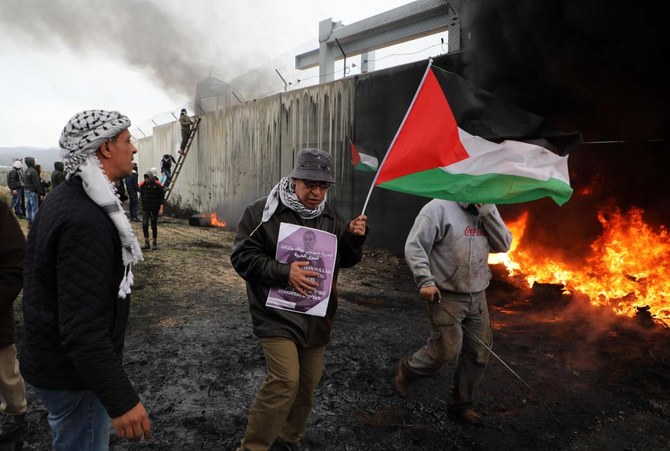
Palestinian protesters take part in a demonstration along Israel's controversial security barrier against a US-brokered peace proposal, in the occupied West Bank village of Bilin near Ramallah on February 7, 2020. (AFP)
Short Url
Updated 07 February 2020
Follow

Palestinian leaders hit back at Kushner claims Palestine to blame for West Bank violence

  • Tensions were high a day after two Palestinians were killed and 16 Israelis injured
  • Palestinians angry at US President Donald Trump’s Middle East peace plan

JERUSALEM: Palestinian and US leaders blamed each other for a surge of violence, as mourners gathered in the occupied West Bank for the funeral of a Palestinian police officer shot dead during unrest, and Israel tightened security ahead of Friday Muslim prayers.

Tensions were high a day after two Palestinians were killed and 16 Israelis injured amid Palestinian anger at US President Donald Trump’s Middle East peace plan, unveiled last week with Israel’s prime minister at his side.

There were sporadic clashes on Friday between Palestinian protesters and Israeli security forces near Azzun, where the funeral was held for the police officer killed in Jenin the previous day.

Palestinian authorities said he was killed by Israeli gunfire. Israeli officials did not comment, and Israeli media reported that he was shot by troops by mistake.

Palestinians also clashed with Israeli troops in Jericho and burned tires in the West Bank village of Bil’in, and Palestinian medics said one protester had been critically wounded near Tulkarm.

“The Palestinian people will not allow the ‘Deal of the Century’ to pass,” said Mohammed Barakeh, waving a Palestinian flag in Bil’in.

“They are fighting for their national character and the independence of their country,” added Barakeh, a former Israeli lawmaker and member of Israel’s 21% Arab minority, many of whom identify with their Palestinian brethren in the West Bank and Gaza.

President Mahmoud Abbas’s Palestinian Authority has rejected Trump’s peace plan, which would give Israel most of what it has sought during decades of conflict, including the disputed holy city of Jerusalem and nearly all the occupied land on which it has built settlements.

Palestinian negotiator Saeb Erekat said Washington was to blame for the unrest since the plan was unveiled.

“Those who introduce plans for annexation and the legalizing of occupation and settlements are really responsible for deepening violence and counter-violence,” he said. Abbas would go to the UN Security Council with “a genuine peace plan,” Erekat said.

Trump’s senior adviser Jared Kushner, the principal architect of the US plan, has repeatedly denounced the Palestinian leadership, a break from decades of diplomacy when Washington strove to appear as a neutral broker. On Thursday he blamed Abbas for the violence.

“I think he does have responsibility,” Kushner said after briefing United Nations Security Council ambassadors. “He calls for days of rage in response, and he said that before he even saw the plan.”

Israeli police said security chiefs had met late on Thursday and decided to increase security “across the country, with emphasis on Jerusalem.”

A police statement singled out the risk of trouble during Friday prayers at the Jerusalem holy site known to Jews as the Temple Mount and to Muslims as the Noble Sanctuary.

Palestinians have long boycotted relations with the Trump administration, which they view as biased against them. Washington says its plan offers a path toward a Palestinian state, and blames the Palestinian leadership for rejecting it over unrealistic demands.


Death toll in Iran protests over 3,000, rights group says

Updated 7 sec ago
Follow

Death toll in Iran protests over 3,000, rights group says

  • The protests erupted on December 28 over economic hardship and swelled into widespread demonstrations calling for the end of clerical rule
  • President Donald Trump, who had threatened ‘very strong action’ if Iran executed protesters, said Tehran’s leaders had called off mass hangings

DUBAI: More than 3,000 people have died in Iran’s nationwide protests, rights activists said on Saturday, while a “very slight rise” in Internet activity was reported in the country after an eight-day blackout.

The US-based HRANA ​group said it had verified 3,090 deaths, including 2,885 protesters, after residents said the crackdown appeared to have broadly quelled protests for now and state media reported more arrests.

The capital Tehran has been comparatively quiet for four days, said several residents reached by Reuters. Drones were flying over the city, but there were no signs of major protests on Thursday or Friday, said the residents, who asked not to be identified ‌for their safety.

A ‌resident of a northern city on the ‌Caspian ⁠Sea ​said ‌the streets there also appeared calm.

The protests erupted on December 28 over economic hardship and swelled into widespread demonstrations calling for the end of clerical rule in the Islamic Republic, culminating in mass violence late last week. According to opposition groups and an Iranian official, more than 2,000 people were killed in the worst domestic unrest since Iran’s 1979 Islamic Revolution.

“Metrics show a very ⁠slight rise in Internet connectivity in #Iran this morning” after 200 hours of shutdown, the ‌Internet monitoring group NetBlocks posted on X. Connectivity ‍remained around 2 percent of ordinary levels, ‍it said.

A few Iranians overseas said on social media that ‍they had been able to message users living inside Iran early on Saturday.

US President Donald Trump, who had threatened “very strong action” if Iran executed protesters, said Tehran’s leaders had called off mass hangings.

“I greatly respect the fact that all scheduled ​hangings, which were to take place yesterday (Over 800 of them), have been canceled by the leadership of Iran. Thank you!” he ⁠posted on social media.

Iran had not announced plans for such executions or said it had canceled them.

Indian students and pilgrims returning from Iran said they were largely confined to their accommodations while in the country, unable to communicate with their families back home.

“We only heard stories of violent protests, and one man jumped in front of our car holding a burning baton, shouting something in the local language, with anger visible in his eyes,” said Z Syeda, a third-year medical student at a university in Tehran.

India’s External Affairs Ministry said on Friday that commercial flights were available and that ‌New Delhi would take steps to secure the safety and welfare of Indian nationals.