

KP government uses drones to battle locusts

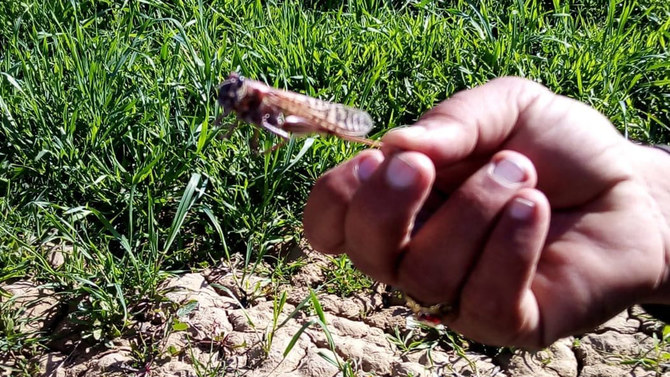
A man shows a locust killed by aerial spraying in Dera Ismail Khan, Khyber Pakhtunkhwa, on Feb. 5, 2020. (Photo courtesy: KP Agriculture Department)
Short Url
Updated 06 February 2020
Follow

KP government uses drones to battle locusts

  • Having devastated crops in parts of Sindh, desert locusts are attacking Khyber Pakhtunkhwa
  • Government should launch simultaneous campaigns in all locust-hit provinces, experts say

PESHAWAR: The Khyber Pakhtunkhwa (KP) government started aerial spraying in Dera Ismail Khan on Wednesday amid a further increase in locust swarms in the impoverished region.
Having devastated crops in parts of Sindh last year, desert locusts are attacking large swathes of the southern region of KP province.
“We have sent a drone to kill and contain locust swarms in Darazinda and Chodwan, two hamlets on the outskirts of Dera Ismail Khan, which share the border with Balochistan province. We are really worried as the insects attacked our main wheat crops. Currently, we use one drone but keeping in view its efficiency, we will acquire four more to thoroughly cleanse the area of the insects,” Rehmat Deen, director general of the KP Agriculture Extension Department, told Arab News on Tuesday.
“The agriculture department uses power sprayers, maruyama, mistblower, micronair, winkle mounted and knapsack sprayers to purge the area of locusts. The KP government is also weighing other options such as giving insecticides to farmers to help them protect their crops from the looming attacks,” he added.
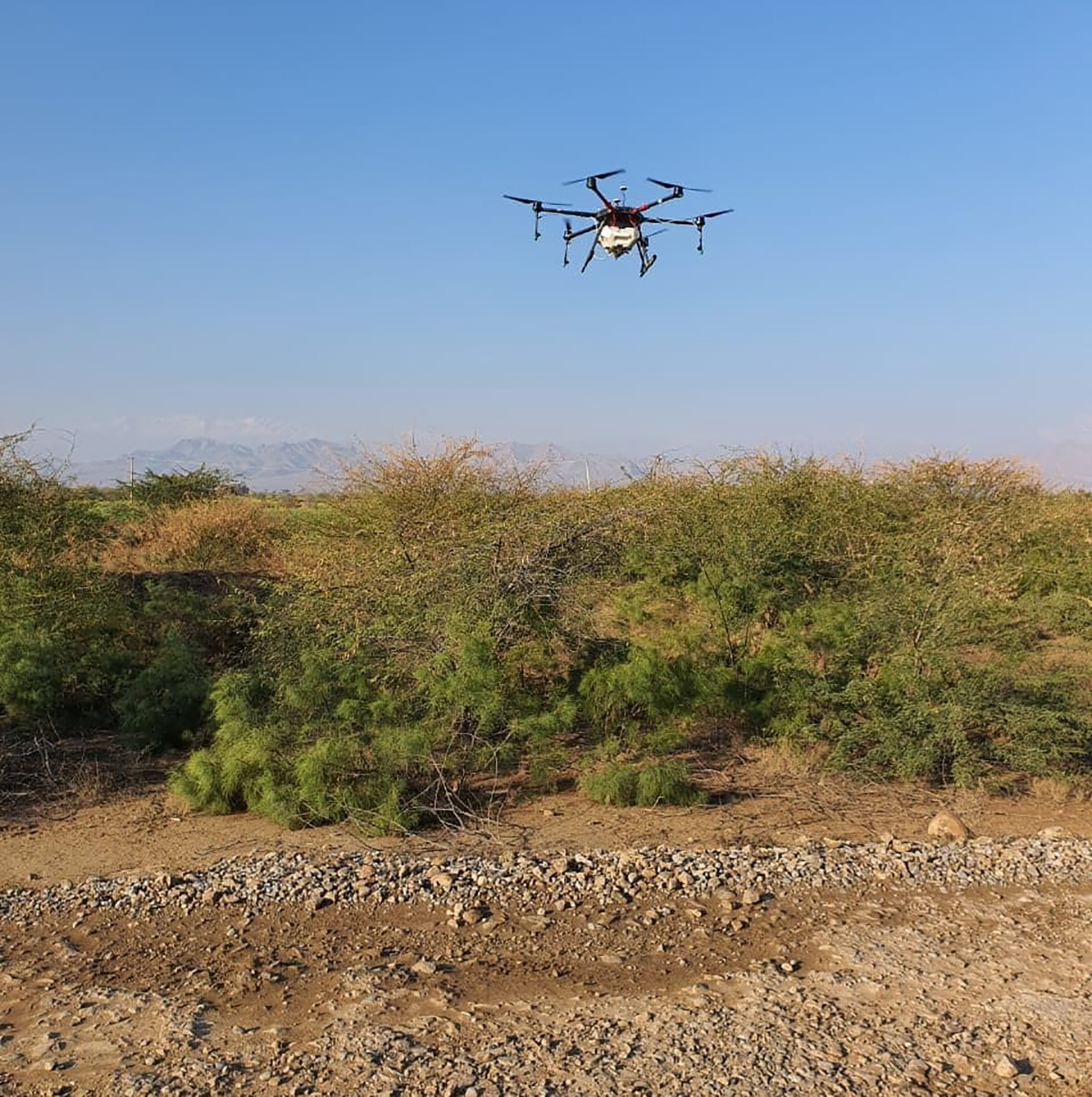


A drone takes off to conduct aerial spraying against locust swarms in Dera Ismail Khan, Khyber Pakhtunkhwa, on Feb. 5, 2020. (Photo courtesy: KP Agriculture Department)

Desert locusts, swarming short-horned grasshoppers, have been destroying crops in Africa and Asia for centuries. Their ability to move in huge swarms with great speed makes them one of the most devastating agricultural plagues.
In January last year, the locusts flew from the Red Sea coast of Sudan and Eritrea to hit Saudi Arabia and Iran. They entered Pakistan’s southwestern Balochistan province in March.
Agriculture expert Anwar Khan Bhittani told Arab News that although aerial spraying would be effective in killing and controlling the outbreak, raising awareness among farmers was of key importance.
“There is a dire need to raise awareness among farmers to inform agriculture officials about the location of locust swarms at night. Aerial spraying should be carried out at night as locusts cannot fly in the dark,” he said.
Abdul Mateen Babar, a farmer from Dera Ismail Khan, said that in his area locusts had invaded ready crops and even trees.
“Before the use of drones, locals used to beat drums in the middle of their crops to frighten them away. I don’t think drone spraying will be effective enough, rather the government should look for a tangible solution such as distribution of pesticides among farmers,” he told Arab News.
According to Bhittani, the central government should launch simultaneous campaigns in all locust-hit provinces to completely eradicate the insects and control their spillover from colder to warmer parts of the country.
“Locusts can travel up to 150 kilometers daily and a female insect lays up to 200 eggs at once. The central government needs to declare a state of emergency to thwart the menace. The insects are not mature yet. They will create havoc if timely measures are not taken,” he said.


ADB, Pakistan sign over $300 million agreements to undertake climate resilience initiatives

Updated 30 December 2025
Follow

ADB, Pakistan sign over $300 million agreements to undertake climate resilience initiatives

  • Pakistan ranks among nations most vulnerable to climate change and has seen erratic changes in weather patterns
  • The projects in Sindh and Punjab will restore nature-based coastal defenses and enhance agricultural productivity

ISLAMABAD: The Pakistani government and the Asian Development Bank (ADB) have signed more than $300 million agreements to undertake two major climate resilience initiatives, Pakistan’s Press Information Department (PID) said on Tuesday.

The projects include the Sindh Coastal Resilience Sector Project (SCRP), valued at Rs50.5 billion ($180.5 million), and the Punjab Climate-Resilient and Low-Carbon Agriculture Mechanization Project (PCRLCAMP), totaling Rs34.7 billion ($124 million).

Pakistan ranks among nations most vulnerable to climate change and has seen erratic changes in its weather patterns. In 2022, monsoon floods killed over 1,700 people, displaced another 33 million and caused over $30 billion losses, while another 1,037 people were killed in floods this year.

The South Asian country is ramping up climate resilience efforts, with support from the ADB and World Bank, and investing in climate-resilient infrastructure, particularly in vulnerable areas.

“Both sides expressed their commitment to effectively utilize the financing for successful and timely completion of the two initiatives,” the PID said in a statement.

The Sindh Coastal Resilience Project (SCRP) will promote integrated water resources and flood risk management, restore nature-based coastal defenses, and strengthen institutional and community capacity for strategic action planning, directly benefiting over 3.8 million people in Thatta, Sujawal, and Badin districts, according to ADB.

The Punjab project will enhance agricultural productivity and climate resilience across 30 districts, improving small farmers’ access to climate-smart machinery, introducing circular agriculture practices to reduce residue burning, establishing testing and training facilities, and empowering 15,000 women through skills development and livelihood diversification.

Earlier this month, the ADB also approved $381 million in financing for Pakistan’s Punjab province to modernize agriculture and strengthen education and health services, including concessional loans and grants for farm mechanization, Science, Technology, Engineering and Mathematics (STEM) education, and nursing sector reforms.