NICOSIA: Washington sees Cyprus as a key player in eastern Mediterranean energy supplies, a visiting senior US official said Wednesday, while warning against further instability in the region as tensions rise over Turkey’s drilling activities off the divided island.
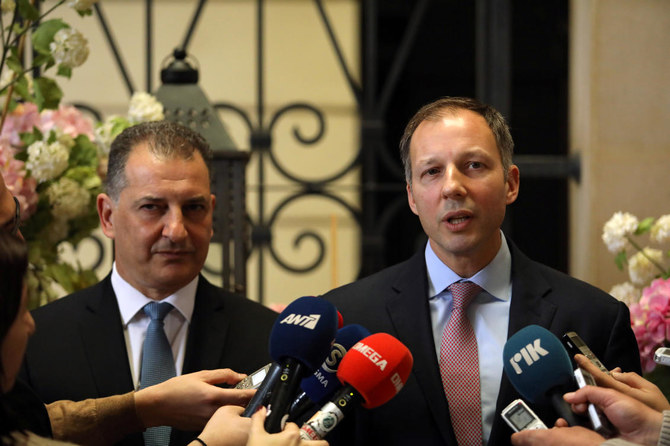
“Cyprus has an incredibly important role to play in this new energy corridor that is still developing throughout the region,” said US Assistant Secretary of State for Energy Resources Francis Fannon.
“We urge all parties to not take any provocative actions that could create any further instability. And we’re steadfast on that,” he added.
He made the comments before a gathering of Israeli, Greek and Cypriot technical experts gathered in Nicosia to discuss ways to boost safety and security in offshore gas drilling.
Fannon’s visit coincides with Turkey upping the ante by pushing ahead with drilling activity in Cyprus’s designated exclusive economic zone (EEZ) despite EU threats of sanctions against Ankara.
The US official said energy resources were a “catalyst for cooperation” and that the United States remained committed at the highest level.
“We support the Republic of Cyprus to develop its resources in its EEZ,” said Fannon.
Fannon welcomed the involvement of American companies in regional cooperation, including their role in developing new energy pathways.
Last year, US energy giant ExxonMobil and Qatar Petroleum discovered the largest natural gas reserve off Cyprus holding an estimated five to eight trillion cubic feet (up to 224 billion cubic meters).
Italy’s ENI and Total of France are also heavily involved in exploring for oil and gas off the island.
Greece, Cyprus and Israel last month signed an agreement to move ahead with construction of an ambitious 6-billion-euro ($6.6 billion) undersea EastMed pipeline to deliver gas to European markets.
Cyprus Energy Minister George Lakkotrypis said that US support in creating an Eastern Mediterranean corridor was “profound and solid.”
“Cooperation among our three countries (Cyprus, Greece, Israel) plus the US is very important,” Lakkotrypis said.
“In contrast to this positive outlook, Turkey acts as a spoiler through its continued illegal exploration activities in the EEZ of the Republic of Cyprus, escalating since last May and clearly violating international law,” he told the Nicosia gathering.
Turkey insists the Turkish Republic of Northern Cyprus — recognized only by Ankara — has the right to explore around the entire island.
UN-sponsored talks on reunifying the island as a bizonal, bi-communal federation collapsed in July 2017 and have not resumed, in part because of deep divisions over offshore gas.
The Cyprus government has no diplomatic relations with Turkey, which dismisses it as an exclusively Greek Cypriot administration
Cyprus is divided between the Greek Cypriot south — an EU member state — and the Turkish Cypriot north which has been occupied by Turkey since 1974 in response to an Athens-engineered coup.


![]()

US sees Cyprus as key player in east Med energy
Short Url
https://arab.news/8av7e
US sees Cyprus as key player in east Med energy
- Fannon’s visit coincides with Turkey pushing ahead with drilling activity in Cyprus’s designated exclusive economic zone
- The US official said energy resources were a “catalyst for cooperation”

Latest updates


© 2026 SAUDI RESEARCH & PUBLISHING COMPANY, All Rights Reserved And subject to Terms of Use Agreement.