

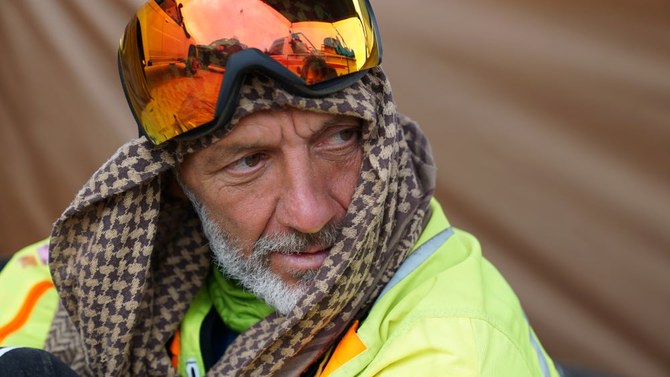
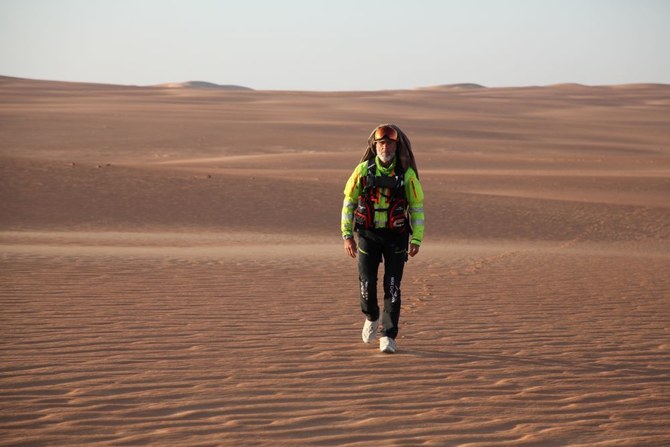


DUBAI: Rub Al-Khali, also known as the Empty Quarter, is the world’s largest uninterrupted sand mass, encompassing most of the southern third of the Arabian Peninsula.
It is a landscape of ever-changing endless dunes made famous by expeditions undertaken between the 1930s and 1950s by Bertram Thomas, Wilfred Thesiger and their Arab companions. Max Calderan, a long-time Dubai resident originally from Italy, has just become the latest man to join that famous group.
Previous explorers are known to have crossed shorter sections of Rub Al-Khali on camels or in off-road vehicles, whereas Calderan completed his journey on foot via an unexplored route.
With his latest feat, Calderan has realized at once a lifelong ambition and, as he puts it, “the dream,” not “a dream.” For the compulsive record-setter, the journey was also a humbling reminder of nature’s awesome power and beauty.
The father of three — and soon-to-be father of four — set off on his 16-day Empty Quarter expedition on Jan. 18 in Saudi Arabia, from Najran, located 880 km from Riyadh.
His plan was to cross on foot one of the world’s hottest and most-brutal deserts, one that covers about 650,000 square km and includes parts of Saudi Arabia, Oman, the UAE and Yemen.
“When I was only seven years old in 1974, I was reading the encyclopedia where it was written that Saudi Arabia’s Rub Al-Khali is the biggest sand desert around the world,” Calderan recalled during an exclusive interview with Arab News.
“No camels could enter that part of the desert, there was no water and even migratory birds were making diversions.
“So, I drew a picture and told my mother that I would be the first man to enter that area and understand why camels can’t. And on that day, I had a dream of an older man, just like me now, walking alone in the Empty Quarter.”
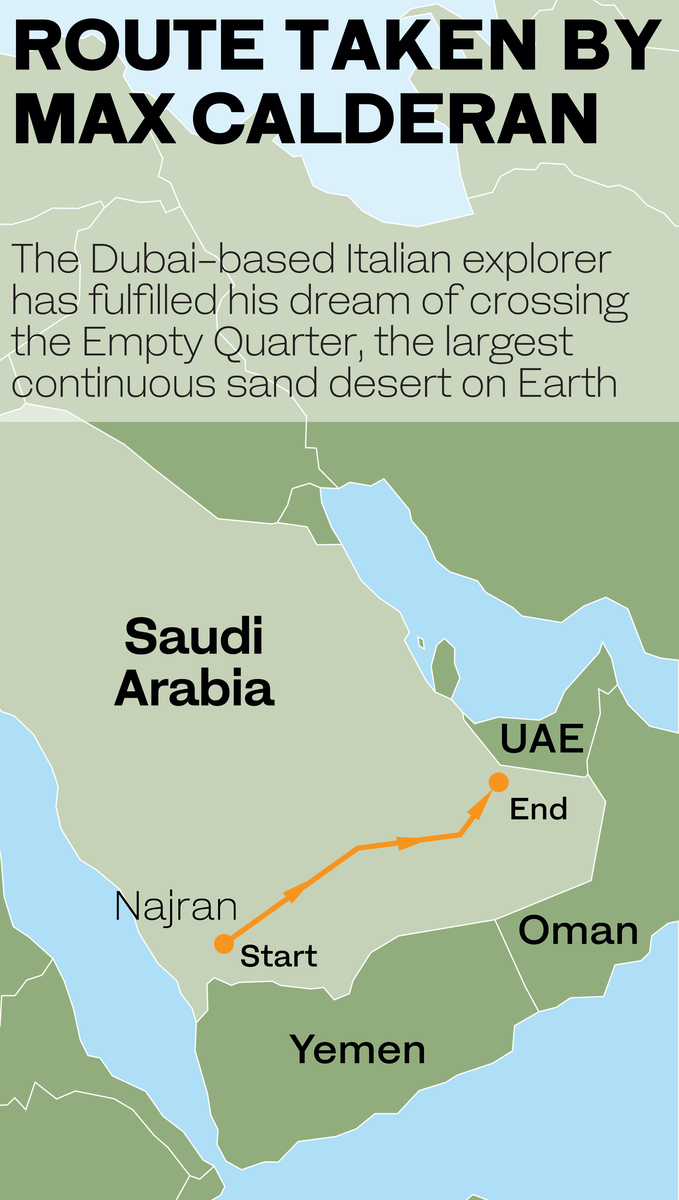
Calderan’s dream came true when he trekked through 1,100 km of desert from west to east, covering over 800 km of “virgin territory” armed with little more than a backpack and a sleeping bag.
He said on most days he trekked for an average of 18 hours in temperatures that ranged from 2.7 degrees Celsius in the early hours of the morning to 35 degrees Celsius during the daytime.
He routinely woke up at 1:30 a.m. and began his exploration in the darkness by 2 a.m., venturing out into the desert to cover about 80 km before setting up his sleeping bag for another night under the stars, often between 7 p.m. and 9 p.m.
Despite planning 67 meeting points along his route, each 18km apart, his support team, which traveled by car and supplied him with food and water, was unable to ensure their paths crossed on a daily basis due to unpredictable weather conditions and diversions.
So Calderan’s exact location was tracked through his satellite phone every 15 minutes by a team based in London that oversaw his entire expedition.
FASTFACT
Rub Al-Khali is part of the larger Arabian Desert, covering 650,000 sq km and including parts of Saudi Arabia, Oman, the UAE and Yemen.
“From my previous experience, I was best prepared — and had the capability to stay totally alone in the desert — when I had enough food and water in my backpack to last at least 250 km,” he said.
About 200 km into his journey, Calderan encountered a community that he referred to as “original, pure and genuine Bedouin tribes.
“I stopped several times to talk to them because I needed as much information as possible about Rub Al-Khali, as what had been written in the books was not totally accurate,” he said.
He was advised to take either the north or south route across the Empty Quarter since these had been previously explored.
The tribesmen tried to convince him that walking straight down the middle of the largest continuous sand desert on Earth was extremely “unsafe” and nearly “impossible,” Calderan said.
“They said: ‘You have to understand that the more you will move ahead, the less you will find animals, trees and water. There’s nothing there.’”
Calderan said he remained undeterred by the tribes’ advice, having made up his mind to stay the course even as he began what he described as a “spiritual conversation with mother nature.”
He told Arab News: “I asked permission from Rub Al-Khali. “I said: ‘Please let me go inside, let me explore your land.’
“The desert replied: ‘Now I will gift you something so you can start to understand who I am.’”
After watching a beautiful sunset, Calderan was caught in a severe sandstorm and was unable to meet his support team at the next agreed point.
“During the sandstorm, you couldn’t see more than two meters in any direction,” he said.
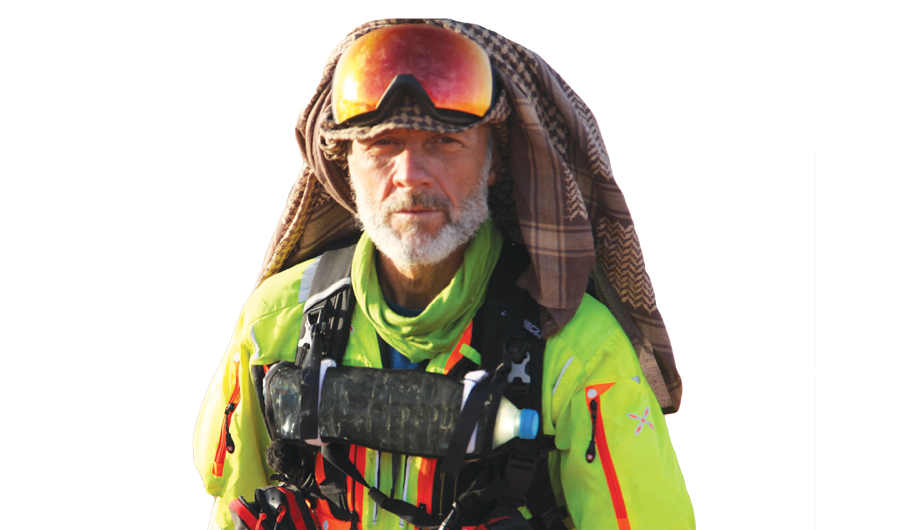
It took Max Calderan 16 days to cross the Empty Quarter. (Photo by Max Calderan/Empty Quarter Studios)
“If you took seven steps and turned around, you could just about see your fifth footstep and, for sure, your seventh would be gone.”
Once the storm had passed, Calderan said he once again called out to nature.
“Dear Rub Al-Khali, I now understand your power,” he said as he as he ventured into a terrain that, to this day, has stayed largely out of humanity’s sight.
Calderan said the landscape was now barren and the silence was deafening.
“This section of the desert was totally empty,” he recalled.
“I didn’t see a single animal track. I didn’t see any other footprints or camel waste. I didn’t even see or hear the sound of an aircraft in the sky.
“If I tried to shout, the sound came out from my mouth, but within a meter from me it would be absorbed by the sand.”
Calderan said it was difficult to form clear thoughts about daily life during the journey. He felt the power of nature had had the effect of silencing his mind.
“The power of the mind cannot do anything in front of thousands of kilometers (of empty desert). You stop thinking and start communicating with nature,” Calderan said.
“I thanked nature for the sights I was witnessing and, at a certain point, I said to it: ‘Do as you want with me — clean my mind, clean my body, clean my thoughts. I have only one mission and that is to see myself with my family again.’ That was indeed my goal.”
After notching up over 100 Empty Quarter sites on his GPS instrument — areas that included waterbeds, wolf footprints and an oryx corpse — Calderan began what he calls the “toughest” trek of all: The final 200km of the expedition.
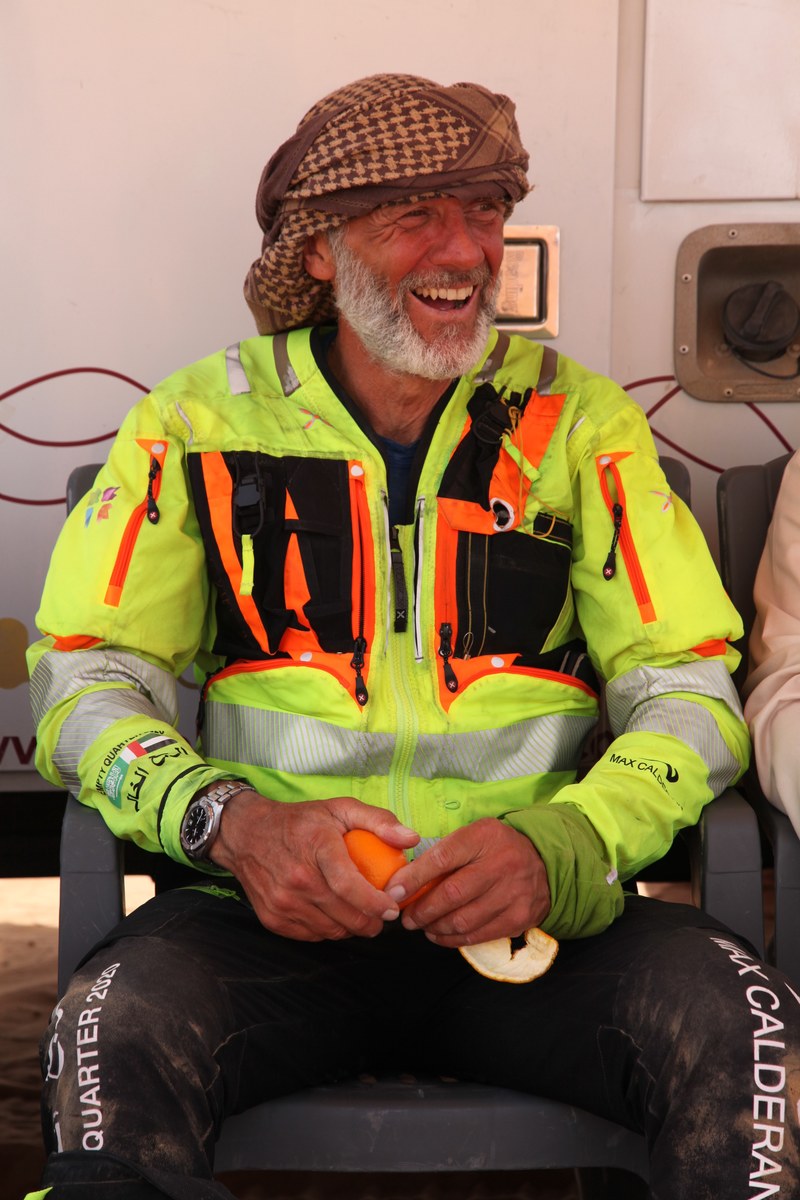
Max Calderan’s location was tracked through his satellite phone every 15 minutes by a team based in London. (Empty Quarter Studios)
He was mentally prepared for encounters with dangerous creatures ranging from wild cats to deadly scorpions. But what turned out to be the biggest danger was the desert itself, Calderan said, recalling a moment when he stood before a “mountain of dunes” as high as 300 meters.
“It was as if I had travelled to hell — and it was the first time in my life I started to pray in order to come out,” he said.
Reaching the finishing point involved negotiating many more monstrous sand dunes, as a result of which Calderan often found himself exhausted, dehydrated and in a hallucinatory state.
“I was destroyed, but what happened is I got the awareness to understand that we as human beings, with all our arrogance and technology, are nothing in front of nature,” he said.
“We are searching for water in Mars while we are destroying our water resources on Earth.
“At this point, all my training, my strength and my previous experience amount to nothing. All I can understand is that it is time to start giving back to the environment.”
As he poured out his thoughts and emotions about his epic journey during the interview, Calderan said he is still overwhelmed and will need time to fully absorb the lessons of the last couple of weeks.
His hope is that his feat will go down in history alongside other famous expeditions of the Empty Quarter, but with an important difference: The newly created west-east "Calderan Line" will be used by generations of explorers to come.


