Former Lebanon economy chief in plea for $25bn bailout plan

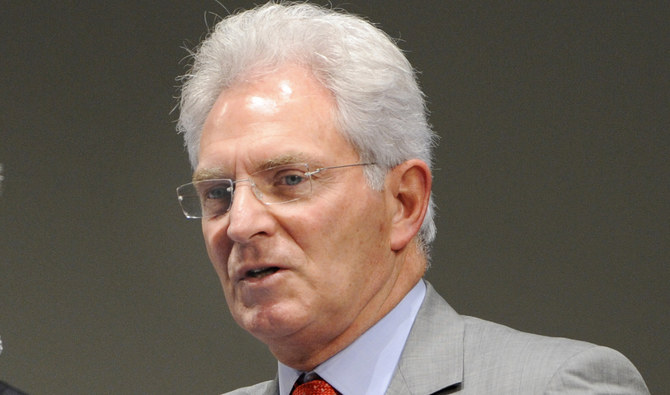
Nasser Saidi. (AFP)
Short Url
Updated 05 February 2020
Follow

Former Lebanon economy chief in plea for $25bn bailout plan

  • Rescue package needed ‘to restore confidence’ and kick-start major banking reforms

PARIS: A former Lebanese economy and trade minister has called for a second Paris summit to bail out the debt-ridden nation with financial support of up to $25 billion.

Nasser Saidi, who is also a former deputy governor of Lebanon’s central bank, told Arab News that restructuring of the country’s banking system is needed urgently and that “depositors should not have to pay for banks’ mismanagement.”

Financial support of between $20 billion and $25 billion is needed “to restore confidence,” he said.

The former minister’s comments come almost two years after a Paris conference rallied international support for an $11 billion investment program in Lebanon. More than 50 countries, including Saudi Arabia, the US and Russia, took part in the summit alongside the World Bank, the IMF and major finance institutions.

Saidi told Arab News: “We need to address Lebanon’s debt burden as part of a comprehensive macro-economic fiscal, financial, banking and currency reform program. The debt problem cannot be viewed in isolation.”

The country’s sovereign debt is now running at $90 billion, or 160 percent of gross domestic product (GDP), he said. The cost of servicing the debt is around $10 billion, which is 22 percent of GDP and more than 65 percent of government revenue — “a debt burden that is totally unsustainable.”

Lebanon’s central bank also owes $120 billion to the country’s banks that it is unable to repay. “So when we talk about the problem, it means addressing the sovereign debt problem and the central bank debt problem,” Saidi said.

He said the $11 billion in infrastructure spending promised at the 2018 Paris meeting “is no longer relevant because Lebanon’s financial circumstances have changed radically.”

“Lebanon is in a recession that will become a depression, meaning that GDP might decline by 8 to 10 percent this year,” the former minister warned. “An economic stabilization fund of around $20 to $25 billion is required for balance of payments problems, dealing with liquidity at the banks and, at the same time, it would need to be accompanied by a restructuring of the banking system.

Saidi urged major shareholders to help Lebanon’s struggling banks recapitalize with cash injections drawn from past profits.

“Recently Bank Audi sold its subsidiary in Egypt. Other banks should sell their subsidiaries outside and bring their money home. They may have other investments they can liquidate, such as real estate, in order to increase capital.”

The former minister claimed that “with the $25 billion Lebanon requires, confidence will be restored, and you can start attracting capital back into the country.”

Commenting on recent government reforms in the energy sector, including electricity, Saidi said: “It is totally unrealistic; power plants can be built in six months. We need to stop corruption and waste. GE, Siemens and the Chinese can build plants in six months. The fuel bought now is priced above international prices, so the government should approach Gulf countries and ask them to supply us with fuel at international prices or even lower, in line with what they did for Egypt in the past.

“That would reduce our fuel and electricity bill by $3 billion. This package needs to be completed with a social safety net since, according to World Bank figures, one-third of the Lebanese population is living below the poverty line,” he said.



From barrels to bytes: How AI is powering Saudi Arabia’s industrial transformation

Updated 08 January 2026
Follow

From barrels to bytes: How AI is powering Saudi Arabia’s industrial transformation

  • Inside the Kingdom’s drive to merge energy expertise with digital intelligence

RIYADH: Artificial intelligence is moving beyond concept to become a cornerstone of Saudi Arabia’s energy sector, reshaping how oil, gas, and power systems are managed and optimized.

Industry giants like Saudi Aramco are embedding smart systems into their operations to boost efficiency, reliability, and sustainability—key pillars in the Kingdom’s efforts to modernize its industrial base and diversify its economy.

According to the International Energy Agency, oil and gas companies were among the first to adopt digital technologies. The agency estimates that applying AI to power plant operations and maintenance could save up to $110 billion annually by 2035 through reduced fuel consumption and maintenance costs.

For Saudi Arabia, this technological momentum offers both a blueprint and an opportunity. Under Vision 2030, integrating data and intelligent automation is transforming how energy is explored, refined, and delivered.

At the heart of Saudi Aramco’s operations is a digital transformation strategy centered on artificial intelligence, big data, and the industrial Internet of Things. These technologies are applied at every stage of production—from mapping reservoirs and optimizing drilling to improving efficiency and safety.

AI also underpins Aramco’s Digital Transformation Program, which develops in-house smart tools and data-driven platforms designed to cut emissions, reduce costs, and enhance performance while ensuring a reliable energy supply.

A prime example is the Upstream Innovation Center, where engineers have implemented AI solutions that reduce fuel gas use in boilers, improve efficiency, and detect potential leaks through fiber-optic monitoring. At the Khurais oil field, more than 40,000 sensors monitor approximately 500 wells via an Advanced Process Control system—the first of its kind for a conventional oil field at Aramco. Digitization at Khurais has increased production by around 15 percent, doubled troubleshooting speed, and lowered both costs and environmental impact.

These advances illustrate how Aramco’s network is evolving into a connected, adaptive model, blending traditional engineering expertise with digital intelligence.

DID YOU KNOW?

• AI could save up to $110 billion a year in global power plant fuel and maintenance costs by 2035.

• Advanced Process Control enables real-time monitoring of hundreds of oil wells in the Kingdom.

• AI-powered simulations now replace weeks of manual analysis, enabling faster operational decisions.

As Saudi Arabia develops an AI-driven energy economy, the King Abdullah University of Science and Technology is bridging the gap between digital innovation and industrial application. 

Bernard Ghanem, chair of the Center of Excellence for Generative AI, said the university is working with Saudi Aramco to develop AI systems that predict the chemical properties of materials and accelerate research into direct air capture technologies for carbon dioxide removal.

He told Arab News that KAUST is partnering with SABIC and ACWA Power to apply AI in process optimization and materials discovery, turning lab-scale research into practical solutions for the energy sector.

Ghanem said KAUST’s generative AI materials program combines a robotic chemistry lab with its AI Chemist foundation model, a system that accelerates the development of catalysts, battery materials, and membranes for clean energy applications.

“This is our lab of the future, automating experimentation and speeding up energy innovation,” he said.

Opinion

This section contains relevant reference points, placed in (Opinion field)

Mani Sarathy, professor of chemical engineering at KAUST, noted that AI-based reinforcement learning tools are already improving efficiency in hydrocarbon refineries by enhancing simulations and shortening analysis cycles.

“AI is helping energy companies run complex simulations that once took weeks, enabling faster and more precise operational decisions,” he told Arab News.

Sarathy added that the next phase will combine automation with expert oversight. Hybrid human-AI control systems, he explained, are likely to become standard in critical operations, balancing digital autonomy with safety and reliability as Saudi industries expand AI deployment.

These efforts highlight KAUST’s growing role in transforming AI from an academic discipline into a driver of industrial innovation in Saudi Arabia’s energy sector under Vision 2030.

Meanwhile, Skeleton Technologies is bringing AI-driven energy storage solutions to Saudi partners, solutions that are already reshaping industrial systems across Europe and beyond. In Europe, the company combines artificial intelligence and advanced materials to reduce energy use and improve efficiency in data centers, electricity grids, and defense systems.

“Our solutions allow AI infrastructure to consume less electricity and reduce grid connection needs, making AI operations more energy efficient,” Arnaud Castaignet, vice president of government affairs and strategic partnerships at Skeleton, told Arab News.

Inside its factories, Skeleton uses AI-driven digital twin models, created with Siemens Digital Industries, to simulate production, optimize operations, and enable predictive maintenance, Castaignet said. At the core of its technology is curved graphene, a proprietary carbon material that gives Skeleton’s supercapacitors exceptional conductivity.

“It allows our supercapacitors to charge and discharge within microseconds, around 12 microseconds, something batteries cannot do,” Castaignet said.

The company’s flagship Graphene GPU system, built on these supercapacitors, cuts energy use in AI data centers by up to 40 percent and reduces grid requirements by 45 percent while boosting computing performance. The devices are free of lithium, nickel, and cobalt, relying instead on graphene derived from silicon carbide—essentially sand—processed entirely in Germany.

“To build sustainable AI infrastructure, you need energy-saving hardware as well as renewable power,” Castaignet added. “Our Graphene GPU shows both can work together.”

As Saudi Arabia continues linking engineering expertise with digital intelligence, its industrial progress is measured not only in barrels of oil but also in bytes, data, and the smart systems shaping its energy future.