Lebanon banks tighten withdrawal caps, sparking outcry

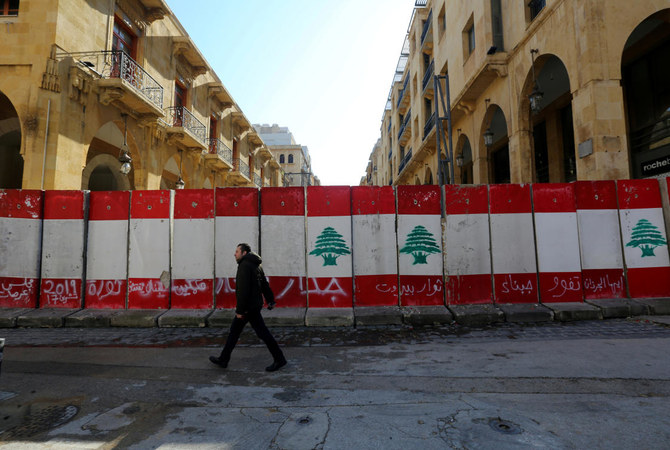
A man walks past concrete barriers erected by authorities to block a street leading to the parliament building in Beirut, Lebanon January 24, 2020. (Reuters)
Short Url
Updated 03 February 2020
Follow

Lebanon banks tighten withdrawal caps, sparking outcry

  • Banks have imposed informal controls on dollar withdrawals and transfers abroad since September

BEIRUT: Major banks in Lebanon began tightening banking controls this month, halving the amount of dollars depositors are allowed to withdraw every month, despite growing public anger.
Faced with a dollar liquidity crunch, banks have imposed informal controls on dollar withdrawals and transfers abroad since September amid widespread anti-government protests and Lebanon’s worst economic crisis in decades.
Withdrawal limits differ from bank to bank, but have so far generally been capped at around $1,000 a month, while most transfers abroad have been halted.
Some banks have now imposed even tighter restrictions.
Three major banks contacted by AFP on Monday said they have halved the dollar withdrawal limit since the beginning of February, some capping the amount at $600 a month.
Several banks have allowed slightly larger allowances to depositors who have more than $100,000 in their accounts, customers said on social media.
But even depositors who have more than one million dollars in their accounts can’t withdraw more than 2,000 to 3,000 a month.
The informal controls have sparked public outrage in protest-hit Lebanon, where an anti-government street movement launched on October 17 has grown increasingly angry at banking policies.
“These new illegal measures by banks come with the political blessing of the new government,” said activist Lucien Bourjeily.
The new cabinet, which was formed last month, is expected this week to outline its financial rescue plan.
Experts and demonstrators say banking controls amount to a de facto “haircut” on savings because they are forcing dollar depositors to deal in the nosediving Lebanese pound.
The currency has plunged against the greenback on the parallel exchange market, though the official peg of 1,507 pounds to the dollar in place since 1997 remains unchanged.
Central bank chief Riad Salameh last month said that he agreed with money exchange houses to cap the parallel rate at 2,000 — but several exchanges continue to charge rates edging toward 2,200.
Salameh last month asked for special powers to authorize the banks to set withdrawal limits, which had not formally been backed by the government.
The finance ministry, however, has yet to publicly respond to his request.


Multilateralism strained, but global cooperation adapting: WEF report

Updated 10 January 2026
Follow

Multilateralism strained, but global cooperation adapting: WEF report

DUBAI: Overall levels of international cooperation have held steady in recent years, with smaller and more innovative partnerships emerging, often at regional and cross-regional levels, according to a World Economic Forum report.

The third edition of the Global Cooperation Barometer was launched on Thursday, ahead of the WEF’s annual meeting in Davos from Jan. 19 to 23.

“The takeaway of the Global Cooperation Barometer is that while multilateralism is under real strain, cooperation is not ending, it is adapting,” Ariel Kastner, head of geopolitical agenda and communications at WEF, told Arab News.

Developed alongside McKinsey & Company, the report uses 41 metrics to track global cooperation in five areas: Trade and capital; innovation and technology; climate and natural capital; health and wellness; and peace and security.

The pace of cooperation differs across sectors, with peace and security seeing the largest decline. Cooperation weakened across every tracked metric as conflicts intensified, military spending rose and multilateral mechanisms struggled to contain crises.

By contrast, climate and nature, alongside innovation and technology, recorded the strongest increases.

Rising finance flows and global supply chains supported record deployment of clean technologies, even as progress remained insufficient to meet global targets.

Despite tighter controls, cross-border data flows, IT services and digital connectivity continued to expand, underscoring the resilience of technology cooperation amid increasing restrictions.

The report found that collaboration in critical technologies is increasingly being channeled through smaller, aligned groupings rather than broad multilateral frameworks.  

This reflects a broader shift, Kastner said, highlighting the trend toward “pragmatic forms of collaboration — at the regional level or among smaller groups of countries — that advance both shared priorities and national interests.”

“In the Gulf, for example, partnerships and investments with Asia, Europe and Africa in areas such as energy, technology and infrastructure, illustrate how focused collaboration can deliver results despite broader, global headwinds,” he said.

Meanwhile, health and wellness and trade and capital remained flat.

Health outcomes have so far held up following the pandemic, but sharp declines in development assistance are placing growing strain on lower- and middle-income countries.

In trade, cooperation remained above pre-pandemic levels, with goods volumes continuing to grow, albeit at a slower pace than the global economy, while services and selected capital flows showed stronger momentum.

The report also highlights the growing role of smaller, trade-dependent economies in sustaining global cooperation through initiatives such as the Future of Investment and Trade Partnership, launched in September 2025 by the UAE, New Zealand, Singapore and Switzerland.

Looking ahead, maintaining open channels of communication will be critical, Kastner said.

“Crucially, the building block of cooperation in today’s more uncertain era is dialogue — parties can only identify areas of common ground by speaking with one another.”