Lebanon struggles over Eurobond decision as clock runs down

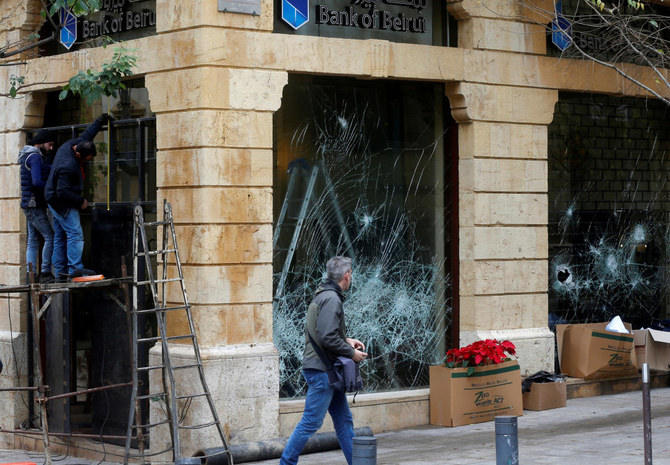
A man walks past a damaged bank in Beirut, Lebanon January 20, 2020. (Reuters)
Short Url
Updated 04 February 2020
Follow

Lebanon struggles over Eurobond decision as clock runs down

BEIRUT: Lebanon’s cash-strapped authorities are struggling to decide what to do about a $1.2 billion Eurobond maturing in March but are leaning toward repayment for foreign holders and a swap for local investors, political and banking sources said on Tuesday.
Lebanon, which has never defaulted on its hefty debt, is in the throes of a financial and economic crisis that has shattered confidence in banks and ignited protests against a political elite blamed for steering the country toward collapse.
A government source and two senior political sources said big differences remained over options: pay in full, ask local holders of the issue to swap for longer-dated notes delaying payment by at least 10 years, or simply not pay.
Two of those sources and three senior bankers said a swap would ease pressure on dwindling foreign currency reserves and buy time. Three sources said the government has not initiated any steps for a default scenario.
Lebanon’s dollar bonds have gained in recent days, with the rally particularly pronounced among shorter-term bonds, signalling growing expectations that the government might pay its most immediate debt obligations.
The country has $2.5 billion in principal and $1.9 billion in coupon payments on Eurobonds due in 2020.
The March 2020 issue has added 12% in the past four trading sessions and was trading at 84.6 cents to the dollar on Tuesday, according to RRPSBONDS data.
In contrast, Lebanon’s longer-dated bonds are trading at 50 cents to the dollar or lower, indicating a higher probability of a debt default or restructuring at some point.
The government source said that Lebanon, grappling with one of the world’s heaviest debt burdens, would not be able to avoid a debt restructuring further down the road and would need assistance from the International Monetary Fund, which would require consensus in Lebanon’s fractured political landscape.
“Kicking the can down the road by paying means a lot of money out of scarce resources and there are more maturities coming in April and June, so it’s only a few months of extra breathing space,” said Paul McNamara, investment director at asset manager GAM.
The two political sources said Prime Minister Hassan Diab preferred making the March payment on time to avoid any blemish on the country’s reputation as his government, formed last month, tries to win back the confidence of international donors.
“He does not want to start his term with a default on debt obligations and give any negative sign to the international community,” one of the political sources told Reuters.
Ratings agencies have warned a swap would constitute a selective default.
One of the senior bankers said he expected the government to ask domestic holders to agree on a swap. “This is bad for the banks ... but it’s not like we have much of a choice,” he said.


Multilateralism strained, but global cooperation adapting: WEF report

Updated 10 January 2026
Follow

Multilateralism strained, but global cooperation adapting: WEF report

DUBAI: Overall levels of international cooperation have held steady in recent years, with smaller and more innovative partnerships emerging, often at regional and cross-regional levels, according to a World Economic Forum report.

The third edition of the Global Cooperation Barometer was launched on Thursday, ahead of the WEF’s annual meeting in Davos from Jan. 19 to 23.

“The takeaway of the Global Cooperation Barometer is that while multilateralism is under real strain, cooperation is not ending, it is adapting,” Ariel Kastner, head of geopolitical agenda and communications at WEF, told Arab News.

Developed alongside McKinsey & Company, the report uses 41 metrics to track global cooperation in five areas: Trade and capital; innovation and technology; climate and natural capital; health and wellness; and peace and security.

The pace of cooperation differs across sectors, with peace and security seeing the largest decline. Cooperation weakened across every tracked metric as conflicts intensified, military spending rose and multilateral mechanisms struggled to contain crises.

By contrast, climate and nature, alongside innovation and technology, recorded the strongest increases.

Rising finance flows and global supply chains supported record deployment of clean technologies, even as progress remained insufficient to meet global targets.

Despite tighter controls, cross-border data flows, IT services and digital connectivity continued to expand, underscoring the resilience of technology cooperation amid increasing restrictions.

The report found that collaboration in critical technologies is increasingly being channeled through smaller, aligned groupings rather than broad multilateral frameworks.  

This reflects a broader shift, Kastner said, highlighting the trend toward “pragmatic forms of collaboration — at the regional level or among smaller groups of countries — that advance both shared priorities and national interests.”

“In the Gulf, for example, partnerships and investments with Asia, Europe and Africa in areas such as energy, technology and infrastructure, illustrate how focused collaboration can deliver results despite broader, global headwinds,” he said.

Meanwhile, health and wellness and trade and capital remained flat.

Health outcomes have so far held up following the pandemic, but sharp declines in development assistance are placing growing strain on lower- and middle-income countries.

In trade, cooperation remained above pre-pandemic levels, with goods volumes continuing to grow, albeit at a slower pace than the global economy, while services and selected capital flows showed stronger momentum.

The report also highlights the growing role of smaller, trade-dependent economies in sustaining global cooperation through initiatives such as the Future of Investment and Trade Partnership, launched in September 2025 by the UAE, New Zealand, Singapore and Switzerland.

Looking ahead, maintaining open channels of communication will be critical, Kastner said.

“Crucially, the building block of cooperation in today’s more uncertain era is dialogue — parties can only identify areas of common ground by speaking with one another.”