Iraqi president appoints Mohammed Allawi as new PM

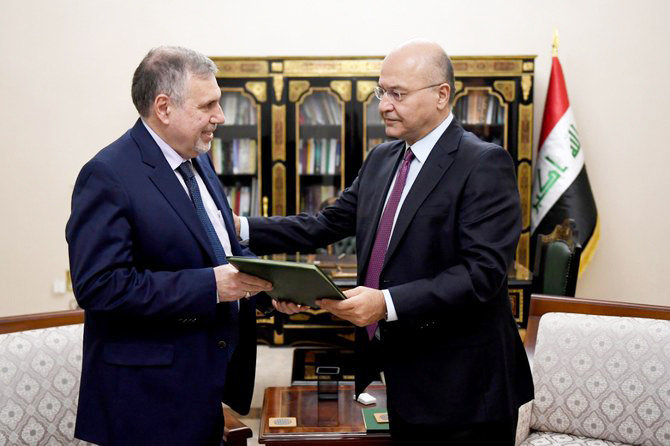
Iraqi President Barham Salih, right, instructs newly appointed Prime Minister Mohammed Allawi in Baghdad, Iraq, Saturday, Feb. 1, 2020. (AP)
Short Url
Updated 02 February 2020
Follow

Iraqi president appoints Mohammed Allawi as new PM

  • For demonstrators, Allawi is part of the corrupt, old-guard system and is unacceptable
  • New PM quoted by State TV as saying he would resign if political blocs sought to impose candidates for different ministries

BAGHDAD/JEDDAH: Iraqi President Barham Salih named Mohammed Tawfiq Allawi prime minister on Saturday, in a move immediately rejected by protesters.

The appointment comes after squabbling political parties failed to name a candidate in the two months since the former premier was ousted by popular protests.

Former Prime Minister Adel Abdul-Mahdi resigned in November amid mass anti-government unrest where hundreds of thousands of Iraqis took to the streets demanding the removal of Iraq's political elite. Nearly 500 protesters have been killed in a deadly crackdown by security forces.

As communications minister in Nuri Al-Maliki’s government, Allawi is also unacceptable to many. “Allawi is rejected,” they chanted in Tahrir Square in Baghdad on Saturday.
Allawi has a month to form a government, but said he would resign if sectarian blocs tried to force Cabinet candidates on him. He told Iraqis to carry on protesting and “do not go back until you get what you want.”

Allawi would run the country until early elections can be held. He must form a new government within a month.
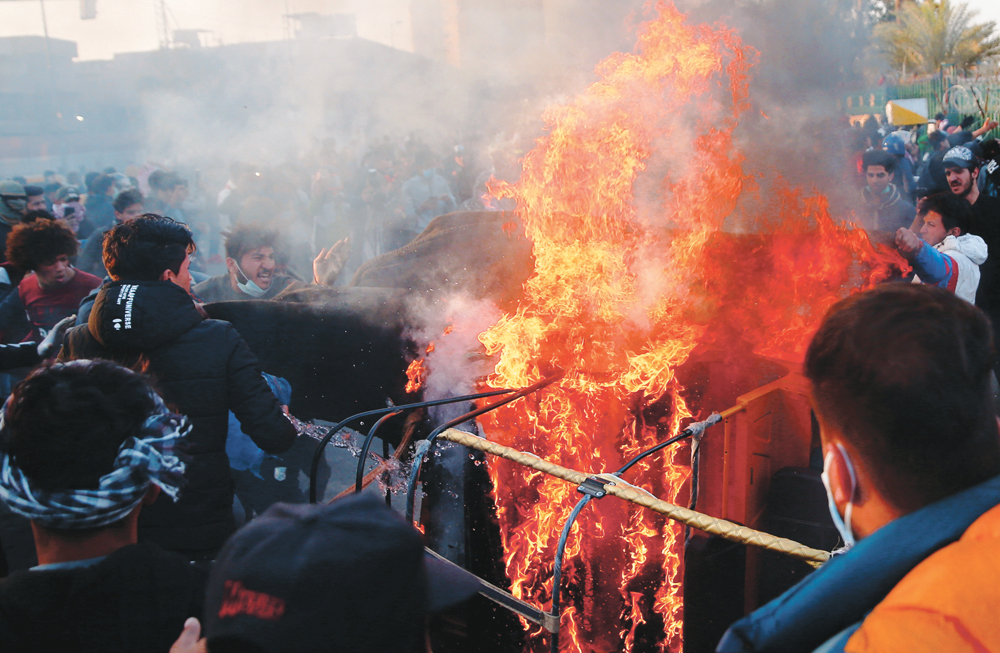


Iraqi demonstrators try to extinguish a burning tuk-tuk after it was set on fire by Iraqi security forces during ongoing anti-government protests in Baghdad. (Reuters)

Allawi was quoted by State TV as saying he would resign if political blocs sought to impose candidates for different ministries. He also called on protesters to continue demonstrating until their demands are met.

However, protesters are likely to oppose him as prime minister.

For demonstrators who demand a removal of what they say is a corrupt ruling elite, the former communications minister under ex-premier Nuri al-Maliki - who presided over the fall of multiple Iraqi cities to Daesh in 2014 and is accused of pro-Shiite sectarian policies - is part of the system and therefore unacceptable.

Iraq is facing its biggest crisis since the military defeat of Daesh in 2017. A mostly Shiite popular uprising in Baghdad and the south challenges the country's mainly Iran-backed Shiite Muslim ruling elite.

The country has been thrown into further disarray since the killing of Iranian military mastermind Qassem Soleimani in a US drone strike in Baghdad on Jan. 3. Iran responded with missile attacks on bases hosting US forces, pushing the region to the brink of an all-out conflict.

Pro-Iran politicians have tried to use those events to shift the focus away from popular discontent with their grip on power and towards anti-American rallies and demands for the withdrawal of US troops.

(With Reuters)


Iraq announces complete withdrawal of US-led coalition from federal territory

Updated 3 sec ago
Follow

Iraq announces complete withdrawal of US-led coalition from federal territory

  • The vast majority of coalition forces had withdrawn from Iraqi bases under a 2024 deal between Baghdad and Washington
  • US and allied troops had been deployed to Iraq and Syria since 2014 to fight the Daesh group

BAGHDAD: Iraq said on Sunday US-led coalition forces had finished withdrawing from bases within the country’s federal territory, which excludes the autonomous northern Kurdistan region.
“We announce today... the completion of the evacuation of all military bases and leadership headquarters in the official federal areas of Iraq of advisers” of the US-led coalition, the military committee tasked with overseeing the end of the coalition’s mission said.
With the withdrawal, “these sites come under the full control of Iraqi security forces,” it said in the statement, adding that they would transition to “the stage of bilateral security relations with the United States.”
The vast majority of coalition forces had withdrawn from Iraqi bases under a 2024 deal between Baghdad and Washington outlining the end of the mission in Iraq by the end of 2025 and by September 2026 in the Kurdistan region.
US and allied troops had been deployed to Iraq and Syria since 2014 to fight the Daesh group, which had seized large swathes of both countries to declare their so-called “caliphate.”
The militant group, also known as “Islamic State,” was territorially defeated in Iraq in 2017 and in Syria in 2019, but continues to operate sleeper cells.
The vast majority of coalition troops withdrew from Iraq over previous stages, with only advisers remaining in the country.
The military committee on Sunday said Iraqi forces were now “fully capable of preventing the reappearance of IS in Iraq and its infiltration across borders.”
“Coordination with the international coalition will continue with regards to completely eliminating IS’s presence in Syria,” it added.
It pointed to “the coalition’s role in Iraq offering cross-border logistical support for operations in Syria, through their presence at an air base in Irbil,” the capital of Iraq’s Kurdistan region.
In December, two US soldiers and a civilian interpreter were killed in Syria in an attack blamed on IS, sparking fears of a resurgence in the country.
The statement added that anti-IS operations would be coordinated with the coalition through the Ain Assad base in Anbar province in western Iraq.
IS attacks in Iraq have massively declined in recent years, but the group maintains a presence in the country’s mountainous areas.
A UN Security Council report in August said: “In Iraq, the group has focused on rebuilding networks along the Syrian border and restoring capacity in the Badia region.”