BAGHDAD: Iraq’s most powerful religious figure Grand Ayatollah Ali Al-Sistani reiterated Friday his condemnation of the use of force against anti-government protesters as the mass movement enters a critical juncture and political blocs tussle over naming a new premier.
Meanwhile, influential and radical cleric Muqtada Al-Sadr called for his followers to return to the street, one week after he withdrew support for anti-government demonstrators camped out in Baghdad’s Tahrir Square.
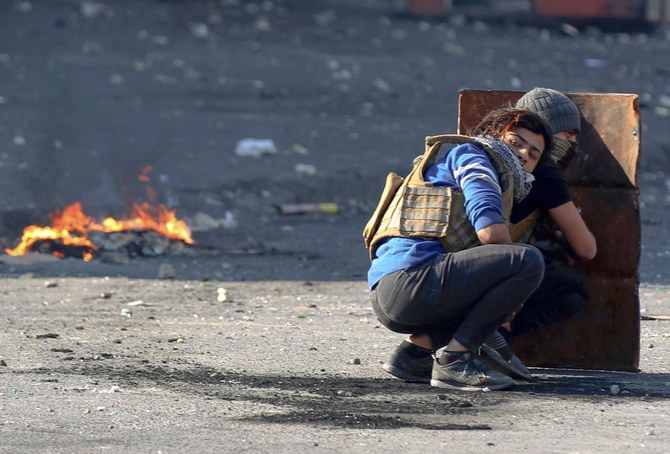
Al-Sistani’s comments came as unrest continued in Baghdad’s Khilani and Wathba squares, where at least 11 demonstrators were wounded Friday by security forces firing tear gas canisters to disperse crowds, according to security and medical officials. The officials spoke on condition of anonymity in line with regulations.
The area has become a flash point in the recent escalation staged by demonstrators to refocus public attention on the demands of the four-month protest movement after a US airstrike that killed a top Iranian general in Baghdad monopolized Iraqi politics.
Protesters called for 1 million Iraqis to take to the streets Friday to revitalize demonstrations and pressure the government to implement a reform agenda after Al-Sadr withdrew his followers from the street last week. Al-Sadr’s pullout was followed by a security crackdown on protest camps. Tents were burned and at least four protesters were killed in Baghdad and Iraq’s south.
But on Friday, Al-Sadr issued a statement calling on his followers to “renew” the demonstrations and return to the street, amid deadlock over the naming of a new prime minister. He said large demonstrations were necessary to pressure political elites to form a new “non-controversial” government and hold early elections.
A second statement from Al-Sadr said the call was “effective immediately” and he called on protesters to head to Tahrir Square, epicenter of the anti-government protest movement.
Al-Sadr is the head of political bloc Saeroon, which won the most seats in Iraq’s 2018 federal election.
Al-Sadr’s departure last week had created clear divisions between his followers and other anti-government protesters in the square.
“All those who are already in protest squares are your brothers,” Al-Sadr’s statement said. “Never be divided in slogans, sayings or deeds.”
Al-Sistani reaffirmed his condemnation of the use of violence against demonstrators in his weekly sermon, delivered in the holy city of Karbala through a representative. Al-Sistani’s opinion holds sway over many Iraqis and elites.
His stances have often sided with the protesters who first took to the streets Oct. 1 to decry rampant government corruption, poor services and unemployment. Though their demands are varied, most want snap elections, reforms and a change of political leadership.
In his sermon he condemned, “the use of violence against peaceful demonstrators, the assassinations and kidnappings of some of them,” and “categorically refused” attempts by security forces to break up peaceful sit-ins using violence and force.”
Al-Sistani also reiterated calls on political blocs to name a new prime minister and form a new government “as soon as possible,” to avoid political crisis and instability.
Outgoing Prime Minister Adil Abdul-Mahdi resigned in December under pressure from protesters. Negotiations among divided political factions have come to a deadlock. President Barham Saleh has given parties until Saturday to name a candidate or would do so himself.

Iraqi cleric Al-Sistani condemns use of force, 11 protesters wounded
https://arab.news/86483
Iraqi cleric Al-Sistani condemns use of force, 11 protesters wounded
- Al-Sistani’s comments came as unrest continued in Baghdad’s Khilani and Wathba squares
- Protesters called for 1 million Iraqis to take to the streets Friday to revitalize demonstrations and pressure the government to implement a reform agenda after Al-Sadr withdrew his followers from the street last week
STC announces dissolution
RIYADH: The Yemeni separatist group Southern Transitional Council (STC) has announced it will dissolve following talks in Saudi Arabia. Several STC members are in Riyadh for discussions on ending unrest in southern Yemen. The group praised Saudi Arabia’s efforts, while former STC leader Aidarous al-Zubaidi, now wanted by the Presidential Council for high treason, has fled Yemen and has not participated in the talks.
A Yemeni source told Arab News: “this announcement and ease shown in the televised video statement shows that in fact Al Zubaidi was the obstacle, and that most southerners are open to resolving their matter via dialogue and discussion”
The members of the Southern Transitional Council (STC) in Yemen spoke during the Riyadh Southern Dialogue Conference on Friday.
During the meeting, the Council said military operations in Hadramout and Mahra harmed the Southern cause in Yemen.
The Council said they did not participate in the decision for the military operations in Hadramout and Mahra.
"We hope to reach a vision and concept for resolving the Southern issue at the Riyadh Conference,” said the Council.
The Council thanked Saudi Arabia for hosting the dialogue conference in Riyadh.
- Below is a full translation of the STC announcement as reported by the Arabic language Yemeni news agency (SABA):
Announcement of the Dissolution of the Southern Transitional Council
The Presidency of the Southern Transitional Council, the Supreme Executive Leadership, the General Secretariat, and the other affiliated bodies convened a meeting to assess the recent unfortunate events in the governorates of Hadramout and Al-Mahrah, and the subsequent rejection of all efforts toward de-escalation and resolution. These developments have led to serious and painful consequences. Referring to the statement issued by the Ministry of Foreign Affairs of the Kingdom of Saudi Arabia regarding its sponsorship of a southern dialogue to resolve the southern issue—and in order to safeguard the future of the southern cause and the right of the southern people to restore their state according to their will and aspirations, and to preserve peace and social security in the South and the broader region—we make the following declaration:
The Southern Transitional Council was established to carry the cause of the southern people, represent them, and lead them toward achieving their aspirations and restoring their state. We founded it with the belief that the goal was to achieve this mission—not to cling to it as a means of gaining power, monopolizing decision-making, or excluding others.
Since we were not involved in the decision to launch the military operation in Hadramout and Al-Mahrah—an operation that harmed southern unity and damaged relations with the coalition led by the Kingdom of Saudi Arabia, which has made and continues to make great sacrifices and provide ongoing political, economic, and military support—the continued existence of the Council no longer serves the purpose for which it was created. In light of this and our historical responsibility toward the southern cause, we hereby announce the dissolution of the Southern Transitional Council, the disbanding of all its main and subsidiary bodies, and the closure of all its offices inside and outside the country. We will instead work to achieve our just southern goal by preparing for and participating in the comprehensive southern conference under the Kingdom’s sponsorship.
We commend the Kingdom of Saudi Arabia for its clear and explicit commitments and the sincere concern it has shown for our cause in seeking solutions that meet the aspirations and will of the southern people.
We call on all active southern figures and leaders to engage in the path of the comprehensive southern dialogue conference, hoping that the participants will reach a vision and framework to resolve the southern issue and fulfill the people’s aspirations through their free will, and to establish an inclusive southern framework.
From this platform, we call on the people of the South, our colleagues in the capital Aden, and all the governorates of our beloved South to recognize the gravity of this moment, the sensitivity of the current phase, and the importance of uniting efforts to preserve our gains and protect the South from chaos or instability.
We reaffirm our continued commitment to serving the just and legitimate cause of the southern people and achieving their aspirations according to their will. We also extend our gratitude to the leadership and people of the Kingdom of Saudi Arabia for hosting the comprehensive southern dialogue conference and for their support of the South, its cause, and its people across all fields and stages.