WASHINGTON: The spotlight on brain injuries suffered by American troops in Iraq this month is an example of America’s episodic attention to this invisible war wound, which has affected hundreds of thousands over the past two decades but is not yet fully understood.
Unlike physical wounds, such as burns or the loss of limbs, traumatic brain injuries aren’t obvious and can take time to diagnose. The full impact — physically and psychologically — may not be evident for some time, as studies have shown links between TBI and mental health problems. They cannot be dismissed as mere “headaches” — the word used by President Donald Trump as he said the injuries suffered by the troops in Iraq were not necessarily serious.
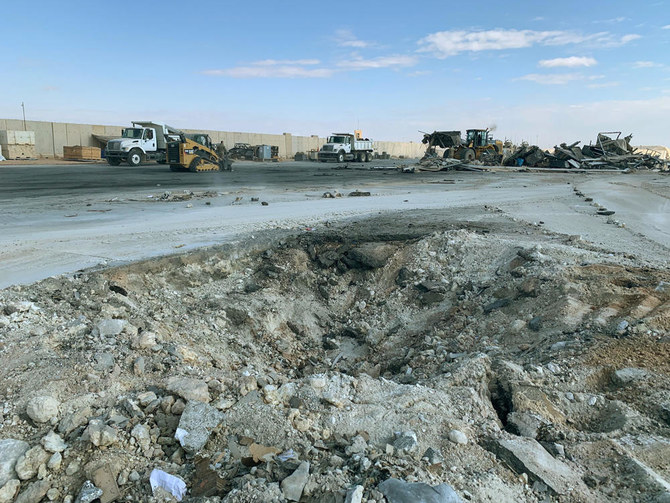
Gen. Mark Milley, chairman of the Joint Chiefs of Staff and a veteran of combat in Iraq and Afghanistan, told reporters Thursday that the number of service members diagnosed with TBI from the Jan. 8 Iranian missile attack in Iraq was still growing. Later, the Pentagon said it had reached 64, up from the 50 reported earlier this week. Milley said all are categorized as “mild” injuries, but in some cases the troops will be monitored “for the rest of their lives.”
Speaking alongside Milley, Defense Secretary Mark Esper said the Pentagon is vigorously studying ways to prevent brain injuries on the battlefield and to improve diagnosis and treatment. Milley said it’s possible, in some cases, that symptoms of TBI from the Iranian missile attack on an air base in Iraq on Jan. 8 will not become apparent for a year or two.
“We’re early in the stage of diagnosis, we’re early in the stage of therapy for these troops,” Milley said.
William Schmitz, national commander for the Veterans of Foreign Wars, last week cautioned the Trump administration against taking the TBI issue lightly.
“TBI is known to cause depression, memory loss, severe headaches, dizziness and fatigue,” sometimes with long-term effects,” he said, while calling on Trump to apologize for his “misguided remarks.”
Rep. Bill Pascrell, Jr., a New Jersey Democrat and founder of the Congressional Brain Injury Task Force, faulted Trump for displaying “a clear lack of understanding of the devastating impacts of brain injury.”
When it announced earlier this week that the number of TBI cases in Iraq had grown to 50, the Pentagon said more could come to light later. No one was killed in the missile attack, which was an Iranian effort to avenge the killing of Qassem Soleimani, its most powerful general and leader of its paramilitary Quds Force, in an American drone strike in Baghdad.
Details of the US injuries have not been made public, although the Pentagon said Tuesday that 31 of the 50 who were diagnosed with traumatic brain injury have recovered enough to return to duty. The severity of the other cases has not been disclosed.
The Pentagon did not announce the first confirmed cases until more than a week after the Iranian attack; at that point it said there were 11 cases. The question of American casualties took on added importance at the time of the Iranian strike because the degree of damage was seen as influencing a US decision on whether to counterattack and risk a broader war with Iran. Trump chose not to retaliate, and the Iranians then indicated their strike was sufficient for the time being.
The arc of attention to TBI began in earnest, for the US military, in the early years after it invaded Iraq in 2003 to topple President Saddam Hussein. His demise gave rise to an insurgency that confounded the Americans with crude but devastatingly effective roadside bombs. Survivors often suffered not just grievous physical wounds but also concussions that, along with psychological trauma, became known as the invisible wounds of war.
“For generations, battlefield traumatic brain injuries were not understood and often dismissed,” said Sen. Jeanne Shaheen, a New Hampshire Democrat.
The injuries have often been dismissed in part because the problem is not fully understood, although the Pentagon began focusing on the problem in the early 1990s when it established a head injury program that grew into today’s Defense and Veteran’s Brain Injury Center. Among its work, the center provides published reviews of research related to TBI, including links between severe TBI and behavioral issues such as alcohol abuse and suicide.
A study published this month by University of Massachusetts Amherst health services researchers concluded that military members who suffered a moderate or severe TBI are more likely than those with other serious injuries to experience mental health disorders.
Concern about TBI has recently given rise to questions about whether military members may suffer long-term health damage even from low-level blasts away from the battlefield, such as during training with artillery guns and shoulder-fired rockets.
“We’re finding that even a mild blast can cause long-term, life-changing health issues,” said Riyi Shi, a professor of neuroscience and biomedical engineering at Purdue University.
A 2018 study by the federally funded RAND Corp. found a dearth of research and understanding of potential damage to the nervous system from repeated exposure to these lower-level blasts. That same year, the Center for a New American Security, a Washington think tank, released a study urging the Pentagon to conduct a blast surveillance program to monitor, record, and maintain data on blast pressure exposure for “any soldier, in training or combat, who is likely to be in a position where he or she may be exposed to blasts.” It said this should include brain imaging of soldiers who have been exposed to blasts as part of the study to better understand how blasts affect the brain.


![]()

Brain injuries in Iraq put attention on invisible war wounds
Short Url
https://arab.news/mvgn3
Brain injuries in Iraq put attention on invisible war wounds
- Study says military members who suffered a moderate or severe TBI are more likely to experience mental health disorders
- Unlike physical wounds, such as burns or the loss of limbs, traumatic brain injuries aren’t obvious and can take time to diagnose


Latest updates


Recommended


© 2026 SAUDI RESEARCH & PUBLISHING COMPANY, All Rights Reserved And subject to Terms of Use Agreement.