

EU’s top bank puts big squeeze on lending to Turkey

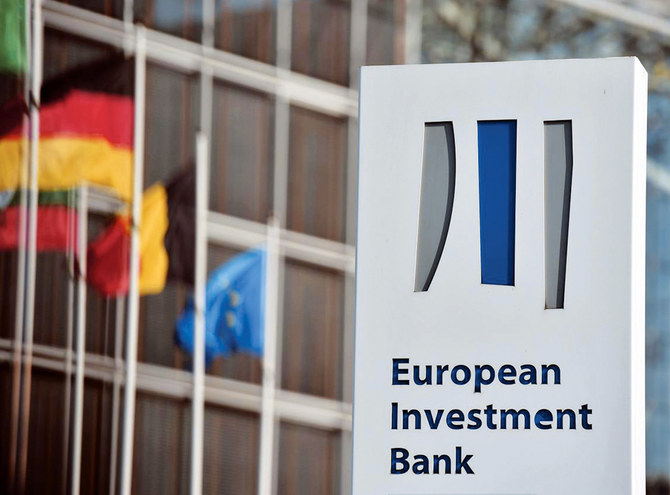
The office of the European Investment Bank in Luxembourg. (Reuters)
Short Url
Updated 31 January 2020
Follow

EU’s top bank puts big squeeze on lending to Turkey

  • European Investment Bank — the lending arm of the EU — has announced it will restrict loans to Turkey

ANKARA: One of the world’s biggest financial institutions is to squeeze its lending to Turkey this year following tensions between the EU and Ankara over its controversial oil and gas drilling operations in waters off Cyprus.

The European Investment Bank (EIB), the lending arm of the EU, has announced it will restrict loans to Turkey which over the last decade have amounted to around €19 billion ($20.94 billion).

Brussels is against any exploration for oil and gas in territory that falls under EU member state Cyprus’ exclusive economic zone. However, Ankara claims Turkish drilling ships are operating within Turkey’s continental shelf.

The EIB is one of the biggest sources of finance for Turkish infrastructure projects, but it has now said it will stop lending to public agencies in the country, while adopting a selective approach to the private sector in Turkey. However, the bank added that funding taps would remain closed to companies with links to the Turkish government.

The EU has felt obliged to take countermeasures against Turkey after it ignored demands not to send a new drilling ship to the Eastern Mediterranean, and its foreign affairs commissioner, Josep Borrell, recently said Brussels was preparing to impose sanctions.

Since last year, the EIB has only made one loan to a private company in Turkey, and that was after two years of negotiation for the construction of a greenfield glass-fiber manufacturing plant.

Kader Sevinc, a Brussels-based senior EU expert, said that although EU sanctions may have little impact on Turkey’s economic relations with the bloc and its members, they still sent a strong political message.

“Turkey’s growing financial and energy dependence on certain non-Western actors is worrisome and may lead to grave dangers in the years to come,” she told Arab News.

“Progressive local authorities, the winners of 2019 local elections in all major cities, have been subjected to a strong political and administrative pressure from the government, suffering from unfair treatment in terms of allocation of resources,” added Sevinc.

In that regard, the EIB’s lending restrictions are likely to affect important infrastructure projects planned in Turkish cities such as Istanbul, Ankara, Izmir and Antalya, which are now governed by opposition mayors. Work in the popular tourist destinations cannot be carried out using municipal resources alone.

According to Sevinc, the EU and the West should develop a constructive agenda and create new mechanisms focused on the promotion of democracy and infrastructure development in support of local authorities.

“Despite the current government’s policies, Turkey still has a pluralistic society and the EU has a role to play. Let’s not forget, only a constructive Europe can play this historical role,” she said.

Turkey has been holding discussions with Brussels about joining the EU since 2005, but prospects faded after talks were de facto suspended following the failed coup attempt in Turkey in 2016.

Amanda Paul, senior policy analyst at the European Policy Centre (EPC), said: “Unless there is a change of policy from the EU, the EIB seems set to maintain this approach. A change in stance from the EU would require a change of approach from Turkey vis-a-vis its drilling activities in the Eastern Mediterranean. There is no sign of that happening for the time being.”

Paul told Arab News that Turkey might be able to seek alternative finance, but it would be difficult to fill the funding gap left by the EIB’s lending restrictions.


Oman special zones investment rises 6.8% to $3.6bn

Updated 14 sec ago
Follow

Oman special zones investment rises 6.8% to $3.6bn

JEDDAH: Investment in Oman’s special economic zones, free zones and industrial cities rose 6.8 percent in 2025, reaching 1.4 billion Omani rials ($3.64 billion), official data showed. 

The figure raises the total committed investment under the supervision of the Public Authority for Special Economic Zones and Free Zones, known as OPAZ, to 22.4 billion rials, the Oman News Agency reported. 

This increase underscores the central role of the zones in Oman’s Vision 2040 strategy to diversify the economy, drive growth, create jobs and expand the private sector. 

The authority said 325 investment agreements were signed across sectors during the year, with additional land allocated for industrial projects in several zones. 

“Development is ongoing in the Al-Dhahira Special Economic Zone, the Al-Rawdah Economic Zone, and the Muscat International Airport Free Zone, alongside four new industrial cities in Al-Mudhaibi, Al Suwaiq, Thumrait and Madha to accommodate diverse industrial activities, enhance local manufacturing, and create additional job opportunities for Omani youth,” the ONA report stated. 

Qais bin Mohammed Al-Yousuf, chairman of OPAZ, emphasized the authority’s commitment to fostering a competitive and attractive investment environment that supports economic diversification and financial sustainability. 

He said the authority’s strategy focuses on positioning special economic zones, free zones and industrial cities as preferred investment destinations through business-friendly regulations, targeted incentives and maximizing value added by projects. 

Al Yousuf added that these zones have established themselves as integrated economic platforms that support diversification, enhance investment attractiveness and maximize the benefits of free trade agreements and comprehensive economic partnerships. 

OPAZ expanded its international outreach in 2025 by joining the World Free Zones Organization, a move aimed at aligning local zones with global standards and attracting cross-border investment. 

The authority is developing specialized clusters including an integrated cold chain hub in Duqm, an aluminum cluster in Sohar Industrial City and a mining cluster in Shaleem, as well as a proposed silica and mining complex in the Duqm Special Economic Zone. 

Ahmed bin Hassan Al-Theeb, deputy chairman of OPAZ, said that 2025 witnessed numerous achievements across the authority’s key focus areas, including planning and development; regulation and supervision; facilitation and aftercare services; marketing and investment attraction; operations and business acceleration; and institutional excellence. 

He further said that the authority increased foreign investment outreach, contacting over 500 companies in sectors such as pharmaceuticals, food, and sustainable construction, as well as services, logistics, storage, and renewable energy technologies. 

A new digital project-tracking system registered 294 investments across sectors including renewables, petrochemicals, fisheries and minerals by year-end, he added. 

The zones created 4,467 jobs for Omanis in 2025, exceeding the 2,500 target and raising total national employment in the network to 30,780 out of about 85,000 workers. Omanization reached 36 percent, with 4,774 small and medium enterprises operating across the zones.