


MOSCOW: President Vladimir Putin on Thursday fast-tracked work on constitutional changes that could keep him in power well past the end of his term in 2024 while lawmakers quickly sealed his choice for new prime minister.
Speaking to a working group created to draft constitutional changes, Putin cast his proposals as a way to strengthen parliament and to bolster democracy.
Kremlin critics described the proposed changes as an attempt by Putin to secure his rule for life.
The Russian leader proposed a set of sweeping amendments to the country’s constitution in Wednesday’s state of the nation address. Hours later, he fired Prime Minister Dmitry Medvedev, who was prime minister for eight years, and named tax chief Mikhail Mishustin to succeed him.
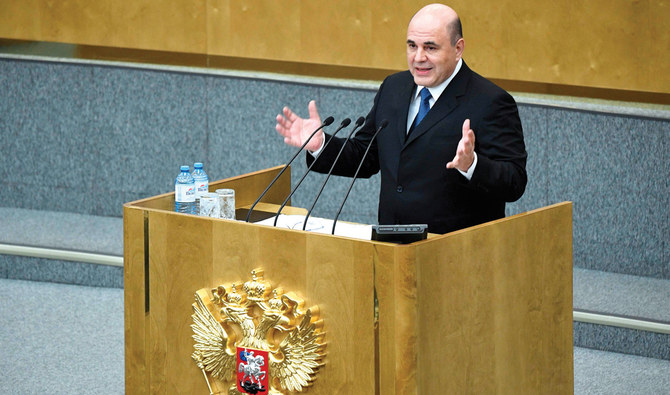
The Kremlin-controlled lower house, the State Duma, quickly approved Mishustin by a unanimous vote on Thursday.
The reshuffle has shaken Russia’s political elites, who were left wildly speculating about Putin’s intentions and future Cabinet appointments.
FASTFACT
As a career bureaucrat who has been in charge of Russia’s taxes for the past 10 years, Mikhail Mishustin has always kept a low profile and stayed away from politics.
A constitutional reform announced by Putin indicated he was working to carve out a new governing position for himself after his current six-year term ends in 2024, although it remains unclear what specific path he will take to stay in charge.
Putin has been in power longer than any other Russian or Soviet leader since Josef Stalin, who led from 1924 until his death in 1953. Under the current law, Putin must step down when his current term ends.
Alexei Navalny, Russia’s most prominent opposition leader, tweeted that Putin’s proposals reflected his intention to “rule until he dies.”
Putin suggested amending the constitution to allow lawmakers to name prime ministers and Cabinet members. The president currently holds the authority to make those appointments.
Speaking to the group tasked with drafting the amendments, Putin emphasized that they are intended to “strengthen the role of civil society, political parties and regions in making key decisions about the development of our state.”
“The role of parliament will grow, and the interaction between parliament and the Cabinet will strengthen,” he said.
At the same time, Putin argued that Russia would not remain stable if it were governed under a parliamentary system. The president should retain the right to dismiss the prime minister and Cabinet ministers, to name top defense and security officials, and to be in charge of the Russian military and law enforcement agencies, he said.
In his address, Putin said the constitution must also specify the authority of the State Council consisting of regional governors and top federal officials.
Observers speculated that Putin might try to stay in charge by shifting into the prime minister’s seat again after increasing the powers of parliament and the Cabinet and trimming presidential authority.
Others suggested that he could also try to continue pulling the strings as head of the State Council.
Another potential option is a merger with neighboring Belarus that would create a new position of the head of a new unified state. That prospect that has been rejected by Belarusian President Alexander Lukashenko, an autocratic ruler who has been in power for more than quarter century.
Putin said that the constitutional changes need to be approved by a public vote, but officials said it doesn’t imply a referendum and it wasn’t immediately clear how it will be organized.
Upper house speaker Valentina Matviyenko said that lawmakers will rush work on amending the constitution and complete it in the spring.
Observers say that Putin’s move to modify the constitution four years before the end of his term may reflect the Kremlin’s concerns that his popularity may suffer amid stagnant living standards.
Parliamentary elections are scheduled for 2021, but some speculated that an early vote could be held.
Putin has kept his longtime ally Medvedev in his close circle, appointing him to the newly created post of deputy head of the presidential Security Council.
Medvedev served as president in 2008-2012, keeping the seat warm for Putin who continued calling the shots as prime minister when he was forced to step down from the top job due to term limits. Under Medvedev, the constitution was amended to extend the presidential term from four years to six, although it limits the leader to two consecutive terms.
The 53-year-old Mishustin is a career bureaucrat who has worked as the tax chief for the past 10 years, keeping a low profile and showing no political ambitions. He has won a good reputation among experts who praised him for boosting tax collection and streamlining Russia’s rigid tax administration system.
Mishustin vowed to focus on social issues and improve living standards.
“We have all the necessary resources to fulfill the goals set by the president,” he told lawmakers before the vote.
“The president wants the Cabinet to spearhead economic growth and help create new jobs. Raising real incomes is a priority for the government.”


