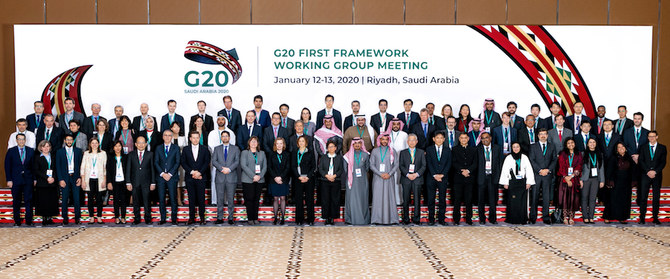
RIYADH: Global policymakers have met in Riyadh to map out “urgent” plans aimed at tackling the challenges and risks to world economic growth.
The first gathering of the Framework Working Group (FWG) under the G20 Saudi presidency discussed ways to improve access to economic opportunities for all, a key priority of the 2020 summit of world leaders’ agenda.
During the FWG meeting held on Jan. 12 and 13, the head of the Saudi team, Dr. Naif Alghaith, said: “It is an urgent priority to break barriers that prevent people from having access to economic opportunities.
“We are working to identify the current conditions of the global economy, the economic risks and challenges facing our world, and the policy responses to mitigate downside risks.”
The group’s talks were co-chaired by Clare Lombardelli, chief economic adviser to the UK Treasury, and Sanjeev Sanyal, principal economic adviser to India’s Ministry of Finance.
Delegates discussed the current risks facing the global economy and the preparedness for policy co-ordination among the G20 countries.
The meeting also studied possible policy options to enhance access to opportunities for all with a special focus on women, youth and small- and medium-sized enterprises (SMEs).
The get-together followed a G20 symposium on enhancing access to opportunities that was held under the Saudi G20 presidency on Dec. 5 last year in Riyadh.
Participants at the FWG symposium also discussed the role of the public and private sectors in leveraging technology and innovation to create jobs, and opportunities that promote sustainable and inclusive growth.
The G20 FWG was established at the 2009 Pittsburgh summit in the US after world leaders agreed to launch a framework to lay out policies aimed at generating strong, sustainable, balanced, and inclusive global growth.


![]()

G20 policymakers meet in Saudi Arabia for world economy talks
Short Url
https://arab.news/9rw6y
G20 policymakers meet in Saudi Arabia for world economy talks
- They discussed ways to improve access to economic opportunities for all
- Delegates also tackled current risks facing the global economy


Latest updates


© 2026 SAUDI RESEARCH & PUBLISHING COMPANY, All Rights Reserved And subject to Terms of Use Agreement.