Malaysia looks to Pakistan after Indian palm oil controls

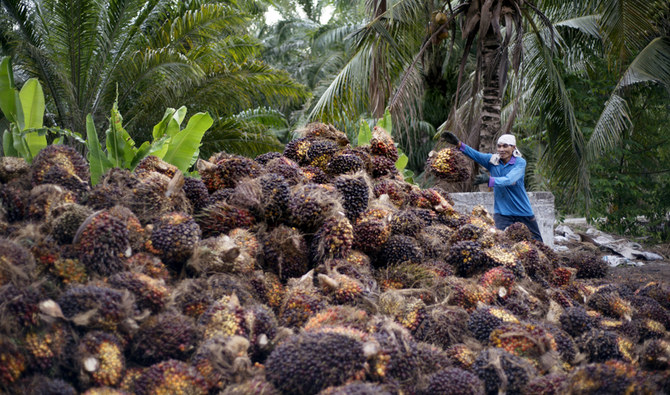
Malaysia may expand its palm oil trade with Pakistan following controls imposed by the Indian government on refined palm oil imports. (Shutterstock)
Short Url
Updated 13 January 2020
Follow

Malaysia looks to Pakistan after Indian palm oil controls

  • India is world’s biggest palm oil importer and in 2018 imported $5.1 billion worth
  • Palm oil restrictions are seen as New Delhi retaliation following Malaysian criticism

KUALA LUMPUR: Malaysia may expand its palm oil trade with Pakistan following controls imposed by the Indian government on refined palm oil imports. 
“Pakistan is one of Malaysia’s most regular and dependable buyers of local palm oil and products,” Malaysian Primary Industries Minister Teresa Kok said on Sunday.
Kok met Pakistan’s Adviser for Commerce, Textiles, Industry and Production and Investment Abdul Razak Dawood on an official visit to Pakistan.
“In 2018, Pakistan imported 1.16 million metric tons of palm oil from Malaysia valued at RM2.97 billion ($730 million). Avenues were discussed to further expand Malaysian palm oil share in this growing market,” said a statement by the Ministry of Primary Industries in Malaysia on Sunday following the minister’s visit.
India’s Directorate General of Foreign Trade (DGFT) last week announced restrictions on the import of refined palm oil and palm olein, a liquid form of palm oil. Importers will now be required to apply for licenses. 
Indian media reported that while the announcement was “not country-specific, but product-specific,” Indian Prime Minister Narendra Modi’s government had “informally” requested palm oil refiners and traders forgo Malaysian palm oil. 
India is the world’s biggest palm oil importer and in 2018 imported $3.8 billion worth of palm oil from Indonesia, and $1.3 billion from Malaysia. The two Southeast Asian countries are the world’s main producers in the palm oil industry.
The Indian import controls came after remarks by Malaysian Prime Minister regarding India’s actions on Kashmir and the new citizenship law last year.
A Malaysian political analyst from the Singapore Institute of International Affairs, Dr. Oh Ei Sun, said that the restriction “doesn’t help to improve bilateral relations” and is seen as New Delhi’s retaliation to a series of remarks made by Malaysian Prime Minister Mahathir Mohamad regarding India’s widely criticized citizenship laws and Kashmir lockdown.
“We speak out our minds and we don’t retract and change,” said the 94-year old leader at a press event in October regarding his UN speech last year calling for a UN resolution on the Jammu and Kashmir conflicts.
He also spoke out against the new citizenship legislation last year during the KL Summit in December, claiming that the new law would “deprive some Muslims of their citizenship.”
Mahathir’s decision to allow controversial Indian preacher Zakir Naik to remain in Malaysia also upset Modi.
“As India is a major buyer of Malaysian refined palm oil, palm oil refining industry will, of course, be significantly affected,” Dr. Oh said, adding that it remains to be seen if the broader crude palm oil-producing industry will be affected.
End.


Gulf-EU value chain integration signals shift toward long-term economic partnership: GCC secretary general

Updated 03 February 2026
Follow

Gulf-EU value chain integration signals shift toward long-term economic partnership: GCC secretary general

RIYADH: Value chains between the Gulf and Europe are poised to become deeper and more resilient as economic ties shift beyond traditional trade toward long-term industrial and investment integration, according to the secretary general of the Gulf Cooperation Council.

Speaking on the sidelines of the World Governments Summit 2026 in Dubai, Jasem Al-Budaiwi said Gulf-European economic relations are shifting from simple commodity trade toward the joint development of sustainable value chains, reflecting a more strategic and lasting partnership.

His remarks were made during a dialogue session titled “The next investment and trade race,” held with Luigi Di Maio, the EU’s special representative for external affairs.

Al-Budaiwi said relations between the GCC and the EU are among the bloc’s most established partnerships, built on decades of institutional collaboration that began with the signing of the 1988 cooperation agreement.

He noted that the deal laid a solid foundation for political and economic dialogue and opened broad avenues for collaboration in trade, investment, and energy, as well as development and education.

The secretary general added that the partnership has undergone a qualitative shift in recent years, particularly following the adoption of the joint action program for the 2022–2027 period and the convening of the Gulf–European summit in Brussels.

Subsequent ministerial meetings, he said, have focused on implementing agreed outcomes, enhancing trade and investment cooperation, improving market access, and supporting supply chains and sustainable development.

According to Al-Budaiwi, merchandise trade between the two sides has reached around $197 billion, positioning the EU as one of the GCC’s most important trading partners.

He also pointed to the continued growth of European foreign direct investment into Gulf countries, which he said reflects the depth of economic interdependence and rising confidence in the Gulf business environment.

Looking ahead, Al-Budaiwi emphasized that the economic transformation across GCC states, driven by ambitious national visions, is creating broad opportunities for expanded cooperation with Europe. 

He highlighted clean energy, green hydrogen, and digital transformation, as well as artificial intelligence, smart infrastructure, and cybersecurity, as priority areas for future partnership.

He added that the success of Gulf-European cooperation should not be measured solely by trade volumes or investment flows, but by its ability to evolve into an integrated model based on trust, risk-sharing, and the joint creation of economic value, contributing to stability and growth in the global economy.

GCC–EU plans to build shared value chains look well-timed as trade policy volatility rises.

In recent weeks, Washington’s renewed push over Greenland has been tied to tariff threats against European countries, prompting the EU to keep a €93 billion ($109.7 billion) retaliation package on standby. 

At the same time, tighter US sanctions on Iran are increasing compliance risks for energy and shipping-related finance. Meanwhile, the World Trade Organization and UNCTAD warn that higher tariffs and ongoing uncertainty could weaken trade and investment across both regions in 2026.