KUALA LUMPUR: Malaysia is in talks with at last six countries on the possibility of using palm oil to pay for arms, as Southeast Asia’s third-biggest economy seeks to replace old equipment to boost its defense capabilities.
Malaysia has struggled to update its defense equipment over the years and a cut in its defense budget this year all but derailed efforts to replace navy ships, some of which have been in service for 35 years or more.
Costs have been a big hurdle but using palm oil to help pay for equipment could open new avenues to upgrade, Defense Minister Mohamad Sabu said on Monday.
Mohamad said discussions on paying with palm oil had started with China, Russia, India, Pakistan, Turkey and Iran.
“If they are prepared to accept a palm barter trade, we are very willing to go in that direction,” Mohamad told Reuters in an interview.
“We have a lot of palm oil.”
Malaysia and Indonesia, the world’s two largest palm oil producers, are embroiled in a dispute with the European Union over a plan to phase out the commodity from renewable fuels used by the bloc by 2030 over deforestation concerns.
The two countries supply about 85% of global palm oil, much of which is used in food but also in items such as lipstick and soap.
Mohamad said he could not put a figure on how much palm oil Malaysia was looking to trade for defense equipment.
Besides new ships, Malaysia was also keen to acquire long-range surveillance aircraft, unmanned aerial vehicles and fast intercept boats, the minister said.
The planned barter is part of a 10-year defense policy to be tabled in parliament this year, which Mohamad said would focus on boosting naval capabilities, including in the disputed South China Sea.
China claims historic jurisdiction over the sea via a so-called nine-dash line on maps, but it overlaps with territory claimed by Malaysia, China, Vietnam, Brunei and the Philippines.
Taiwan also claims most of the sea.
Recent Chinese naval deployments in the disputed sea, through which over $3.4 trillion in goods are transported annually, have reignited tension with Vietnam and the Philippines.
Malaysia had been critical of China’s South China Sea position, but has not been excessively outspoken recently, especially after China pumped in billions of dollars into infrastructure projects under its Belt and Road Initiative.
Malaysia regularly tracked Chinese naval and coast guard vessels entering Malaysia’s territorial waters, Mohamad said, but added that China respects Malaysia and had “not done anything that caused us trouble, so far.”
However, Southeast Asian counties would need to work together to make sure their interests are not drowned out by big powers like the US and China jostling for control, Mohamad said.
“We want this region to remain peaceful and neutral,” Mohamad said.


Malaysia hopes to pay for military equipment with palm oil
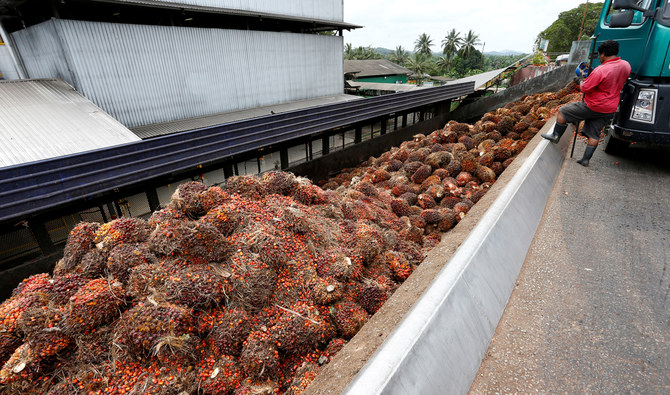
Malaysia hopes to pay for military equipment with palm oil

- Discussions on paying with palm oil had started with China, Russia, India, Pakistan, Turkey and Iran


Saudi Arabia leads outcome-based education to prepare future-ready generations: Harvard Business Review
- The Riyadh-based school group developed a strategy that links every classroom activity to measurable student competencies, aiming to graduate learners equipped for the digital economy and real-world contexts
RIYADH: Saudi Arabia’s education system is undergoing a sweeping transformation aligned with Vision 2030, shifting from traditional, input-focused methods to outcome-based education designed to equip students with future-ready skills, Harvard Business Review Arabic reported.
The transformation is being adopted and spearheaded by institutions such as Al-Nobala Private Schools, which introduced the Kingdom’s first national “learning outcomes framework,” aimed at preparing a generation of leaders and innovators for an AI-driven future, the report said.
Al-Nobala has leveraged international expertise to localize advanced learning methodologies.
The Riyadh-based school group developed a strategy that links every classroom activity to measurable student competencies, aiming to graduate learners equipped for the digital economy and real-world contexts. The school’s group approach combines traditional values with 21st-century skills such as critical thinking, communication, innovation and digital fluency.
According to the report, the shift addresses the growing gap between outdated models built for low-tech, resource-constrained environments and today’s dynamic world, where learners must navigate real-time information, virtual platforms, and smart technologies.
“This is not just about teaching content, it’s about creating impact,” the report noted, citing how Al-Nobala’s model prepares students to thrive in an AI-driven world while aligning with national priorities.
The report noted that Saudi Arabia’s Ministry of Education has paved the way for this shift by transitioning from a centralized controller to a strategic enabler, allowing schools such as Al-Nobala to tailor their curriculum to meet evolving market and societal needs. This is part of the long-term goal to place the Kingdom among the top 20 global education systems.
Al-Nobala’s work, the report stated, has succeeded in serving the broader national effort to link education outcomes directly to labor market demands, helping to fulfill the Vision 2030 pillar of building a vibrant society with a thriving economy driven by knowledge and innovation.
Last February, Yousef bin Abdullah Al-Benyan, Saudi Arabia’s minister of education, said that the Kingdom was making “an unprecedented investment in education,” with spending aligned to the needs of growth and development. He said that in 2025, education received the second-largest share of the state budget, totaling $53.5 billion.