MOSCOW/ANKARA: Turkey’s President Recep Tayyep Erdogan on Tuesday said ‘putschist Haftar’ has ‘ran away’ from Moscow after the Libya truce talks.
Turkey will not refrain from teaching ‘putschist Haftar’ a lesson if he continues attacks against Libya’s government, people Erdogan added.
Libya’s eastern strongman General Khalifa Haftar has left Moscow without signing a cease-fire agreement to end nine months of fighting in the country, the Russian foreign ministry confirmed on Tuesday.
Haftar’s decision to not sign a cease-fire agreement with Libya’s internationally recognized government shows who wants war and who wants peace in the country, Turkish Foreign Minister Mevlut Cavusoglu said on Tuesday.
Speaking to reporters in Ankara, Cavusoglu said Turkey had done what it can to ensure the cease-fire, adding that if Haftar continued to act this way a Libya summit planned to be held Berlin on Sunday will have no meaning.
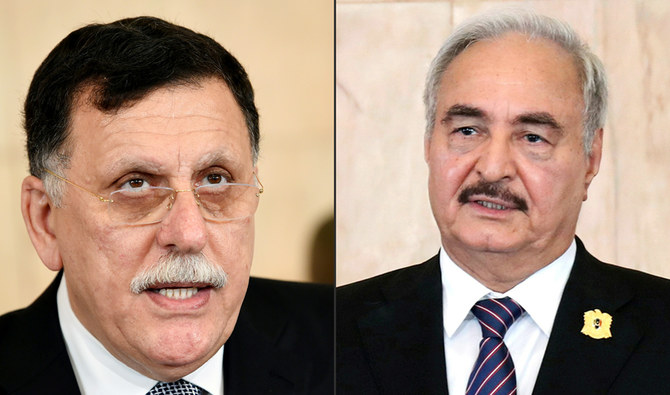
Haftar on Monday evening asked until Tuesday morning to look over the agreement already signed by the head of UN-recognized government Fayez Al-Sarraj, but left the Russian capital without signing, Russia’s foreign ministry spokeswoman Maria Zakharova said.
Sarraj and Haftar met with top diplomats and military officials from Russia and Turkey for the talks that lasted about seven hours.
The negotiations were held behind closed doors, and Sarraj and Haftar didn’t meet directly. A tentative truce came into force on Sunday.
Russian Foreign Minister Sergey Lavrov and his Turkish counterpart Cavusoglu said that Sarraj signed the draft agreement, but that Haftar requested more time to consider it.
“They have a positive view of the document and asked for extra time until the next morning to decide,” Lavrov said of Haftar and his delegation. “I hope they will make a positive decision. Russian and Turkish representatives will continue to offer their assistance.”
The truce marks the first break in fighting in months. There were immediate reports of violations by both sides, however, raising concerns it might not hold.
The civil war had been on the brink of a major escalation. Various foreign players back Libya’s rival governments, and they have recently been stepping up their involvement in the oil-rich nation’s conflict.
Libya plunged into turmoil after the 2011 civil war that ousted and killed long-time dictator Muammar Qaddafi.
Russia has maintained contacts with both conflicting parties in Libya, but the government in Tripoli has recently charged that Russian military contractors were fighting alongside Haftar.
Asked Saturday about Russian private security companies in Libya, Russian President Vladimir Putin responded that “if there are Russian citizens there, they do not represent the interests of the Russian state and do not receive any money from the Russian state.”
Putin noted that mercenaries were sent to Libya from Syria’s rebel-held province of Idlib alongside Turkey’s border, voicing hope that a lasting truce will help end the deployment of foreign fighters to Libya.
Turkish President Recep Tayyip Erdogan said earlier this month that his country was sending military personnel to Libya to support Sarraj’s government. Sarraj visited Istanbul for talks with Erdogan Sunday before heading to Moscow.
The negotiations follow the deals struck by Russia and Turkey to coordinate their action in Syria, where Moscow has shored up President Bashar Assad’s government and Ankara has backed his foes.
Putin discussed the situation in Libya with German Chancellor Angela Merkel, who visited Moscow on Saturday. The Russian leader welcomed Germany’s plan to hold a Libya peace summit in Berlin early this year.
In Putin’s conversations Sunday with French President Emmanuel Macron and Italian Prime Minister Giuseppe Conte, they also emphasized their support of the planned summit in Berlin.
Merkel’s spokesman, Steffen Seibert, said that preparations for a Libya conference in Berlin are “in the home stretch” after weeks of consultations.
He said the plan is for it to be held in January, but things aren’t yet so far advanced that a date can be officially announced.
Turkey’s Erdogan, speaking at a joint news conference Monday with the Italian prime minister, said he was hopeful that the Moscow meeting would form the basis for the Berlin meeting.
“My wish is for a cease-fire on a solid foundation to be the basis of peace for the future of our Libyan siblings and Libyan friends,” he said.
Seibert indicated that Sunday is one possibility for the conference. He was responding to a question about a report by CNN Turk that Erdogan would visit Germany on Sunday to attend the meeting.
Erdogan’s office later confirmed that he will visit on Sunday, but didn’t specify why.
“Such a Berlin conference could only be the start of a longer process, and it must of course ultimately be certain that Libyan interests are at the forefront,” Seibert said. “Such a Berlin conference is certainly not the end of anything.”


![]()

‘Putschist Haftar’ has ‘ran away’ from Moscow after Libya truce talks – Turkey’s Erdogan
Short Url
https://arab.news/6g3xv
‘Putschist Haftar’ has ‘ran away’ from Moscow after Libya truce talks – Turkey’s Erdogan
- Erdogan: Turkey will not refrain from teaching ‘putschist Haftar’ a lesson if he continues attacks against Libya’s government, people
- Libya plunged into turmoil after the 2011 civil war that ousted and killed long-time dictator Muammar Qaddafi


Latest updates





© 2026 SAUDI RESEARCH & PUBLISHING COMPANY, All Rights Reserved And subject to Terms of Use Agreement.