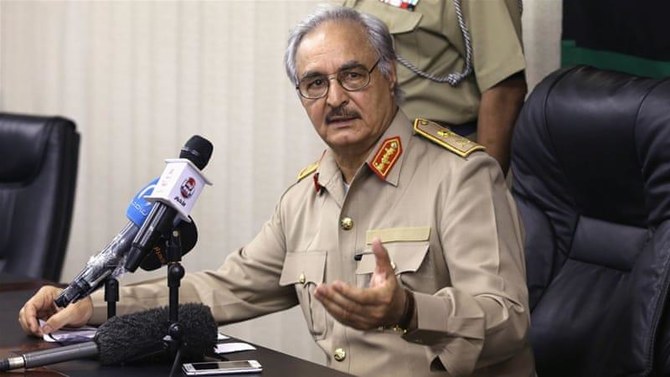
BENGHAZI: Eastern Libyan strongman Khalifa Haftar late Thursday rejected calls for a cease-fire by Turkey and Russia and announced a continuation of his military operations against a UN-recognized government.
In a statement read by his spokesman Ahmad Al-Mesmari, Haftar claimed that a revival of the political process and the country’s stability could only be assured by the “eradication of terrorist groups” and the dissolution of militia controlling Tripoli.
Haftar’s forces in April launched an offensive against the capital, seat of the UN-recognized Government of National Accord.
Turkish President Recep Tayyip Erdogan and his Russian counterpart Vladimir Putin issued their call for a truce on Wednesday in Istanbul.
Turkey supports the GNA while Russia is accused of supporting Haftar.
Haftar “hailed... President Vladimir Putin’s initiative” in his statement Thursday, but stressed that the “efforts of the armed forces in the war against terrorists” would continue.
“These groups have seized the capital and received the support of some countries and governments who supply them with military equipment, ammunition... and drones,” he said.
“These countries also send terrorists all over the world to fight (Haftar’s) armed forces,” he added.
Haftar was referring to Turkey, which has recently sent some troops to shore up the GNA, while he also accused Ankara of sending pro-Turkish Syrian fighters to Libya.

Libya’s Haftar rejects Ankara, Moscow’s call for cease-fire
https://arab.news/cfa8p
Libya’s Haftar rejects Ankara, Moscow’s call for cease-fire
- Haftar’s forces in April launched an offensive against the capital, seat of the UN-recognized Government of National Accord
- Turkish President Recep Tayyip Erdogan and his Russian counterpart Vladimir Putin issued their call for a truce on Wednesday in Istanbul
January settler attacks cause record West Bank displacement since Oct 2023: UN
- At least 694 Palestinians were forcefully driven from their homes last month, according OCHA figures
- OHCHR said in late January that settler violence has become a key driver of forced displacement in the West Bank
RAMALLAH: Israeli settler violence and harassment in the occupied West Bank displaced nearly 700 Palestinians in January, the United Nations said Thursday, the highest rate since the Gaza war erupted in October 2023.
At least 694 Palestinians were forcefully driven from their homes last month, according to figures from the UN’s humanitarian agency OCHA, which compiles data from various United Nations agencies.
The UN Human Rights Office (OHCHR) said in late January that settler violence has become a key driver of forced displacement in the West Bank.
January’s displacement numbers were particularly high in part due to the displacement of an entire herding community in the Jordan Valley, Ras Ein Al-Auja, whose 130 families left after months of harassment.
“What is happening today is the complete collapse of the community as a result of the settlers’ continuous and repeated attacks, day and night, for the past two years,” Farhan Jahaleen, a Bedouin resident, told AFP at the time.
Settlers in the West Bank, which Israel has occupied since 1967, use herding to establish a presence on agricultural lands used by Palestinian communities and gradually deny them access to these areas, according to a 2025 report by Israeli NGO Peace Now.
To force Palestinians out, settlers resort to harassment, intimidation and violence, “with the backing of the Israeli government and military,” the settlement watchdog said.
“No one is putting the pressure on Israel or on the Israeli authorities to stop this and so the settlers feel it, they feel the complete impunity that they’re just free to continue to do this,” said Allegra Pacheco, director of the West Bank Protection Consortium, a group of NGOS working to support Palestinian communities against displacement.
She pointed to a lack of attention on the West Bank as another driving factor.
“All eyes are focused on Gaza when it comes to Palestine, while we have an ongoing ethnic cleansing in the West Bank and nobody’s paying attention,” she told AFP.
West Bank Palestinians are also displaced when Israel’s military destroys structures and dwellings it says are built without permits.
In January, 182 more Palestinians were displaced due to home demolitions, according to OCHA.
Excluding Israeli-annexed east Jerusalem, the West Bank is home to more than 500,000 Israelis living in settlements and outposts considered illegal under international law.
Around three million Palestinians live in the West Bank.