

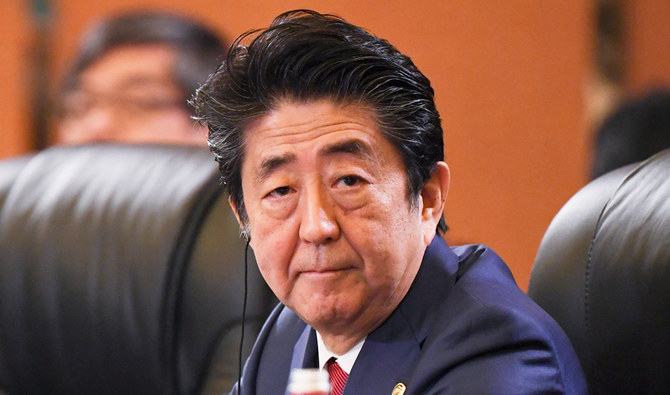
Japanese Prime Minister begins Arab tour with Saudi visit

Abe will go ahead with a planned visit to the Middle East this weekend despite the crisis in the region, a spokesman said Friday, Jan. 10, 2020. (AP)
Short Url
Updated 11 January 2020
Follow

Japanese Prime Minister begins Arab tour with Saudi visit

  • Abe to explain plans to send Self-Defense Forces personnel to the region

RIYADH: Japanese Prime Minister Shinzo Abe will arrive in Riyadh today as part of a trip to the Middle East to further enhance bilateral cooperation between Tokyo and the region.

Abe is visiting Saudi Arabia and the UAE to explain Japanese plans to send Self-Defense Forces (SDF) personnel to the region, the Japan Times said, citing government sources.
During his visit to Saudi Arabia he is expected to be received by King Salman in Riyadh and is also expected to make a trip to the historical site of AlUla, where he will have a meeting with Saudi Crown Prince Mohammed bin Salman.
The Japanese government is considering sending an SDF aircraft and patrol vessel to monitor shipping and gather information independent of the US-led coalition guarding ships traveling through the Strait of Hormuz, a vital oil route in the region.
The Kingdom and the UAE are part of the US initiative.
Japan is the world’s fourth-largest oil consumer and relies heavily on the Middle East for its supply of crude. Saudi Arabia accounted for almost 40 percent of Japanese oil imports in fiscal 2018. The import volume of Arab-L crude oil accounted for the largest share of the crude oil imports from Saudi Arabia to Japan, with around 31.6 million kiloliters.
Saudi Arabia and Japan are building on their mutual trust developed through understanding of each other’s culture to deepen and broaden the existing bilateral relations and establish a solid strategic partnership. In the spirit of mutual benefit and co-prosperity, both countries have recognized the importance to cooperate in realizing their respective visions. In Sept. 1, 2016, Deputy Crown Prince Mohammed bin Salman and Prime Minister Shinzo Abe decided to set up the Joint Group for “Saudi-Japan Vision 2030 (SJV 2030)”, heralding a new era of partnership between the two countries.

BACKGROUND

• Abe last visited Saudi Arabia in 2013 when he held talks with King Abdullah and then-Crown Prince Salman bin Abdul Aziz, and signed an investment agreement between Japan and the Kingdom.

• Abe also made a visit to the Kingdom in 2007 during his first term as prime minister (2006–2007).

The first Joint Group meeting was held in Riyadh, on Oct. 9, 2016. The Joint Group strives to serve as the platform for cooperation and exchange among subgroup representatives from the Kingdom of Saudi Arabia and Japan.
Abe last visited Saudi Arabia in 2013 when he held talks with King Abdullah and then-Crown Prince Salman bin Abdul Aziz, and signed an investment agreement between Japan and the Kingdom.
During the meeting with the then-crown prince, the two sides decided to start a security dialogue and promote defense exchanges while expanding cooperation in politics and security.
Abe also delivered a policy speech titled, “Japan’s Ties with the Middle East in a New Age of Synergy, Mutual Prosperity, and Cooperation.”
Abe also made a visit to the Kingdom in 2007 during his first term as prime minister (2006–2007).


Al-Manshiyah carnival in AlUla invites families to enjoy winter weather

Updated 6 sec ago
Follow

Al-Manshiyah carnival in AlUla invites families to enjoy winter weather

  • Open-air celebration welcomes visitors of all ages

ALULA: As part of the Winter at Tantora festival, which runs until Jan. 10, families in AlUla can enjoy moonlit fun at the Al-Manshiyah Plaza Winter Carnival.

The open-air celebration welcomes visitors of all ages with games, mini parades, live concerts and hands-on workshops, including hat-making and wool crafts. Guests can also browse and purchase handmade goods from local vendors.

Open on weekends from 6 p.m. until midnight for the duration of the festival, the carnival blends AlUla’s rich heritage with contemporary entertainment.

Arab News spoke to Yorgo Saade, a Lebanese national who has lived in AlUla for the past five years and is manager of Lapain Coffee & Bakery.

On the night of the visit, Saade was serving hot drinks and cakes, sharing his trademark energy as a chilly breeze swept through the plaza.

He told Arab News: “Because it’s winter season now, we have winter drinks — hot chocolate, and we have French hazelnut. In Saudi Arabia, people (also) love the hot coffee of the day.

“This is a great carnival. All the families come here for amusement because there is a clown, entertainment, music, and everything. There’s a lot of seating areas.”

Saade is impressed by the historic and geographic significance of the event.

He added: “This park is next to an old, ancient train station, which is no longer in operation. It’s a heritage area  — as you can see with all the old houses.”

The nearby train station, built in the early 20th century, now stands abandoned. It once formed part of the Hejaz Railway, which briefly connected AlUla to a vast regional network of pilgrimage, trade and empire.

Although its use was short-lived, the railway marked AlUla’s first encounter with large-scale modern transportation and industrial architecture.

Decades later, Al-Manshiyah Plaza emerged as the area’s social and administrative center, as residents moved from the Old Town into organized neighborhoods.

While the railway symbolized movement through AlUla, the plaza came to represent the life within it — schools, services, markets and everyday gatherings that shaped a settled community.

Today, Al-Manshiyah Plaza’s atmosphere helps to keep families engaged with activities, and snacks are available throughout the evening.

No ticket is required to enter, and free parking is available. The site is wheelchair accessible, although visitors are advised that the festivities offered include loud noises and flashing lights.

Children under 16 must be accompanied by an adult.

For Saade, the carnival has breathed new life into the historic space, and he added: “There’s a lot of food corners here. As you can see, there’s a lot of children and this is an ancient area. It’s new and old — with food.”