Japanese ambassador asks Lebanon for more cooperation over Ghosn

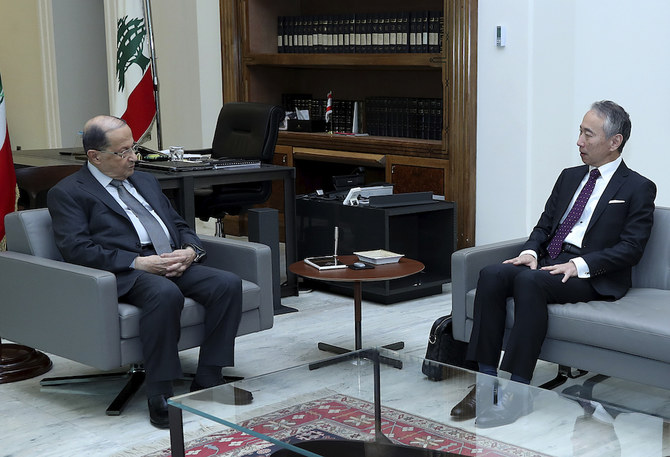
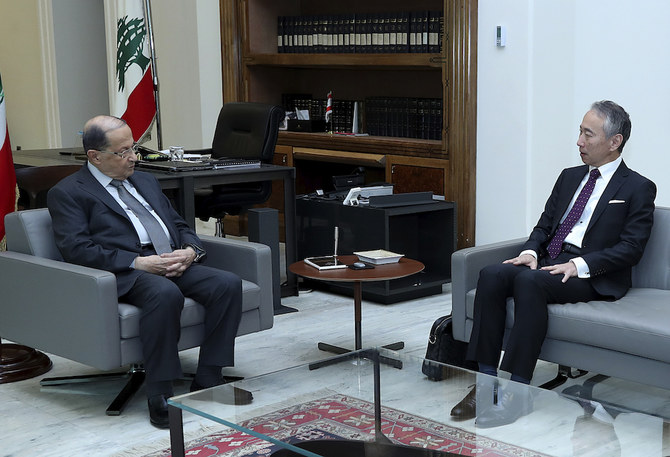
Lebanese president Michel Aoun with Japan's Ambassador to Lebanon Takeshi Okubo in the presidential palace, in Baabdaon Tuesday. (AP)
Short Url
Updated 08 January 2020
Follow

Japanese ambassador asks Lebanon for more cooperation over Ghosn

  • Ex-Nissan boss says he has proof of govt-backed ‘coup’
  • Japan issues arrest warrant against wife

BEIRUT: Less than 24 hours before Carlos Ghosn held his press conference in Beirut, the Japanese Ambassador to Lebanon Takeshi Okubo asked President Michel Aoun for “more cooperation” to “avoid negative repercussions on our friendly relations.”

The former chairman of the Renault-Nissan Group board of directors took refuge in Beirut on Dec. 30 after he left Japan illegally, where he was under house arrest.

Ghosn announced at the time that he “intends to speak freely to the press and is no longer hostage to a biased Japanese judicial system, where guilt is assumed.”

He said that he “did not escape justice, but rather freed myself from political injustice and persecution. Finally, I can freely communicate with the media, which is what I will do.”

The visit of Okubo on the eve of the press conference comes after the Japanese authorities sent an international arrest warrant last week to arrest Ghosn. Lebanon received the Interpol warrant and referred it to the judiciary.

The meeting between Aoun and Okubo was attended by both the Minister of State for Presidential Affairs in the caretaker government, Salim Jreissati, and the Director General of General Security Maj. Gen. Abbas Ibrahim.

Presidential media adviser Rafiq Shalala told Arab News that the Japanese envoy “stressed the importance of Lebanese cooperation in the Ghosn file.”

Okubo said: “The discussion dealt with historical bilateral relations and strong bonds of friendship between the two countries in various fields. We raised the issue of Ghosn and expressed our view on it. We said that the government and people of Japan are very concerned about the issue, especially in terms of his way out of Japan and his entry into Lebanon. I asked the president of the republic for more cooperation in this regard in order to avoid negative repercussions on our friendly relations, especially as I make intensive efforts to preserve the relations between the two peoples and the two countries.”

Ghosn is scheduled to hold his press conference at 3 p.m. on Wednesday in the headquarters of the Lebanese Press Syndicate. 

“Last time Carlos Ghosn announced a press conference and got re-arrested. This time, the day before he is announced to speak out freely for the first time, they issued an arrest warrant for his wife Carole Ghosn,” a spokeswoman for Ghosn said.

The organizers of the event told Arab News that “the number of journalists invited to attend the press conference amounted to about 150, including a small number of Japanese media personnel, while the rest are from foreign and local media.”

Citing an interview with Ghosn, Fox Business reported that he said he has “actual evidence” and documents to show there was a Japanese government-backed coup to “take him out.” He plans to identify those he believes responsible, the broadcaster said.

On the eve of the press conference, Lebanon’s caretaker Justice Minister, Albert Sarhan, reiterated that Ghosn is a Lebanese citizen and has the right to be treated on this basis.

Sarhan said that Lebanon “has not yet received any file related to the arrest warrant for Ghosn’s wife, Carole Ghosn.”

Last time Ghosn announced a press conference and got re-arrested. This time, the day before he is announced to speak out freely for the first time, they issued an arrest warrant for his wife.

Spokesman for Carlos Ghosn

Japanese media had reported on Tuesday that “Japan’s prosecutors issued an arrest warrant for Carole Ghosn, accusing her of false testimony.” The National News Agency (official news of Lebanon) confirmed that Carole Ghosn is “currently in Lebanon.”

Sarhan told the National News Agency that “the public prosecution received the red notice issued by the Interpol office in Japan related to the Ghosn case, and it will proceed with the required action in the light of it.”

Nissan said Ghosn’s flight from Japan would not affect its policy of holding him responsible for “serious misconduct.”

“The company will continue to take appropriate legal action to hold Ghosn accountable for the harm that his misconduct has caused to Nissan,” the automaker said in a statement.

Japan’s Chief Cabinet Secretary, Yoshihide Suga, on Tuesday, described Ghosn’s escape to Beirut as “regrettable” and said Tokyo had asked Lebanon for help, although he declined to say what exactly Japan had asked of Lebanon.

“It’s necessary to carefully consider the legal systems of both countries,” he told a news conference.

Meanwhile, Nissan Motor Co. has strengthened a taskforce of senior officials. “Now that he has escaped, he can say anything he wants and will keep throwing mud at us until people prove him otherwise,” one company executive said. “The more sympathy he gets from the media and general public, the stronger his leverage over the Lebanese government to protect him.”

The Nissan taskforce was set up shortly after Ghosn’s arrest to deal with “anything Ghosn-related,” as one source put it — a testament to the significance of a man who forged the company’s alliance with French carmaker Renault and presided over it for almost two decades.

The taskforce is led by Chief Executive Makoto Uchida and has recently been reinforced with the inclusion of former acting CEO Yasuhiro Yamauchi and former senior executive Hitoshi Kawaguchi, the sources said.

Both former executives were previously close allies of Ghosn and while they stepped down in a recent management shakeup they remain employed at Nissan as advisers.


Germany’s Merz hails China ties as he seeks reset with Beijing

Updated 6 sec ago
Follow

Germany’s Merz hails China ties as he seeks reset with Beijing

  • Merz, who was accompanied by a large business delegation, told President Xi Jinping that he wanted to deepen economic ties with China
  • “There are challenges, which we should talk about today, but the framework in which we operate is exceptionally good,” he said

BEIJING: German Chancellor Friedrich Merz won a pledge by China to import more high-quality goods from Germany on Wednesday, as he visited Beijing aiming to reset relations that have been clouded by a yawning trade deficit with the world’s second-largest economy.
On his first visit to China as Chancellor, Merz, who was accompanied by a large business delegation, told President Xi Jinping that he wanted to deepen economic ties with China, Germany’s largest trading partner last year.
“There are challenges, which we should talk about today, but the framework in which we operate is exceptionally good and we have worked together very well over the past decades,” he said.
Xi welcomed the comments from Merz, who faces a tough balancing act of redefining an economic relationship that is increasingly unfavorable to German interests.
“The more turbulent and intertwined the world becomes, the more China and Germany need to strengthen strategic communication and enhance strategic mutual trust,” he said.

CHINA’S MASSIVE TRADE SURPLUS
Merz’s visit follows his warning this month that the postwar international order underwritten ⁠by the US ⁠alliance with Europe was no more and that Europe must stand on its own in a world of great power rivalry.
In an earlier meeting with Premier Li Qiang, Merz said there were “very specific concerns regarding our cooperation, which we want to improve and make fair.”
Merz’s comments reflect longstanding German concerns about what Berlin sees as an undervalued yuan, market-distorting subsidies and overcapacity among Chinese exporters that have built massive trade surpluses with Europe’s largest economy, amounting to 90 billion euros ($106 billion) last year.
He noted that the deficit had increased fourfold since 2020, and said this was largely due to overcapacity. “This dynamic is not healthy,” he told reporters after the meetings.
German business has been deeply ⁠concerned by its dependence on strategic commodities from China including rare earths and basic chips after Beijing tightened export controls last year, sending shockwaves through Western manufacturers.
At the same time, Merz’s visit underlined the vital importance of China’s huge consumer market and the technical sophistication of its all-conquering manufacturers.
“We want Chinese investment in Germany,” Merz said at a business event attended by senior German and Chinese business leaders from the tech and auto sectors.
Li told Merz that China wished to cooperate in areas like automobiles and chemicals as well as emerging fields including artificial intelligence and biomedicine.
He also said China was willing to import more high-quality products from Germany and encouraged Chinese companies to invest in Germany, according to a readout from the meeting released by Xinhua news agency.
“China will unswervingly expand high-level opening-up and actively address the reasonable demands of foreign-invested enterprises from Germany and other countries,” he said.

“JUST AND FAIR GLOBAL GOVERNANCE“
Merz is accompanied by top executives from 30 German firms including top carmakers such as Volkswagen and BMW which are acutely ⁠feeling the strain of Chinese competition — ⁠contributing to the growing trade imbalance.
China has been seeking to present itself as a reliable economic partner, as Europe struggles with a new, less certain relationship with Washington and vulnerabilities in its supply chains exposed during a bout of trade turbulence last year.
China’s market, once coveted by foreign businesses for its wide consumer base and rising spending power, has changed in recent years with a slowing economy capping consumer demand and manufacturing overcapacity increasingly pushing domestic firms to look for opportunities abroad.
Li called on both sides to work together to safeguard multilateralism and free trade, in a comment seen as a reference to US President Donald Trump’s trade war and said they should “strive to build a more just and fair global governance system.”
Despite their calls for deeper engagement, the agreements Merz and Li formalized after their meeting were narrowly targeted and in industries peripheral to both economies.
The five documents signed covered continued efforts in climate change and green transition, cooperation in animal disease prevention and a poultry products protocol, as well as sports collaboration agreements for football and table tennis.
That paled in comparison with Canada and Britain, which respectively signed eight and 12 documents with China last month during visits by Canadian Prime Minister Mark Carney and British Prime Minister Keir Starmer.