

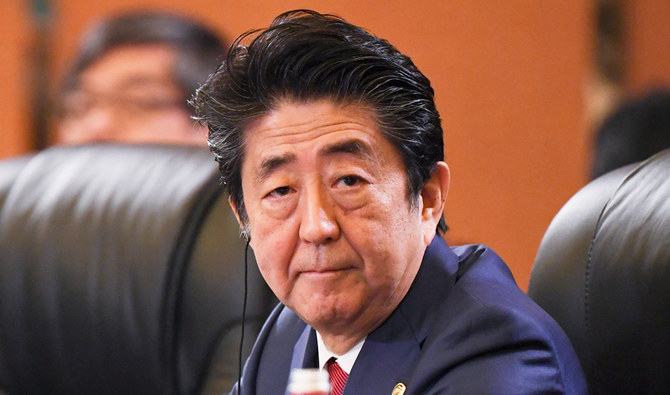

RIYADH: Japanese Prime Minister Shinzo Abe will arrive in Riyadh today as part of a trip to the Middle East to further enhance bilateral cooperation between Tokyo and the region.
Abe is visiting Saudi Arabia and the UAE to explain Japanese plans to send Self-Defense Forces (SDF) personnel to the region, the Japan Times said, citing government sources.
During his visit to Saudi Arabia he is expected to be received by King Salman in Riyadh and is also expected to make a trip to the historical site of AlUla, where he will have a meeting with Saudi Crown Prince Mohammed bin Salman.
The Japanese government is considering sending an SDF aircraft and patrol vessel to monitor shipping and gather information independent of the US-led coalition guarding ships traveling through the Strait of Hormuz, a vital oil route in the region.
The Kingdom and the UAE are part of the US initiative.
Japan is the world’s fourth-largest oil consumer and relies heavily on the Middle East for its supply of crude. Saudi Arabia accounted for almost 40 percent of Japanese oil imports in fiscal 2018. The import volume of Arab-L crude oil accounted for the largest share of the crude oil imports from Saudi Arabia to Japan, with around 31.6 million kiloliters.
Saudi Arabia and Japan are building on their mutual trust developed through understanding of each other’s culture to deepen and broaden the existing bilateral relations and establish a solid strategic partnership. In the spirit of mutual benefit and co-prosperity, both countries have recognized the importance to cooperate in realizing their respective visions. In Sept. 1, 2016, Deputy Crown Prince Mohammed bin Salman and Prime Minister Shinzo Abe decided to set up the Joint Group for “Saudi-Japan Vision 2030 (SJV 2030)”, heralding a new era of partnership between the two countries.
BACKGROUND
• Abe last visited Saudi Arabia in 2013 when he held talks with King Abdullah and then-Crown Prince Salman bin Abdul Aziz, and signed an investment agreement between Japan and the Kingdom.
• Abe also made a visit to the Kingdom in 2007 during his first term as prime minister (2006–2007).
The first Joint Group meeting was held in Riyadh, on Oct. 9, 2016. The Joint Group strives to serve as the platform for cooperation and exchange among subgroup representatives from the Kingdom of Saudi Arabia and Japan.
Abe last visited Saudi Arabia in 2013 when he held talks with King Abdullah and then-Crown Prince Salman bin Abdul Aziz, and signed an investment agreement between Japan and the Kingdom.
During the meeting with the then-crown prince, the two sides decided to start a security dialogue and promote defense exchanges while expanding cooperation in politics and security.
Abe also delivered a policy speech titled, “Japan’s Ties with the Middle East in a New Age of Synergy, Mutual Prosperity, and Cooperation.”
Abe also made a visit to the Kingdom in 2007 during his first term as prime minister (2006–2007).


