
Pakistan says 34 militants killed in counterterror operations in Balochistan, KP this week 

A man uses his mobile to film the damaged police vehicles, loaded on a truck, after a terrorist attack in Kohat, in Khyber Pakhtunkhwa province, Pakistan, on February 24, 2026. (REUTERS/File)
Short Url
Updated 25 February 2026
Follow

Pakistan says 34 militants killed in counterterror operations in Balochistan, KP this week 

  • Pakistan military says 26 militants killed in separate operations in Khyber Pakhtunkhwa this week
  • Eight other militants were gunned down in southwestern Balochistan’s Zhob district, says military

ISLAMABAD: Pakistani security forces killed 34 militants this week in the southwestern Balochistan and northwestern Khyber Pakhtunkhwa (KP) provinces bordering Afghanistan, the military’s media wing said on Wednesday amid a surge in militant attacks in the country. 

The Inter-Services Public Relations (ISPR), the military’s media wing, said security forces carried out a series of “high tempo intelligence-driven operations” this week in the two provinces. It said 26 militants belonging to the Pakistani Taliban or the Tehreek-e-Taliban Pakistan (TTP) outfit were killed while eight militants were killed in Balochistan in the operations. 

In the first counterterror operation on Tuesday, Pakistani forces targeted a TTP militant who was trying to enter the country in North Waziristan through the Pakistan-Afghanistan border, the ISPR said. Three TTP militants were killed in a second counterterror operation in Lakki Marwat district, the military added. 

In the third counterterror operation, 10 TTP militants were killed in Bannu district while 12 others were gunned down in North Waziristan in another separate operation, the ISPR said. 

“During the fifth engagement, own troops conducted an intelligence-based operation in the general area of Sambaza, Zhob District,” the military’s media wing said in a statement.

“After an intense fire exchange, eight terrorists belonging to Fitna Al Hindustan were successfully neutralized.”

Pakistan’s military uses the terms “Fitna Al-Khwarij” for the TTP and “Fitna Al Hindustan” for separatist militants in Balochistan. Islamabad alleges these militant groups are supported by India, a charge New Delhi has always denied. 

The ISPR said security forces retrieved weapons and ammunition from the militants in Balochistan’s Zhob district, adding that they were involved in “terrorist activities” in the area.

“The security forces of Pakistan remain resolute and unwavering in their commitment to defend the nation’s frontiers,” the ISPR said. 

FOUR POLICE PERSONNEL KILLED 

Separately, four police personnel were killed in KP’s district Bajaur on Wednesday after they were ambushed by unidentified gunmen. 

The police personnel were on patrol duty when the gunmen opened fire on them, a statement from the chief minister’s office said. 

“Such cowardly acts of terrorism cannot shake the resolve and morale of the police force,” Chief Minister Sohail Afridi was quoted as saying. 

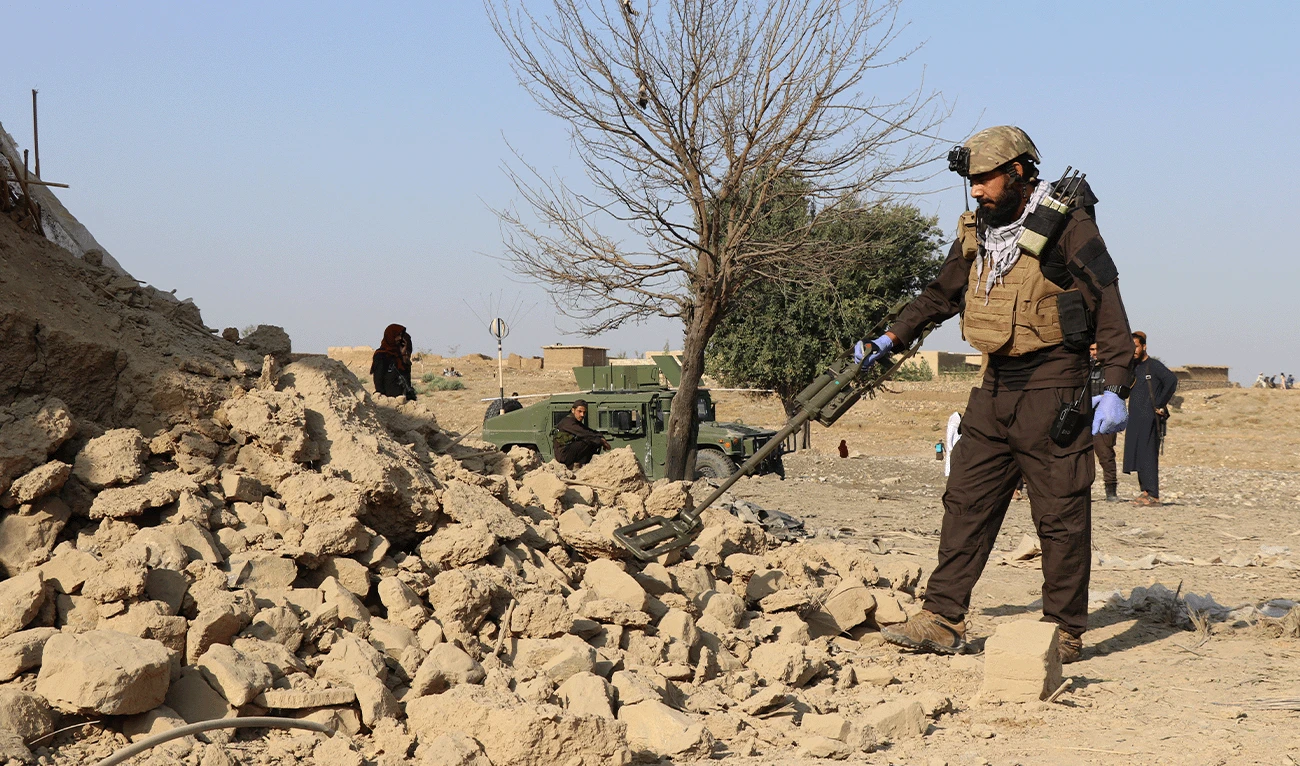
The counterterror operations take place amid surging tensions between Pakistan and Afghanistan. Islamabad said it carried out strikes on alleged militant camps in Afghanistan on Saturday night, killing over 100 militants. 

Afghanistan said the attacks violated its territorial sovereignty, accusing Islamabad of killing and wounding dozens of civilians. 

Islamabad alleges militants based in Afghanistan are responsible for surging militant attacks inside Pakistani territory. Afghanistan rejects these allegations and urges Pakistan to focus on its security challenges instead of blaming Kabul.
Pakistan says defense pact with Saudi Arabia elevated brotherly ties to ‘new heights’

Updated 25 February 2026
Follow

Pakistan says defense pact with Saudi Arabia elevated brotherly ties to ‘new heights’

  • Pakistan, Saudi Arabia signed strategic defense pact last year pledging aggression against one will be treated as attack on both
  • Deputy PM Ishaq Dar says enduring bonds with Islamic and Arab nations form vital pillar of Pakistan’s foreign policy 

ISLAMABAD: Deputy Prime Minister Ishaq Dar said on Wednesday that Pakistan’s defense pact with Saudi Arabia elevated its brotherly ties with the Kingdom to “new heights,” stressing that close ties with Arab and Islamic nations form a key pillar of Islamabad’s foreign policy. 

Pakistan and Saudi Arabia signed a Strategic Mutual Defense Agreement on Sept. 17 last year, pledging that aggression against one country would be treated as an attack on both, enhancing joint deterrence and formalizing decades of military and security cooperation.

Both nations agreed in October 2025 to launch an economic cooperation framework to strengthen trade and investment ties. 

“In the Middle East, our landmark Strategic Mutual Defense Agreement with Saudi Arabia has elevated our brotherly ties to new heights,” Dar said while speaking at the Pakistan Governance Forum 2026 event in Islamabad. 

The Pakistani deputy prime minister was speaking on the topic “Navigating International Relations Amidst Changing Geo-Politics.”

Dar noted that Pakistan has reinforced partnerships with other Middle Eastern nations such as the UAE, Qatar, Jordan, Oman, Egypt and Bahrain. He said these partnerships have yielded “concrete agreements” in investment, agriculture, infrastructure, and energy sectors. 

“Our enduring bonds with Islamic and Arab nations form a vital pillar of our foreign policy, and we will continue to expand our partnerships across Asia, Latin America, and Africa,” he said. 

Dar pointed out that the presidents of Kazakhstan, Uzbekistan and Kyrgyzstan have undertaken visits to Pakistan in recent months, reflecting Central Asian nations’ desire to boost cooperation with Islamabad.

On South Asia, the Pakistani deputy PM said Pakistan has successfully transformed its fraternal ties with Bangladesh into “a substantive partnership.”

“Similarly, the trilateral mechanism involving China, Pakistan, and Bangladesh has been launched with a view to expanding and deepening regional cooperation and synergy,” the Pakistani minister said. 

He said Islamabad has strengthened its “all-weather” partnership with China via the second phase of the multi-billion-dollar China-Pakistan Economic Corridor agreement and “unwavering support” from both sides for each other’s core interests. 

Dar said Pakistan had also reinvigorated its partnership with the US, advancing cooperation in trade, technology, investment, and regional stability. 

“This calibrated approach has enhanced our ability to navigate complexity with skill and confidence, ensuring that our national interests are served without compromising our core foreign policy principles,” he said.