

Turkiye’s Erdogan dismisses secular critics of Ramadan school plan

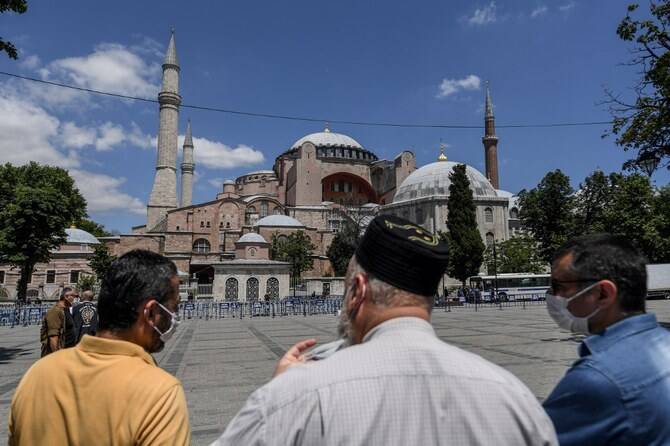
President Recep Tayyip Erdogan on Wednesday defended a directive introducing Ramadan-related activities in public schools, rejecting criticism from opponents who said the move undermined Turkiye’s secular principles. (AFP/File)
Short Url
Updated 25 February 2026
Follow

Turkiye’s Erdogan dismisses secular critics of Ramadan school plan

  • Critics say that has opened a faultline in Turkiye, a constitutionally secular state
  • They accuse the government of seeking to Islamise the education system and erode the separation of religion and state

ISTANBUL: President Recep Tayyip Erdogan on Wednesday defended a directive introducing Ramadan-related activities in public schools, rejecting criticism from opponents who said the move undermined Turkiye’s secular principles.
Education Minister Yusuf Tekin issued a circular ordering schools from preschool to high school nationwide to organize religious activities during the Muslim holy month.
Critics say that has opened a faultline in Turkiye, a constitutionally secular state. They accuse the government of seeking to Islamise the education system and erode the separation of religion and state.
Erdogan told lawmakers from his Islamic-rooted AKP party in parliament: “What has been done is right, appropriate, lawful, and ... a highly beneficial service that reflects the sentiments of our nation.”
Schools would organize discussion programs and fast-breaking dinners aimed at strengthening school-family cooperation, he said, adding that participation would be voluntary.
Erdogan, a devout Muslim and graduate of a clerical school, has previously said he aims to raise a “pious generation.” But that remark has hit a nerve among secular Turks, who accuse his government of pursuing a broader religious agenda.

-’Not a crime’-

The education ministry’s circular has prompted an online petition of protest, so far signed by more than 42,000 people. Among them are more than 160 prominent figures, including author Ayse Kulin and actress Mujde Ar.
Turkiye was facing a “reactionary-shariah siege,” says the petition. “Defending secularism is not a crime ... We will not surrender to darkness,” it adds.
On Wednesday, Erdogan dismissed it accusing its authors of repeating “their worn-out song of ‘secularism is under threat’” and accusing them of double standards.
“They are not disturbed when Christmas decorations are put up,” he said.
“They are not bothered when all kinds of questionable nonsense are staged under the name of New Year’s or Halloween celebrations,” he added.
“But whenever, at the doorstep of Ramadan, our children are to be taught the national and spiritual values of these lands, that is when they immediately become uncomfortable.”
Erdogan reiterated his long-standing argument that secular policies in past decades had discriminated against religious citizens — widely interpreted as referring to the ban on the Islamic headscarf in state institutions that his government lifted in 2013.
“Their issue has never truly been secularism,” said Erdogan.
“Their issue is with the sacred values of these lands, with the national and spiritual values of this nation — their issue is with this nation itself.”
Erdogan’s right-wing ally MHP leader Devlet Bahceli has also backed the education ministry’s Ramadan circular and attacked the petition.
“If believing in God is reactionary, then we are also reactionary,” he told his party’s meeting in parliament on Tuesday.


UN nuclear watchdog says it’s unable to verify whether Iran has suspended all uranium enrichment

Updated 58 min 22 sec ago
Follow

UN nuclear watchdog says it’s unable to verify whether Iran has suspended all uranium enrichment

VIENNA: Iran has not allowed the United Nations nuclear watchdog to access nuclear facilities affected by the 12-day war in June, according to a confidential report by the watchdog circulated to member states and seen Friday by The Associated Press.
The report from the International Atomic Energy Agency stressed that therefore it “cannot verify whether Iran has suspended all enrichment-related activities,” or the “size of Iran’s uranium stockpile at the affected nuclear facilities.”
The IAEA report on Friday warned that due to the continued lack of access to any of Iran’s four declared enrichment facilities, the agency “cannot provide any information on the current size, composition or whereabouts of the stockpile of enriched uranium in Iran.”
The report stressed that the “loss of continuity of knowledge over all previously declared nuclear material at affected facilities in Iran needs to be addressed with the utmost urgency.”
Iran long has insisted its program is peaceful, but the IAEA and Western nations say Tehran had an organized nuclear weapons program up until 2003.
Highly enriched material should be verified regularly
According to the IAEA, Iran maintains a stockpile of 440.9 kilograms (972 pounds) of uranium enriched up to 60 percent purity — a short, technical step away from weapons-grade levels of 90 percent.
That stockpile could allow Iran to build as many as 10 nuclear bombs, should it decide to weaponize its program, IAEA director general Rafael Grossi warned in a recent interview with the AP. He added that it doesn’t mean that Iran has such a weapon.
Such highly enriched nuclear material should normally be verified every month, according to the IAEA’s guidelines.
The IAEA also reported that it had observed, through the analysis of commercially available satellite imagery, “regular vehicular activity around the entrance to the tunnel complex at Isfahan.”
The facility in Isfahan, some 350 kilometers (215 miles) southeast of Tehran, was mainly known for producing the uranium gas that is fed into centrifuges to be spun and purified.
Israel has struck buildings at the Isfahan nuclear site, among them a uranium conversion facility. The US also struck Isfahan with missiles during the war last June.
The IAEA also reported that through the analysis of commercially available satellite imagery, it has observed “activities being conducted at some of the affected nuclear facilities, including the enrichment facilities at Natanz and Fordow,” but it added that “without access to these facilities it is not possible for the Agency to confirm the nature and the purpose of the activities.”
The confidential IAEA report also said Friday that Iran did provide access to IAEA inspectors “to each of the unaffected nuclear facilities at least once since the military attacks of June 2025, with the exception of Karun Nuclear Power Plan, which is in the early stages of construction and does not contain nuclear material.”
IAEA joined Geneva talks between Iran and US
The IAEA reported on Friday that Grossi attended negotiations between the US and Iran on Feb. 17 and Feb. 26 in Geneva at which he “provided advice on issues relevant to the verification of Iran’s nuclear program.” The report said that those negotiations are “ongoing.”
The Trump administration has held three rounds of nuclear talks this year with Iran under Omani mediation. Thursday’s round of talks in Geneva ended without a deal, leaving the danger of another Mideast war on the table as the US has gathered a massive fleet of aircraft and warships in the region.
Oman’s Foreign Minister Badr Al-Busaidi said technical talks involving lower-level representatives would continue next week in Vienna, the home of the IAEA. The agency is likely to be critical in any deal.
The US is seeking a deal to limit Iran’s nuclear program and ensure it does not develop nuclear weapons.
Iran says it is not pursuing weapons and has so far resisted demands that it halt uranium enrichment on its soil or hand over its stockpile of highly enriched uranium.
Similar talks last year between the US and Iran about Iran’s nuclear program broke down after Israel launched what became a 12-day war on Iran, that included the US bombing Iranian nuclear sites.
Before the June war, Iran had been enriching uranium up to 60 percent purity.