

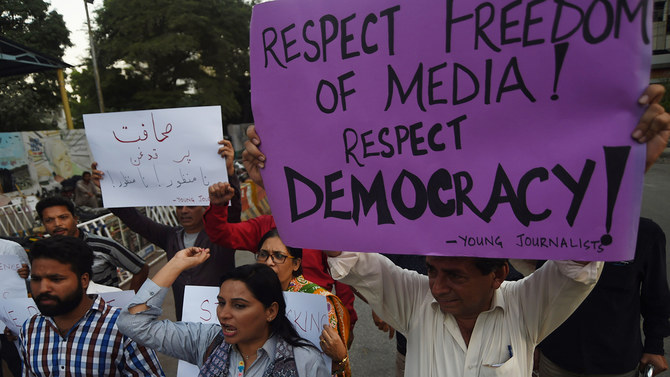
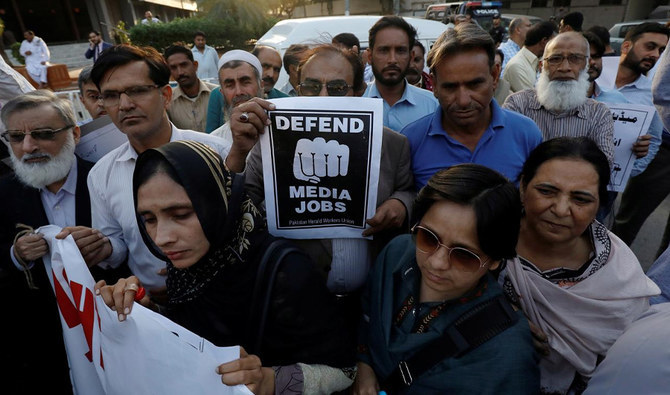

KARACHI: Shakir Ali never thought that one day he would have to throw out his pen and start stitching shoes to make a living. He used to work as an editor of an Urdu-language daily in Karachi.
“All of a sudden, I was told that a financial crunch didn’t allow the newspaper to hire me anymore,” Ali told Arab News. From Nawa-e-Waqt he moved to his brother’s factory and became a cobbler.
According to the Karachi Union of Journalist (KUJ), 3105 media workers – mostly journalists – lost their jobs in 2019.
“Several journalists have become living corpses as they have nothing to support their families,” said Shoaib Ahmed, assistant secretary-general of the Pakistan Federal Union of Journalists (PFUJ).
Pakistani journalists have been increasingly exposed to violence despite declining violent crime rates across the country. According to a recent report by the Freedom Network, an independent Pakistani media watchdog, at least 33 journalists were murdered in reprisal for their work in the past six years. Eight of them were killed between November 2018 and November 2019.
According to the report, not a single perpetrator was brought to justice, with “mysterious,” “nameless and unidentified actors” becoming the biggest threat to the lives of on-duty journalists.
KUJ president Hasan Abbas said journalism had never been an easy task in Pakistan, especially since the late 1970s, with the ascent of military dictator Zia-ul-Haq, under whom the state started to exert control over the media.
“Imran Khan’s government, however, has caused the biggest blow to the media in Pakistan’s history, leaving thousands of journalists unemployed,” Abbas said.
For a week and to no avail, Arab News has been requesting comment from Firdous Ashiq Awan, the prime minister’s special assistant on information and broadcasting.
However, speaking at a National Assembly’s meeting on broadcasting earlier this month, Awan said the government believes in the freedom of expression and press, as guaranteed by the Constitution. “Media has the right to criticize the government’s policies, but it should act more responsibly when the interests of the state are involved,” a state-run radio station quoted her as saying
During the meeting, she also asked for the formation of a committee that would formulate a strategy to protect the rights of on-duty journalists.
Meanwhile, media owners blame the government for the industry’s deplorable economic condition, partly relating it to a decline in state advertising.
“There is a sharp decline of up to 50 percent in federal and provincial governments’ advertising, while private sector advertisements have declined between 30 and 40 percent, forcing media owners to unwillingly lay off workers,” Sarmad Ali, secretary-general of the All Pakistan Newspaper Society (APNS), told Arab News. He added that huge outstanding payments from the governments remain due, only aggravating the situation.
However, Freedom Network executive director Iqbal Khattak said that since this is not the first crisis, it could have been handled by media organizations without sacking journalists. “Instead of laying off journalists’ media groups may have reduced the number of pages to save money on print,” he said.
The year has greatly affected the quality of Pakistani journalism as well.
“An unpaid journalist would care more about his financial problems instead of concentrating on quality and doing efforts for freedom of the press. With journalists surrounded by their own problems, there is hardly any debate about censorship and this is dangerous for journalism,” said senior journalist Mazhar Abbas.
“If the situation persists, the ultimate losers will be journalists and journalism,” he said.
However, while the economic situation may silence some voices, established journalists, even when sacked from their jobs, will continue to assess and censure the government and its policies.
Citing censorship and following the closure of several private channels, many renowned TV journalists such as Talat Hussain, Matiullah Jan, and Najam Sethi moved to YouTube and other social media platforms, where they can criticize the government even more severely.


