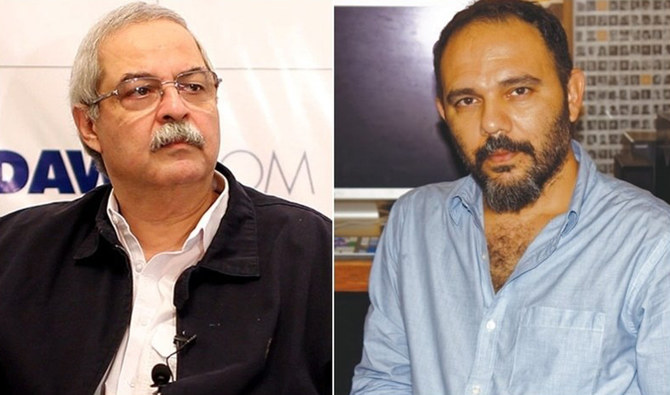
ISLAMABAD: The chief executive of one of Pakistan’s most influential newspapers has denied accusations he raped an acclaimed filmmaker, in a case that has spotlighted sexual abuse targeting men and added momentum to the country’s fledgling #MeToo movement.
Director Jamshed Mahmood Raza took to social media over the weekend to allege that Dawn newspaper’s Hameed Haroon raped him 13 years ago.
In October, Raza first described the assault publicly on Twitter but referred to the alleged perpetrator as a “powerful person in our media world.”
Haroon — who hails from one of Pakistan’s wealthiest and most influential families — issued a fierce denial in Dawn, the country’s most popular English daily, late Monday, calling the accusations “simply untrue and intentionally fabricated.”
“I categorically deny the allegation of rape leveled against me,” said Haroon in a statement.
Raza later slammed Haroon’s comments, saying the statement was “nothing but a slap to all us survivors.”
The allegations have again stirred controversy in the deeply conservative country, where most discussions about sex and abuse are considered taboo.
Some voices have called for accountability, while others dismissed notions of male-on-male sexual assault.
“I have a question: how can a grown man be raped by another individual? Couldn’t they have fought him off,” tweeted writer Salman Rashid.
Others disagreed.
“Rape is not only about physical power; it is about power in general. If a powerful person coerces you to have sex with them, that is rape,” wrote Nida Kirmani on Twitter.
The #MeToo and #Timesup campaigns have gone global since allegations of sexual misconduct by Hollywood producer Harvey Weinstein were made in 2017, sparking an avalanche of accusations against other powerful men.
However, the movement has been slow to catch on in Pakistan, where women have fought for their rights for years in a patriarchal society where so-called “honor” killings and attacks on women remain commonplace.
Cases and allegations involving men assaulting other men have been even more rarely discussed in the country.

Pakistani media mogul rejects rape accusations by filmmaker
https://arab.news/6pbku
Pakistani media mogul rejects rape accusations by filmmaker
- Filmmaker alleges Dawn newspaper’s Hameed Haroon raped him 13 years ago
- Haroon dissed the allegations as “simply untrue and intentionally fabricated“
Pakistan terms climate change, demographic pressures as ‘pressing existential risks’
- Pakistan has suffered frequent climate change-induced disasters, including floods this year that killed over 1,000
- Pakistan finmin highlights stabilization measures at Doha Forum, discusses economic cooperation with Qatar
ISLAMABAD: Pakistan’s Finance Minister Muhammad Aurangzeb on Saturday described climate change and demographic pressures as “pressing existential risks” facing the country, calling for urgent climate financing.
The finance minister was speaking as a member of a high-level panel at the 23rd edition of the Doha Forum, which is being held from Dec. 6–7 in the Qatari capital. Aurangzeb was invited as a speaker on the discussion titled: ‘Global Trade Tensions: Economic Impact and Policy Responses in MENA.’
“He reaffirmed that while Pakistan remained vigilant in the face of geopolitical uncertainty, the more pressing existential risks were climate change and demographic pressures,” the Finance Division said.
Pakistan has suffered repeated climate disasters in recent years, most notably the 2022 super-floods that submerged one-third of the country, displaced millions and caused an estimated $30 billion in losses.
This year’s floods killed over 1,000 people and caused at least $2.9 billion in damages to agriculture and infrastructure. Scientists say Pakistan remains among the world’s most climate-vulnerable nations despite contributing less than 1 percent of global greenhouse-gas emissions.
Aurangzeb has previously said climate change and Pakistan’s fast-rising population are the only two factors that can hinder the South Asian country’s efforts to become a $3 trillion economy in the future.
The finance minister noted that this year’s floods in Pakistan had shaved at least 0.5 percent off GDP growth, calling for urgent climate financing and investment in resilient infrastructure.
When asked about Pakistan’s fiscal resilience and capability to absorb external shocks, Aurangzeb said Islamabad had rebuilt fiscal buffers. He pointed out that both the primary fiscal balance and current account had returned to surplus, supported significantly by strong remittance inflows of $18–20 billion annually from the Middle East and North Africa (MENA) and Gulf Cooperation Council (GCC) regions.
Separately, Aurangzeb met his Qatari counterpart Ali Bin Ahmed Al Kuwari to discuss bilateral cooperation.
“Both sides reaffirmed their commitment to strengthening economic ties, particularly by maximizing opportunities created through the newly concluded GCC–Pakistan Free Trade Agreement, expanding trade flows, and deepening energy cooperation, including long-term LNG collaboration,” the finance ministry said.
The two also discussed collaboration on digital infrastructure, skills development and regulatory reform. They agreed to establish structured mechanisms to continue joint work in trade diversification, technology, climate resilience, and investment facilitation, the finance ministry said.


