US strikes hit Iraqi militia blamed in contractor’s death

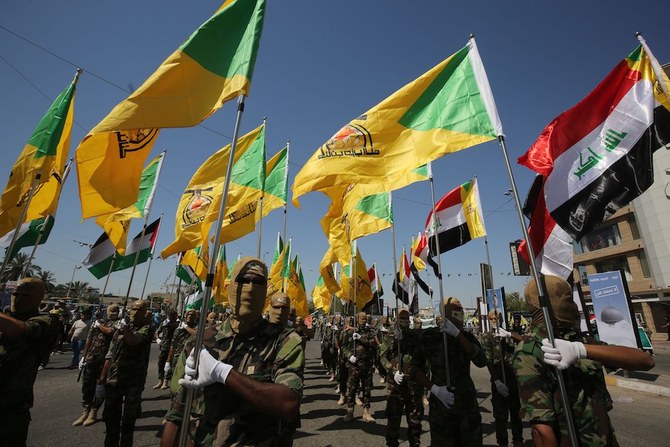
Kataib Hezbollah militants march in Baghdad earlier this year. The US hit five of the group's bases in Iraq and Syria on Sunday. (AFP/File photo)
Short Url
Updated 30 December 2019
Follow

US strikes hit Iraqi militia blamed in contractor’s death

  • The Pentagon said it targeted 3 locations in Iraq and two in Syria
  • A US civilian contractor was killed on Friday and Washington said it was looking into possible Kataib Hezbollah involvement

WASHINGTON: The US carried out military strikes in Iraq and Syria targeting an Iranian-backed Iraqi militia blamed for a rocket attack that killed an American contractor, Defense Secretary Mark Esper said Sunday.
Secretary of State Mike Pompeo said the strikes send the message that the US will not tolerate actions by Iran that jeopardize American lives.
“Precision defensive strikes” were conducted against five sites of Kataeb Hezbollah, or Hezbollah Brigades, Defense Department spokesman Jonathan Hoffman said in a statement earlier Sunday.
The US blames the militia for a rocket barrage Friday that killed a US defense contractor at a military compound near Kirkuk, in northern Iraq. Officials said as many as 30 rockets were fired in Friday’s assault.
Esper said the US hit three of the militia’s sites in western Iraq and two in eastern Syria, including weapon depots and the militia’s command and control bases.
US Air Force F-15 Strike Eagles carried out the strikes and all the aircraft safely returned to their home base, Esper said. At the ammunition storage facilities that were struck, significant secondary explosions were observed.
Pompeo, Esper and Gen. Mark Milley, chairman of the Joint Chiefs of Staff, flew to Palm Beach, Florida, after the operation to brief President Donald Trump.
Esper said they discussed with Trump “other options that are available” to respond to Iran.
“I would note also that we will take additional actions as necessary to ensure that we act in our own self-defense and we deter further bad behavior from militia groups or from Iran,” Esper, who was accompanied by Pompeo and Milley, said in a brief statement to reporters in a ballroom at Trump’s Mar-a-Lago resort, where the president is on a more than two-week winter break.
The national security officials did not answer any questions.
Pompeo said the “decisive response” makes clear that the US ”will not stand for the Islamic Republic of Iran to take actions that put American men and women in jeopardy.”
Trump was at Mar-a-Lago but did not appear with his top national security officials. After Pompeo and Esper spoke, the president traveled to his private golf club in West Palm Beach. The White House did not immediately say why Trump returned to the club after spending nearly six hours there earlier Sunday.

Iraq’s Joint Operations Command said in a statement that three US airstrikes on Sunday evening Iraq time hit the headquarters of the Hezbollah Brigades at the Iraq-Syria border, killing four fighters.
Iraq’s Hezbollah Brigades, a separate force from the Lebanese group Hezbollah, operate under the umbrella of the state-sanctioned militias known collectively as the Popular Mobilization Forces. Many of them are supported by Iran.
The Popular Mobilization Forces said Sunday that the US strikes killed at least 19 of Kataeb Hezbollah’s members.
Kataeb Hezbollah is led by Abu Mahdi Al-Muhandis, one of Iraq’s most powerful men. He once battled US troops and is now the deputy head of the Popular Mobilization Forces.
In 2009, the State Department linked him to the elite Quds Force of Iran’s Revolutionary Guard, designated a foreign terrorist organization by President Donald Trump earlier this year.
The US maintains some 5,000 troops in Iraq. They are there based on an invitation by the Iraqi government to assist and train in the fight against the Daesh group.
The militia strike and US counter-strike come as months of political turmoil roil Iraq. About 500 people have died in anti-government protests in recent months, most of them demonstrators killed by Iraqi security forces.
The mass uprisings prompted the resignation of Prime Minister Adel Abdul-Mahdi late last month. Abdul-Mahdi remains for now in a caretaker capacity.
Abdul-Mahdi had made no public comment on Friday’s militia attack but condemned the US retaliatory strike on Sunday. He called it a violation of Iraqi sovereignty and a “dangerous escalation that threatens the security of Iraq and the region.”
In a statement, Abdul-Mahdi said Defense Secretary Mark Esper had called him about a half-hour before the US strikes to tell him of US intentions to hit bases of the militia suspected of being behind Friday’s rocket attack. Abdul-Mahdi said in the statement he asked Esper to call off US retaliation plans.
The statement said Iraqi President Barham Salih also received advance notice from a US diplomat, and also asked unsuccessfully for Americans to call off it off.


Aidarous Al-Zubaidi: Fugitive at large

Updated 6 sec ago
Follow

Aidarous Al-Zubaidi: Fugitive at large

  • Yemen appoints committee to probe allegations against former STC leader after the group’s collapse and his reported flight from the country
  • Preliminary findings accuse Al-Zubaidi of exploiting public office for personal gain, fueling political division and instability in south

LONDON: A special committee formed on presidential authority by Yemen’s public prosecutor’s office has made a series of findings against Maj. Gen. Aidarous Al-Zubaidi, the sacked vice-president of the country’s Presidential Leadership Council (PLC).
Al-Zubaidi, who is accused of high treason and other crimes against the state, is currently on the run.
Arab News has seen a copy of preliminary findings by the committee which reveal that Al-Zubaidi is accused of abuses of power including corruption, land grabbing and oil trading for personal gain.
On Jan. 7, the PLC issued a decree revoking Al-Zubaidi’s membership of the PLC and accusing him of high treason and other serious crimes, including forming an armed gang, killing military officers and soldiers, and undermining the country’s sovereignty.
At the same time it authorized the public prosecutor’s office to form a special committee to investigate allegations against Al-Zubaidi, empowering it to summon and arrest individuals, gather evidence and take necessary actions according to the law, with a mandate to complete the investigation quickly and to provide periodic reports to the PLC.
The committee’s preliminary findings identify a series of serious allegations against Al-Zubaidi, who is said to be responsible for multiple abuses “which have contributed to creating a state of political and popular division in the southern governorates.”
Al-Zubaidi is the leader of the Southern Transitional Council (STC). On Jan. 7, Al-Zubaidi was due to attend talks in Riyadh with a 50-member delegation from the STC, but at the last minute, he fled instead.
The committee’s findings include allegations that Al-Zubaidi is alleged to have seized large plots of land, including in the Aden Free Zone, on Al-Ummal Island, in Bir Fadl and the Ras Omran area.
The committee has also uncovered allegations that pressure was exerted on the Yemen Petroleum Company and its director, Tareq Al-Walidi, to prevent the import of fuel except through a company affiliated with Al-Zubaidi’s brother-in-law, Jihad Al-Shoudhabi, and the Minister of Transport, Abdul Salam Humaid.
For nearly two years, it is claimed, Al-Shoudhabi has been the sole supplier, earning large profits that have gone to Al-Zubaidi’s treasury.
The report also identifies commercial companies owned by Al-Shoudhabi and, “behind him,” it is claimed, Al-Zubaidi. Two are named in the report: Alahlia Exchange &  Transfers Company and Arabian Furniture Center, one of Yemen’s largest furniture companies. Both are headquartered in Aden.
All these and other “deeply regrettable acts of seizure, plunder, and financial and administrative corruption,” the committee says, “have had serious repercussions in southern circles and were a direct cause of southern division and the emergence of many grievances.”
On Thursday, a spokesman for the Saudi-led coalition in Yemen said there was reliable intelligence indicating that on the night of Jan. 7, Al-Zubaidi had departed from Aden on a ship bound for Somaliland — probably the port of Berbera, 260 kilometers south across the Gulf of Aden.
From there he is believed to have been flown on a cargo aircraft to Abu Dhabi, capital of the UAE, via Mogadishu, the coastal capital of Somalia, a flight of about 2,600 km.
Some of the crimes of which Al-Zubaidi is accused relate to the largescale military offensive launched by STC forces across southern Yemen in December.
“We know that the Southern Transitional Council worked to storm the eastern cities militarily,” a source close to the Yemeni government told Arab News.
“The pattern and scale of grave human-rights violations and acts of security and military escalation witnessed by the eastern cities in the south of the homeland — Hadhramout, Al-Mahra and Shabwah — as a result of the military incursion by the forces of the Transitional Council during the monitoring period extending from Dec. 3, are considered heinous crimes against the Yemeni people.”
According to the Yemeni Ministry of Legal Affairs and Human Rights, a total of 2,358 individual offences have been identified, including cases of extrajudicial killing and physical injuries, arbitrary arrests and captivity, enforced disappearance and displacement, and the destruction and looting of public and private property.
Backed by Saudi airstrikes, in the first week of January, the Yemeni government quickly regained the captured territories, Al-Zubaidi was sacked from the PLC and charged with treason, and the UAE announced it would withdraw its remaining troops from the country.
Following Al-Zubaidi’s disappearance on the eve of the planned talks in Riyadh, Saudi Arabia has accused the UAE of helping to smuggle the wanted man out of the country.
The same source told Arab News there is evidence that Al-Zubaidi “was receiving YER 10 billion ($42 million) monthly … deducted from the aid that Yemen was receiving.
“While Al-Zubaidi was receiving those funds, Yemeni citizens had not been receiving their lawful salaries for years, including the diplomatic corps.”
Last Thursday, Mohammed Al-Jaber, the Saudi ambassador to Yemen, announced that the Kingdom would assume responsibility for the salaries of Yemeni state employees, including military personnel, giving $90 million to cover salaries for two months.
On Friday evening, Al-Zubaidi, his whereabouts still unconfirmed, made his first public statement since his disappearance 10 days ago.
“We will no longer accept any solutions that diminish our rights or impose an unacceptable reality upon us,” he wrote in a social media post that left no doubt about his determination to undermine the internationally recognized government of Yemen.
He added: “I pledge to you ... that we will continue together until we achieve the desired national goal.
“With your determination, we will prevail. With your unity, the South will be protected, and with your will, the future state will be established.”