

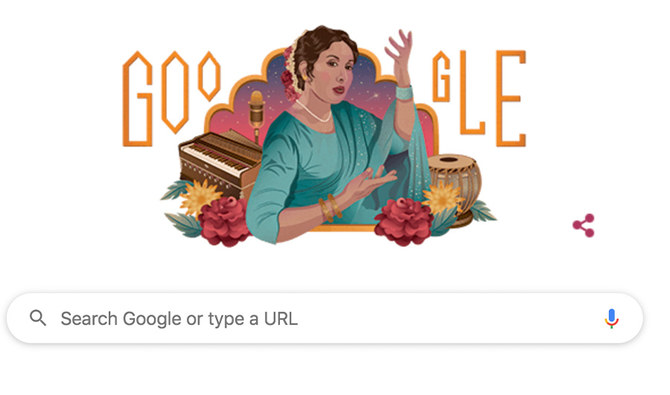
Google honors Pakistani ghazal singer Iqbal Bano

Iqbal Bano is December 28, 2019's Google Doodle. Google honors the late ghazal singer on what would have been her 81st birthday. (Courtesy of Google)
Short Url
Updated 28 December 2019
Follow

Google honors Pakistani ghazal singer Iqbal Bano

  • Bano received the Pride of Performance award in 1974
  • She would have turned 81 today

ISLAMABAD: Google doodle has once again honored a Pakistani great, this time by illustrating the country’s famous ghazal singer, Iqbal Bano, on what would have been her 81st birthday.

Bano was born in New Delhi, India, in 1935. She spent her formative years in the neighboring country and started training in classical music under Ustad Sabri Khan of the Delhi Gharana. In 1952, at the age of 17, she married and moved to Pakistan where her singing career flourished.

She was known for her classical Urdu ghazals, thumri, ballads as well as easy-listening tunes which found their way into popular consumption through film soundtracks and the radio.

Bano was also known for her activism, most legendarily for her defiant and radical bucking of the rules when in 1986 she performed Faiz Ahmed Faiz’s poetry and work which was banned at the time before a crowd in Lahore. Recordings of Bano’s bold move found their ways to all corners of South Asia. One of those songs, “Hum Dekhenge,” has long been a song and recitation of resistance in South Asia, both in Pakistan and India.

That same poem has recently been sung and performed by students and protesters in neighboring India where people have been rallying against the Citizenship Amendment Act (CAA) which its critics describe as an anti-Muslim piece of legislation. In fact, a faculty member of the Indian Institute of Technology in Kanpur filed a complaint against his students for performing the song during a protest, claiming that it was pro-communist and anti-Indian.

Bano’s first public performance in Pakistan took place in 1957 at the Lahore Arts Council prior to which she worked with Radio Pakistan where she sang ghazals live on air. Her music found its way to Afghanistan and Iran since she also performed Persian poetry.

Bano received Pakistan’s Pride of Performance award in 1974 for her contributions to classical music. She passed away after battling a short illness on April 21, 2009 at age 74.

Google Doodle has honored a number of Pakistani greats in the past, including Abdul Sattar Edhi, Nusrat Fateh Ali Khan and Noor Jehan.


Pakistan, Malaysia discuss halal food, energy and tourism to boost cooperation

Updated 47 min 44 sec ago
Follow

Pakistan, Malaysia discuss halal food, energy and tourism to boost cooperation

  • Bilateral trade between both countries stands at about $1.4 billion a year
  • In Oct., both countries announced a new $200 million halal meat trade quota

ISLAMABAD: Pakistan and Malaysian officials have held talks on halal food, green energy and tourism sectors as part of renewed efforts to expand ties between the two Muslim-majority nations, the Pakistani High Commission in Malaysia on Monday.

The discussions took place during a meeting between Pakistan’s High Commissioner to Malaysia, Syed Ahsan Raza Shah and Tun Pehin Sri Dr. Wan Junaidi Tuanku Jaafar, governor of Malaysia’s Sarawak state.

Bilateral trade between the two countries stands at about $1.4 billion a year, according to official data from both governments. In Oct., both countries announced a new $200 million halal meat trade quota.

“Constructive talks on Pakistan-Malaysia ties in halal [food], palm oil, green energy, rice, labor, tourism, culture & sustainable development,” the Pakistani High Commission in Malaysia said on X.

Malaysia’s exports to Pakistan are led by palm oil and other vegetable fats, followed by machinery, rubber products and organic chemicals. Pakistan’s main exports to Malaysia include rice, textiles, seafood and minerals.

The two countries have also traded under the Malaysia-Pakistan Closer Economic Partnership Agreement since 2008, which provides preferential market access for goods and services.

Pakistan has been rapidly growing its green energy, halal food, and tourism sectors. Its halal food industry is attracting global buyers with Shariah-compliant products, while tourism is leveraging the country’s natural beauty, heritage sites and cultural attractions to draw international visitors.