

Al-Koot Hotel: Saudi establishment transports guests to the Eastern Province’s cultural past

1 / 3
(AN photo by Huda Bashatah)
2 / 3
(AN photo by Huda Bashatah)
3 / 3
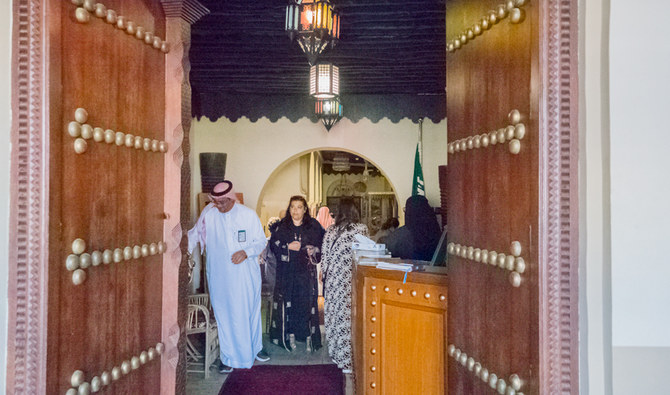
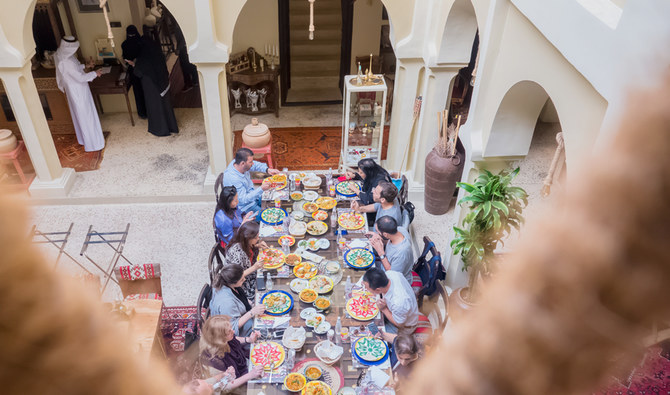
Being the first heritage hotel in the Middle East, its significant location and design have won the approval by many guests. (AN photo by Huda Bashatah)
Short Url
Updated 28 December 2019
Follow

Al-Koot Hotel: Saudi establishment transports guests to the Eastern Province’s cultural past

  • The area houses Al-Ahsa Oasis, with 2.5 million palm trees that date back to the fifth century — considered to be the largest palm oasis in the world

JEDDAH: Al-Koot Heritage Hotel takes visitors on a walk through the history of the Eastern Province, where houses are made of mud walls and wooden ceilings, with handmade sadu pattern woven rugs strewn about the floors.
With a picturesque landscape, Al-Koot’s interior is decked in a heavy traditional feel that is nothing short of elegant sophistication. From its use of materials mimicking the region’s old houses with antique furniture and wall decorations, the boutique hotel captures the secluded mystique of the Eastern Province.
Known for its ancient history, heritage and arts, the area houses Al-Ahsa Oasis, with 2.5 million palm trees that date back to the fifth century — considered to be the largest palm oasis in the world, and a UNESCO World Heritage Site. Al-Ahsa was chosen as the Middle East Capital of Tourism this year by the Arab Tourism Organization.
Omar Abdul Aziz Al-Asfour, general manager of the hotel, told Arab News that he seeks to promote Al-Ahsa and its heritage.
“It (the hotel) is an architectural masterpiece within walking distance of Ibrahim Historical Palace, which dates back to 1571, and adjacent to Al-Fateh Heritage Mosque. It is 500 meters from Al-Qasariyah Market, where one can find traditional handicrafts and products. Another famous market is Al-Fawaris,” he said.

BACKGROUND

The hotel was opened by EP Gov. Prince Saud bin Naif in the presence of Prince Sultan bin Salman, the then president of the SCTH.

Owned by Sheikh Abdul Aziz Al-Abdulqadir, it is the first heritage hotel in the Middle East. The hotel’s significant location and design have won the  approval by many guests, and it was opened by Eastern Province Gov. Prince Saud bin Naif in the presence of Prince Sultan bin Salman, the then president of the Saudi Commission for Tourism and National Heritage (SCTH). A number of ambassadors, businessmen and women also attended the ceremony.
The hotel’s design gives a homey feel to it for visitors and guests. Surrounded by the oasis, visitors are able to disconnect and unwind while enjoying local markets nearby and tourist attractions. It has seven wood-ceilinged rooms, corridors with balconies and a lobby with a glass ceiling to allow in light.


Experimental farm in Al-Lith looks into future of Saudi Arabian agriculture

Updated 5 sec ago
Follow

Experimental farm in Al-Lith looks into future of Saudi Arabian agriculture

  • Research initiative reflects strategic transformation

JEDDAH: An experimental farm in Saudi Arabia’s Al-Lith Governorate is one of the research initiatives reflecting the strategic transformation taking place in the Kingdom’s agricultural sector.

The farm uses highly efficient, sustainable production models that combine scientific research with commercial application, contributing to strengthening the country’s food security system and the sustainability of water resources.

Located in the Ghumaiqa Center on an area of about 10 hectares, the cutting-edge farm is a testing platform for modern agricultural technologies that tackle the challenge of water scarcity.

The farm includes developed open fields and modern greenhouses, supported by smart irrigation encompassing drip and sprinkler irrigation alongside surface and subsurface technologies.

All the systems operate via smart controls that enable the monitoring of water consumption and ensure improved efficiency, thereby achieving a balance between agricultural production and water conservation.

The farm also uses treated and diluted low-salinity seawater.

It aims to diversify agricultural water sources, reduce reliance on freshwater, and open new horizons for agriculture in coastal and semi-arid environments.

The project represents a promising investment opportunity in the field of smart agriculture, enabling the development of commercially scalable production models, particularly for high-value vegetables and fruits, while reducing operational costs associated with water and energy, enhancing the economic feasibility of future agricultural projects.

In addition, the project contributes to transferring and localizing agricultural expertise, supporting local food supply chains, and creating an attractive environment for agricultural investment.

This aligns with Sustainable Development Goals and enhances the efficiency of the private sector in adopting innovative agricultural solutions.

Yahya bin Abdulrahman Al-Mahabi, the director of the Ministry of Environment, Water and Agriculture office in Al-Lith Governorate, told the Saudi Press Agency that the project represented the future of agriculture in the Kingdom.

He explained that the vision was based on investing in technology, enhancing the return on water per unit, and integrating scientific research with investment opportunities.

Al-Mahabi spoke of the experimental farm as a modern, scalable and replicable model applicable in several regions of the Kingdom, particularly in coastal environments.

Al-Mahabi highlighted the Ministry of Environment, Water and Agriculture’s commitment to supporting distinctive projects that contributed to achieving food security while developing rural areas and enhancing agricultural production efficiency, in line with the objectives of the Kingdom’s Vision 2030.