Queen Elizabeth admits ‘bumpy’ year in Christmas message

During her traditional Christmas address, Queen Elizabeth II intends to call on the British to overcome their divisions after a year “full of pitfalls.” (AFP)
Short Url
Updated 24 December 2019
Follow

Queen Elizabeth admits ‘bumpy’ year in Christmas message

  • The royal family was swept up in scandals that included a calamitous BBC interview with the queen’s second son Andrew
  • Royal commentators noted the queen’s use of the word “bumpy,” compared to her headline-grabbing description of 1992 as an “annus horribilis”

LONDON: Queen Elizabeth II described 2019 as “quite bumpy” in a Christmas Day message at the end of a chaotic year which saw Britain bitterly divided over its split from the European Union and her scandal-plagued son Prince Andrew withdraw from public life.
The 93-year-old monarch’s address — to be televised in full Wednesday but partially released in advance — came as her husband Philip was in hospital with an undisclosed illness.
The royal family was swept up in scandals that included a calamitous BBC interview in which the queen’s second son Andrew tried to distance himself from American paedophile Jeffrey Epstein.
Andrew promised to “step back from public duties” after his denial of having sex with one of Epstein’s alleged victims was ridiculed in the UK media and reportedly criticized in Buckingham Palace.
The queen pointed to the life of Jesus as an example of how reconciliation can be achieved and “how small steps taken in faith and in hope can overcome long-held differences and deep-seated divisions.”
The remarks were interpreted by many as a reference to the Brexit debate that has torn Britain apart since it voted to leave the EU in a referendum in 2016.
“The path, of course, is not always smooth, and may at times this year have felt quite bumpy, but small steps can make a world of difference.”
Royal commentators noted the queen’s use of the word “bumpy,” compared to her headline-grabbing description of 1992 as an “annus horribilis,” when the marriages of three of her children fell apart and her beloved Windsor Castle nearly went up in flames.
The queen found herself dragged into the tortuous political drama of Brexit when she approved Prime Minister Boris Johnson’s request to suspend parliament in August. Critics claimed it was an attempt to silence opponents to his Brexit proposals.
In fact, the Supreme Court subsequently ruled that Johnson’s request had been unlawful and many people blamed him for making the queen look bad.
The queen was also rumored to have been disappointed by her grandson Prince Harry and his American former actress wife Meghan Markle.
The young couple made waves by speaking out about their struggle with living in the public eye and then suing three British newspapers for prying into their private lives.
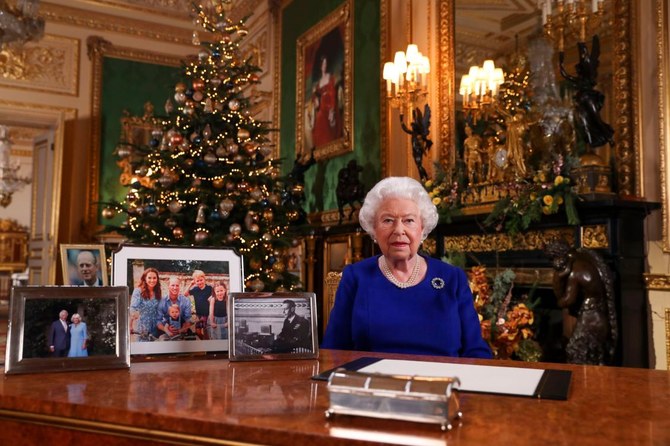
Their picture was notably absent from the collection of family photographs on the queen’s desk in her televised address.
It was a difficult year for Philip, too, beginning with a car accident in which two women were injured. The police found the 98-year-old responsible but brought no charges.
Buckingham Palace has released little information about Philip’s condition since his hospitalization on Friday for “treatment in relation to a pre-existing condition.”
“He’s alright,” Philip’s son Charles told a reporter during a visit in northern England on Monday.
“Once you get to that age things don’t work as well.”
The queen has remained one of Britain’s most popular figures despite the royal family’s travails.
A poll by YouGov in November showed 72 percent of respondents had a positive opinion of the monarch.
The queen’s Christmas Day message also reflected on the heroism of British forces during the D-Day landings in Normandy that turned the course of World War II in 1944.
Her trips abroad are becoming increasingly rare, but she made one in June to attend the 75th anniversary commemorations in France.
“For the 75th anniversary of that decisive battle, in a true spirit of reconciliation, those who had formerly been sworn enemies came together in friendly commemorations either side of the Channel, putting past differences behind them,” the queen said in her message.
“By being willing to put past differences behind us and move forward together, we honor the freedom and democracy once won for us at so great a cost.”


Two high-speed trains derail in Spain, police sources say 21 people killed

Updated 19 January 2026
Follow

Two high-speed trains derail in Spain, police sources say 21 people killed

  • The accident happened near Adamuz, in Cordoba province. So far, 21 people ​have been confirmed dead by police

MADRID: A high-speed train derailed and smashed into another oncoming train in southern Spain on Sunday, pushing the second train off the tracks in a collision that police sources confirmed to Reuters had killed at least 21 people.
The accident happened near Adamuz, in Cordoba province. So far, 21 people ​have been confirmed dead by police, with state broadcaster Television Espanola adding that 100 people had been injured, 25 seriously. The driver of one of the trains, which was traveling from Madrid to Huelva, was among those who died, the TV station added.
“The Iryo 6189 Malaga — (to Madrid) train has derailed from the track at Adamuz, crashing onto the adjacent track. The (Madrid) to Huelva train which was traveling on the adjacent track has also derailed,” said Adif, which runs the rail network, in a social media post.
Adif said the accident happened at 6:40 p.m. (1740 GMT), about 10 minutes after the Iryo train left Cordoba heading toward Madrid.
Iryo is a private rail operator, majority-owned by Italian state-controlled railway group Ferrovie dello Stato. The train involved was a Freccia 1000 train which was traveling between ‌Malaga and Madrid, ‌a spokesperson for Ferrovie dello Stato said.
The company said in a statement that it ‌deeply ⁠regretted what ​had happened ‌and had activated all emergency protocols to work closely with the relevant authorities to manage the situation.
The second train was operated by Renfe, which also did not respond to a request for comment.
Adif has suspended all rail services between Madrid and Andalusia.

HORRIFIC SCENE
The Iryo train had more than 300 passengers on board, while the Renfe train had around 100.
Paco Carmona, Cordoba fire chief, told TVE the first train heading to Madrid from Malaga had been evacuated.
The other train’s carriages were badly damaged, he said, with twisted metal and seats. “There are still people trapped. We don’t know how many people have died and the operation is concentrating on getting people out of areas which are very narrow,” he ⁠said. “We have to remove the bodies to reach anyone who is still alive. It is proving to be a complicated task.”
Transport Minister Oscar Puente said he was following events ‌from rail operator Adif’s headquarters in Madrid.
“The latest information is very serious,” ‍he posted on X. “The impact was terrible, causing the first two ‍carriages of the Renfe train to be thrown off the track. The number of victims cannot be confirmed at this time. ‍The most important thing now is to help the victims.”
The mayor of Adamuz, Rafael Moreno, told El Pais newspaper that he had been among the first to arrive at the scene of the accident alongside the local police and saw what he believed to be a badly lacerated body several meters from the accident site.
“The scene is horrific,” he said. “I don’t think they were on the same track, but it’s not clear. Now ​the mayors and residents of the area are focused on helping the passengers.”

CALLS FOR MEDICS
Images on local television showed a reception center set up for passengers in the town of Adamuz, population 5,000, with locals coming ⁠and going with food and blankets amid nighttime temperatures of around 42 degrees Fahrenheit (6 degrees Celsius).
A woman named Carmen posted on X that she had been on board the Iryo train to Madrid. “Ten minutes after departing (from Cordoba) the train started to shake a lot, and it derailed from coach 6 behind us. The lights went out.”
Footage posted by another Iryo train passenger, also on X, showed an Iryo staffer in a fluorescent jacket instructing passengers to remain in their seats in the darkened carriages, and those with first aid training to keep watch over fellow passengers. He also urged people to maintain mobile phone batteries to be able to use their torches when they disembarked.
Salvador Jimenez, a journalist for RTVE who was on board the Iryo train, shared images showing the nose of the rear carriage of the train lying on its side, with evacuated passengers sitting on the side of the carriage facing upwards.
Jimenez told TVE by phone from beside the stricken trains that passengers had used emergency hammers to smash the windows and climb out, and they had seen two people taken ‌out of the overturned carriages on stretchers.
“There’s a certain uncertainty about when we’ll get to Madrid, where we’ll spend the night, we’ve had no message from the train company yet,” he said. “It’s very cold but here we are.”