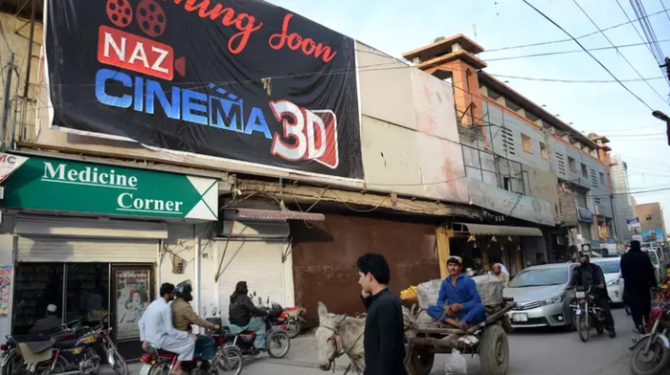
PESHAWAR: Peshawar’s historic Naz Cinema, a landmark in the northwestern Pakistani city, will be getting an upgrade in January next year and be converted into the province’s first 3D cineplex, the cinema’s owner said on Saturday.
The then ‘White Rose Cinema’ was established in 1942 by a Sikh entrepreneur. After the creation of Pakistan in 1947, it was bought by a grandfather of its current owner, Jawad Raza Khan. Since then, the theater, with its name changed to ‘Naz Cinema’ has been owned by Khan’s family.
Only a handful of cinemas have survived in the province, after a wave of militancy that lasted more than a decade. A series of back-to-back bombings in February 2014 targeted two cinemas in Peshawar, killing 20 people and wounding over 50 others.
But Khan said he believed the show must go on. Over the years, he refused to shut his cinema down despite insecurity and a sharp decline in cinema-goers. Now, the movie aficionado is giving Naz the ultimate face-lift.
“For years, the idea of converting my cinema into 3D was under consideration. I myself... travel to Islamabad to watch movies in 3D there because Peshawar has no such facility. But it is time-consuming and expensive to travel all the way and return after watching a three-hour-long film,” Khan told Arab News.
A decade ago, he recalled, Peshawar had almost 27 movie theaters. Presently only seven were still open for business in the city of two million people.
But in an effort to revive the flailing movie industry in the city, Khan’s new 3D theater will have seating capacity for 450 people, with 170 seats reserved just for families.
Cinema manager Muhammad Naeem said renovation and repair work had been expedited to launch the facility after an overwhelming response and heightened anticipation from Peshawar’s movie fans.
“This will be a combination of the latest high-tech luxury, an opera theater with digital sound system and 3D screens,” Naeem told Arab News with a hint of pride.
“There will be separate seating boxes for families to enjoy the movies in a tension-free environment,” he said.
In socially conservative Peshawar, segregation in public places like restaurants is common, with a majority of local women observing traditional ‘purdah.’
Noorshad Wazir, a student at the University of Peshawar and a cinema fan, welcomed the idea that people in KP would be able to enjoy a night at the movies without having to travel hours to the capital.
“These days, university students and families hesitate to go to regular cinemas in Peshawar where you don’t have comfortable seating or good food. But the 3D cinema will attract families and bachelors,” he said.
Daily life, office responsibilities and weekend holidays had no real charm, he added, if there was no option of watching a film on the big screen at the end of the day.


Peshawar’s historic Naz Cinema to get a 3D facelift in new year
https://arab.news/8bhpx
Peshawar’s historic Naz Cinema to get a 3D facelift in new year

- When over a decade of militancy swept KP province, Naz was one of the few cinemas that didn’t shut down
- Presently, movie lovers in Peshawar have to travel three hours to Islamabad to watch their favorite films

Pakistan, US discuss investment in energy, minerals and counter-terrorism fields
- PM Shehbaz Sharif met US State Secretary Marco Rubio, International Development Finance Corporation CEO Benjamin Black
- The prime minister invites US officials to visit Pakistan at the earliest to explore mutually beneficial investment opportunities
ISLAMABAD: Prime Minister Shehbaz Sharif has discussed investment in Pakistan’s energy, minerals, counterterrorism and other sectors with top United States (US) officials, Sharif’s office said.
The meetings took place on the sidelines of the inaugural meeting of the Gaza Board of Peace in Washington that is intended to oversee international stabilization and rebuilding efforts in Gaza after months of war.
Sharif, accompanied by his deputy Ishaq Dar, met US Secretary of State Marco Rubio, who appreciated Pakistan’s ongoing support of Trump’s peace plan for Gaza and for joining the Board of Peace.
“In our meeting, we discussed the importance of our strategic relationship on critical minerals development and counterterrorism,” Rubio said on X after the meeting.
Pakistan has sought to re-energize economic diplomacy with Washington as it attempts to enhance its exports, attract foreign investment and stabilize its economy under an International Monetary Fund-backed reform program.
In July 2025, the two countries agreed to a bilateral trade deal that included reciprocal tariff reductions, while the two sides have increased diplomatic contacts alongside engagements on trade, minerals, security cooperation and regional stability in recent months.
Sharif, who this week traveled to the US on Trump’s invitation, later met US International Development Finance Corporation (DFC) CEO Benjamin Black, who was accompanied by DFC’s Head of Investments Conor Coleman and other senior officials, according to his office.
The prime minister invited Black to visit Pakistan at his earliest convenience to explore mutually beneficial investment opportunities in various sectors of shared interest.
“The Prime Minister appreciated the expanding economic partnership between Pakistan and the United States and recognized DFC’s crucial role in catalyzing joint ventures between private enterprises of the two countries, essential to job creation and productivity enhancement,” Sharif’s office said.
“Highlighting Pakistan’s fast improving macroeconomic fundamentals, Government’s commitment to deepening structural reforms, and attractive investment climate, the Prime Minister invited DFC to enhance its financing for projects in the energy, mines and minerals, agriculture and IT sectors.”
Sharif also invited DFC to participate in the upcoming minerals conference in Islamabad in April.
In Oct., Pakistan dispatched its first ever shipment of rare earth and critical minerals to the United States, a Chicago-based public relations (PR) firm said, following a landmark $500 million deal between the two countries.
The agreement, signed between American firm US Strategic Metals (USSM) and Pakistan’s Frontier Works Organization (FWO), aimed to create a framework for joint development of the entire mineral value chain, including exploration, beneficiation, concentrate production and eventual establishment of refineries in Pakistan.


