

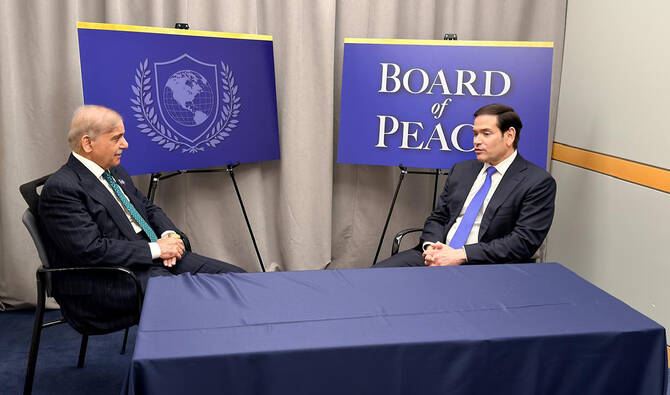

ISLAMABAD: Prime Minister Shehbaz Sharif and United States (US) officials have discussed investment in Pakistan’s energy, minerals and other sectors as well as counterterrorism cooperation between Islamabad and Washington, they said on Friday.
The meetings took place on the sidelines of the inaugural meeting of the Gaza Board of Peace in Washington that is intended to oversee international stabilization and rebuilding efforts in Gaza after months of war.
Sharif, accompanied by his deputy Ishaq Dar, met US Secretary of State Marco Rubio, who appreciated Pakistan’s ongoing support of Trump’s peace plan for Gaza and for joining the Board of Peace.
“In our meeting, we discussed the importance of our strategic relationship on critical minerals development and counterterrorism,” Rubio said on X after the meeting.
Pakistan has sought to re-energize economic diplomacy with Washington as it attempts to enhance its exports, attract foreign investment and stabilize its economy under an International Monetary Fund-backed reform program.
In July 2025, the two countries agreed to a bilateral trade deal that included reciprocal tariff reductions, while the two sides have increased diplomatic contacts alongside engagements on trade, minerals, security cooperation and regional stability in recent months.
Sharif, who this week traveled to the US on Trump’s invitation, later met US International Development Finance Corporation (DFC) CEO Benjamin Black, who was accompanied by DFC’s Head of Investments Conor Coleman and other senior officials, according to his office.
The prime minister invited Black to visit Pakistan at his earliest convenience to explore mutually beneficial investment opportunities in various sectors of shared interest.
“The Prime Minister appreciated the expanding economic partnership between Pakistan and the United States and recognized DFC’s crucial role in catalyzing joint ventures between private enterprises of the two countries, essential to job creation and productivity enhancement,” Sharif’s office said.
“Highlighting Pakistan’s fast improving macroeconomic fundamentals, Government’s commitment to deepening structural reforms, and attractive investment climate, the Prime Minister invited DFC to enhance its financing for projects in the energy, mines and minerals, agriculture and IT sectors.”
Sharif also invited DFC to participate in the upcoming minerals conference in Islamabad in April.
In Oct., Pakistan dispatched its first ever shipment of rare earth and critical minerals to the United States, a Chicago-based public relations (PR) firm said, following a landmark $500 million deal between the two countries.
The agreement, signed between American firm US Strategic Metals (USSM) and Pakistan’s Frontier Works Organization (FWO), aimed to create a framework for joint development of the entire mineral value chain, including exploration, beneficiation, concentrate production and eventual establishment of refineries in Pakistan.


