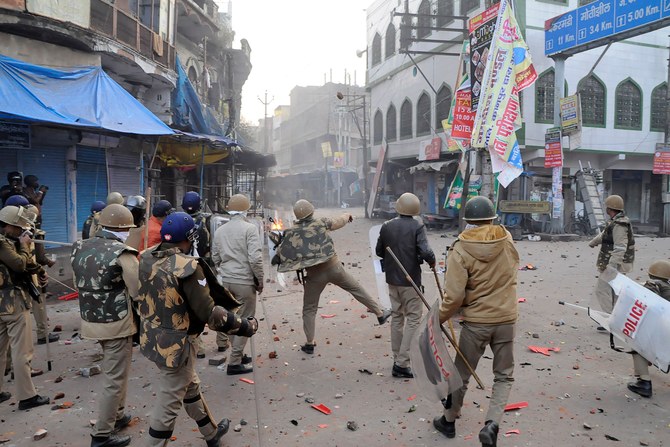
NEW DELHI: Violent protests against India’s citizenship law that excludes Muslim immigrants swept the country over the weekend despite the government’s ban on public assembly and suspension of Internet services in many parts, raising the nationwide death toll to 23, police said.
Nine people died in clashes with police in Uttar Pradesh on Saturday, said state police spokesman Pravin Kumar. He said most of the victims were young people but denied police were responsible.
“Some of them died of bullet injuries, but these injuries are not because of police fire. The police have used only tear gas to scare away the agitating mob,” he said.
Around a dozen vehicles were set on fire as protesters rampaged through the northern cities of Rampur, Sambhal, Muzaffarnagar, Bijnore, and Kanpur, where a police station was also torched, Singh said.
The backlash against the law marks the strongest show of dissent against the Hindu nationalist government of Prime Minister Narendra Modi since he was first elected in 2014.
The law allows Hindus, Christians and other religious minorities who are in India illegally to become citizens if they can show they were persecuted because of their religion in Muslim-majority Bangladesh, Pakistan, and Afghanistan. It does not apply to Muslims.
Critics have slammed the legislation as a violation of India’s secular constitution and have called it the latest effort by the Modi government to marginalize the country’s 200 million Muslims. Modi has defended the law as a humanitarian gesture.
Uttar Pradesh state is controlled by Modi’s ruling Bharatiya Janata Party.
An anti-terror squad was deployed and Internet services were suspended for another 48 hours in the state.
Six people were killed during clashes in Uttar Pradesh on Friday, and police said Saturday that over 600 had been taken into custody since then as part of “preventive action.” In addition, five people have been arrested and 13 cases filed for posting “objectionable” material on social media.
Police have imposed a British colonial-era law banning the assembly of more than four people statewide. The law was also imposed elsewhere in India to thwart an expanding protest movement demanding the revocation of the citizenship law.
India’s Ministry of Information and Broadcasting issued an advisory Friday night asking broadcasters across the country to refrain from using content that could inflame further violence. The ministry asked for “strict compliance.”
In the northeastern border state of Assam, where Internet services were restored after a 10-day blockade, hundreds of women staged a sit-in against the law in Gauhati, the state capital.
“Our peaceful protests will continue till this illegal and unconstitutional citizenship law amendment is scrapped,” said Samujjal Bhattacharya, the leader of the All Assam Students Union, which organized the rally.
He rejected an offer for dialogue by Assam Chief Minister Sarbananda Sonowal, saying talks could take place when the “government was hoping to strike some compromise.”
In New Delhi, police charged more than a dozen people with rioting in connection with violence during a protest Friday night in the capital’s Daryaganj area.
Two US Democratic presidential candidates, Sen. Elizabeth Warren and Sen. Bernie Sanders, denounced the new law on Twitter, and Malaysian Prime Minister Mahathir Mohamad criticized it at a news conference following the conclusion of an Islamic summit in Kuala Lumpur.
Mahathir said that India is a secular state and people’s religion should not prevent them from obtaining citizenship.
“To exclude Muslims from becoming citizens, even by due process, I think is unfair,” he said.
India’s foreign ministry summoned the Malaysian charge d’affaires to lodge a complaint against Mahathir’s remarks. Government ministers have said Muslims of foreign origin will not be prohibited from pursuing citizenship, but will have to go through the normal process like other foreigners.
Protests against the law come amid an ongoing crackdown in Muslim-majority Kashmir, the restive Himalayan region stripped of its semi-autonomous status and demoted from a state into a federal territory in August.
The demonstrations also follow a contentious process in Assam meant to weed out foreigners living in the country illegally. Nearly 2 million people were excluded from an official list of citizens, about half Hindu and half Muslim, and have been asked to prove their citizenship or else be considered foreign.
India is building a detention center for some of the tens of thousands of people who the courts are expected to ultimately determine have entered illegally. Modi’s interior minister, Amit Shah, has pledged to roll out the process nationwide.


![]()

23 dead as protests grow against India citizenship law
Short Url
https://arab.news/gw4az
23 dead as protests grow against India citizenship law
- Critics say the legislation is a violation of the country’s secular constitution and will marginalize Muslims
- The backlash marks the strongest show of dissent against India’s Hindu nationalist government so far
Latest updates


© 2026 SAUDI RESEARCH & PUBLISHING COMPANY, All Rights Reserved And subject to Terms of Use Agreement.