

India citizenship law protests rage on as death toll rises to 23

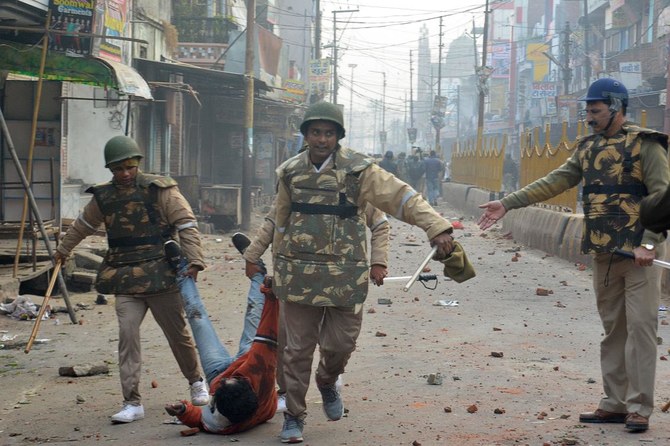
Dozens have been injured in violent clashes between police and protesters, many in sensitive parts of Uttar Pradesh, above. (AFP)
Short Url
Updated 21 December 2019
Follow

India citizenship law protests rage on as death toll rises to 23

  • Police have clashed with thousands of protesters who took to the streets in several parts of the country to oppose the new law
  • Ongoing backlash against the law marks the strongest show of dissent against the Hindu nationalist government

NEW DELHI: Thousands of people joined fresh rallies against a contentious citizenship law in India on Saturday, with 21 killed so far in this month’s unrest.
The death toll jumped after demonstrations turned violent on Friday in the most populous state Uttar Pradesh, leaving at least 11 dead including an eight-year-old boy, who was trampled.
Another protester died Saturday after clashes in Rampur, also in Uttar Pradesh, as police used tear gas and batons against a stone-pelting crowd, police told AFP.
Disquiet has been growing about the law, which was passed by parliament on December 11 and gives people from persecuted minorities from three neighboring countries an easier path to citizenship — but not if they are Muslim.

The rebirth of AlUla
Hegra, ancient city of the Nabataeans in Saudi Arabia’s historic AlUla Valley, is emerging from the mists of time to take its rightful place as one of the wonders of the world

Enter


keywords

Critics say the law discriminates against Muslims and is part of Prime Minister Narendra Modi’s Hindu-nationalist agenda, a claim his political party has denied.
Authorities have scrambled to contain the situation — imposing emergency laws, blocking Internet access, and shutting down shops in sensitive areas across the country.
Demonstrators have vowed to keep up their fight until the law is revoked.
Protests were held Saturday in numerous states, including in the cities of Chennai, Gurgaon and Guwahati.
As day broke in the capital New Delhi, demonstrators held up their mobile phones as torches at India’s biggest mosque Jama Masjid in a show of dissent.
In Patna in the eastern state of Bihar, three demonstrators suffered bullet wounds and six were hurt from stone-pelting after clashing with counter-protesters, police said.

At an all-women protest in Assam state’s Guwahati city in the northeast — where the wave of protests started amid fears the immigrants would dilute their local cultures — participants said it was time to speak up.
“We came out to fight for our motherland, we came to fight without any arms and ammunition, we will fight peacefully,” Lily Dutta told AFP.
Since being re-elected this year Modi and his Bharatiya Janata Party have stripped Muslim-majority Kashmir of its autonomy and carried out a register of citizens in Assam.
The BJP has said it wants to conduct the National Register of Citizens (NRC) nationwide, fueling fears Muslims — a 200-million minority in India — were being disenfranchised.
BJP’s general secretary Bhupender Yadav told reporters Saturday the party would “launch an awareness campaign” and hold 1,000 rallies to dispel “lies” about the law.
In northern Uttar Pradesh, Muslims make up almost 20 percent of the 200-million population. The state’s police spokesman Shirish Chandra told AFP 10 people died Friday after being shot.
The boy also died Friday in a “stampede-like situation” when 2,500 people including children joined a rally in the holy city of Varanasi, district police chief Prabhakar Chaudhary told AFP.
The unrest had already seen one death in Uttar Pradesh, two in the southwestern state of Karnataka and six in Assam.
On Saturday police erected barricades along Delhi’s Jantar Mantar, an avenue that in recent years has been a hotspot for protests.
It came after street battles broke out on Friday evening in Delhi with police firing a water cannon and baton-charging protesters, who chanted anti-Modi slogans and threw stones.
An AFP reporter at the scene saw protesters, including children, being detained and beaten by police.
Forty people were taken into custody, including at least eight under 18 years old, police told AFP Saturday, adding that most of them were released.
Sixteen others were arrested over charges of violence, the police spokesman added.
Delhi’s chief metropolitan magistrate late Friday had ordered the release of everyone under 18 who was detained.
The leader of a prominent organization in the Dalit community — the lowest group in the Hindu caste system — who joined the Delhi demonstrators was arrested Saturday, police added.
On Saturday, distraught families and lawyers waited outside a police station in Old Delhi where nearly dozen people were being held.


Rubio says technical talks with Denmark, Greenland officials over Arctic security have begun

Updated 29 January 2026
Follow

Rubio says technical talks with Denmark, Greenland officials over Arctic security have begun

  • US Secretary of State on Wednesday appeared eager to downplay Trump’s rift with Europe over Greenland

WASHINGTON: Technical talks between the US, Denmark and Greenland over hatching an Arctic security deal are now underway, Secretary of State Marco Rubio said on Wednesday.
The foreign ministers of Denmark and Greenland agreed to create a working group aimed at addressing differences with the US during a Washington meeting earlier this month with Vice President JD Vance and Rubio.
The group was created after President Donald Trump’s repeated calls for the US to take over Greenland, a Danish territory, in the name of countering threats from Russia and China — calls that Greenland, Denmark and European allies forcefully rejected.
“It begins today and it will be a regular process,” Rubio said of the working group, as he testified before the Senate Foreign Relations Committee. “We’re going to try to do it in a way that isn’t like a media circus every time these conversations happen, because we think that creates more flexibility on both sides to arrive at a positive outcome.”
The Danish Foreign Ministry said Wednesday’s talks focused on “how we can address US concerns about security in the Arctic while respecting the red lines of the Kingdom.” Red lines refers to the sovereignty of Greenland.
Trump’s renewed threats in recent weeks to annex Greenland, which is a semiautonomous territory of a NATO ally, has roiled US-European relations.
Trump this month announced he would slap new tariffs on Denmark and seven other European countries that opposed his takeover calls, only to abruptly drop his threats after a “framework” for a deal over access to the mineral-rich island was reached, with NATO Secretary-General Mark Rutte’s help. Few details of the agreement have emerged.
After stiff pushback from European allies to his Greenland rhetoric, Trump also announced at the World Economic Forum in Davos, Switzerland, last week that he would take off the table the possibility of using American military force to acquire Greenland.
The president backed off his tariff threats and softened his language after Wall Street suffered its biggest losses in months over concerns that Trump’s Greenland ambitions could spur a trade war and fundamentally rupture NATO, a 32-member transatlantic military alliance that’s been a linchpin of post-World War II security.
Rubio on Wednesday appeared eager to downplay Trump’s rift with Europe over Greenland.
“We’ve got a little bit of work to do, but I think we’re going to wind up in a good place, and I think you’ll hear the same from our colleagues in Europe very shortly,” Rubio said.
Rubio during Wednesday’s hearing also had a pointed exchange with Sen. Tim Kaine, D-Virginia, about Trump repeatedly referring to Greenland as Iceland while at Davos.
“Yeah, he meant to say Greenland, but I think we’re all familiar with presidents that have verbal stumbles,” Rubio said in responding to Kaine’s questions about Trump’s flub — taking a veiled dig at former President Joe Biden. “We’ve had presidents like that before. Some made a lot more than this one.”