NEW DELHI: Police banned public gatherings in parts of the Indian capital and other cities for a third day Friday and cut Internet services to try to stop growing protests against a new citizenship law that have so far left eight people dead and more than 1,200 others detained.
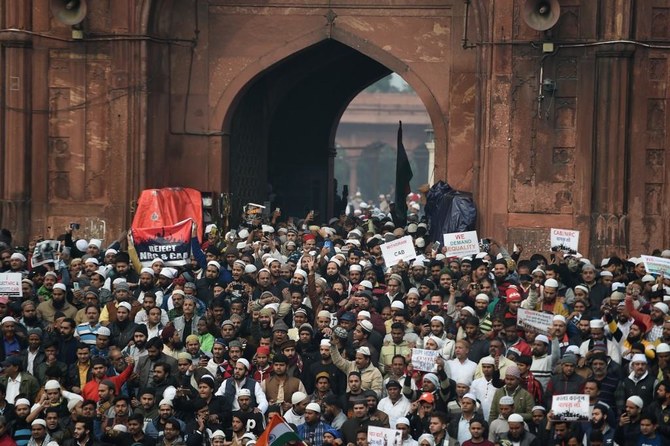
Thousands of protesters stood inside and on the steps of New Delhi’s Jama Masijd, one of India’s largest mosques, after Friday afternoon prayers, waving Indian flags and shouting slogans against the government and the citizenship law, which critics say threatens the secular nature of Indian democracy in favor of a Hindu state.
Police had banned a proposed march from the mosque to an area near India’s Parliament, and a large number of officers were waiting outside the mosque.
About 2,000 people protested outside New Delhi’s Jamia Millia Islamia University, which was the site of weekend clashes in which students accused to police of using excessive force that sent dozens to hospitals.
The protests have targeted the new citizenship law, which applies to Hindus, Christians and other religious minorities who are in India illegally but can demonstrate religious persecution in Muslim-majority Bangladesh, Pakistan and Afghanistan. It does not apply to Muslims.
Critics say it’s a violation of the country’s secular constitution and the latest effort by Prime Minister Narendra Modi’s Hindu nationalist-led government to marginalize India’s 200 million Muslims.
Modi has defended it as a humanitarian gesture.
The protests began last week at predominantly Muslim universities and communities and have spread across the country and now include a broad section of the Indian public.
A law banning the assembly of more than four people was in place in parts of the Indian capital as well as in several cities in northeastern Assam state and the northern state of Uttar Pradesh, where a motorized rickshaw driver was killed during a protest in Lucknow.
A total of eight deaths have been reported so far, including five in Assam and two in southern Karnataka state.
Authorities erected roadblocks and turned areas around mosques in New Delhi, Lucknow and other Muslim-dominated areas into security fortresses to prevent widespread demonstrations after Friday prayers.
Police temporarily held 1,200 protesters in New Delhi alone on Thursday and hundreds of others were detained in other cities after they defied bans on assembly. Most protesters were released later in the day.
While some see the citizenship law as a slight against Muslims, others, including some Hindu conservatives in Modi’s Bharatiya Janata Party, fear it will encourage immigration to India, where public services for its 1.3 billion people are already highly strained.
“In effect, some of the BJP’s own rank and file, the very people the party has sought to help, have come out against the law,” said Michael Kugelman, deputy director of the Asia Program at the US-based Wilson Center.
Kugelman said that the government’s failure to respond to the protests, except to accuse political opponents of orchestrating them, is “likely to galvanize the protesters even more.”
The protests come amid an ongoing crackdown in Muslim-majority Kashmir, the restive Himalayan region stripped of its semi-autonomous status and demoted from a state into a federal territory last summer.
They also follow a contentious process in Assam meant to weed out foreigners in the country illegally. Nearly 2 million people were excluded from an official list of citizens, about half Hindu and half Muslim, and have been asked to prove their citizenship or else be considered foreign.
India is also building a detention center for some of the tens of thousands of people the courts are expected to ultimately determine have entered illegally. Modi’s interior minister, Amit Shah, has pledged to roll out the process nationwide.
Critics say the process is a thinly veiled plot to deport millions of Muslims.


![]()

Amid citizenship law outcry, Indian authorities ban protest
Short Url
https://arab.news/z5dqv
Amid citizenship law outcry, Indian authorities ban protest
- Thousands of protesters gathered inside and on the steps one of the India’s largest mosques
- Police banned a proposed march from the mosque to an area near India’s Parliament


Latest updates


© 2026 SAUDI RESEARCH & PUBLISHING COMPANY, All Rights Reserved And subject to Terms of Use Agreement.