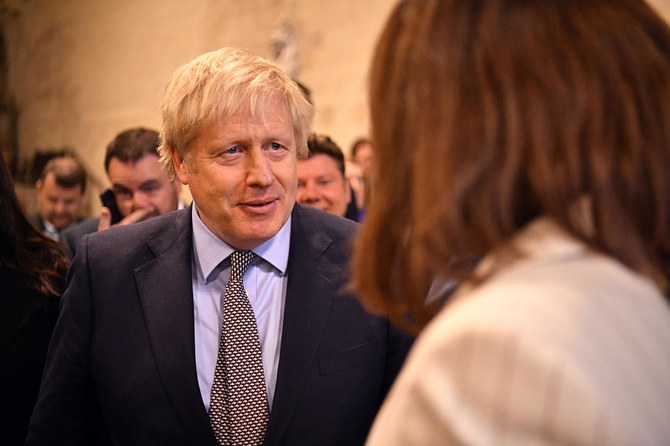
UK uses threat of Brexit cliff-edge to demand EU trade deal by end of 2020
Boris Johnson will use his control of parliament to outlaw any extension of the Brexit transition period beyond 2020
The EU hopes to start the trade talks with Britain by March
Updated 18 December 2019
Reuters
LONDON: British Prime Minister Boris Johnson will use the prospect of a Brexit cliff-edge at the end of 2020 to demand the European Union gives him a comprehensive free trade deal in less than 11 months.
In his boldest move since winning a large majority in last Thursday’s election, Johnson will use his control of parliament to outlaw any extension of the Brexit transition period beyond 2020.
“Our manifesto made clear that we will not extend the implementation (transition) period and the new Withdrawal Agreement Bill will legally prohibit government agreeing to any extension,” a senior government official said on Tuesday.
Asked if the government would legislate to rule out any extension of the transition beyond 2020, one of Johnson’s most senior ministers, Michael Gove, said: “Exactly, absolutely.”
After the United Kingdom leaves the European Union on Jan. 31, it enters a transition period in which it remains an EU member in all but name while both sides try to hammer out a deal on their post-Brexit relationship.
A comprehensive free trade deal would encompass everything from financial services and rules of origin to tariffs, state aid rules and fishing, though the scope and sequencing of any future deal is still up for discussion.
By enshrining in law his campaign promise not to extend the transition period beyond the end of 2020, Johnson cuts the amount of time he has to negotiate a trade deal to 10-11 months — and possibly quite a lot less, given the time needed for UK and EU parliamentary approval of any deal.
The EU hopes to start the trade talks with Britain by March.
Trade deals usually take many years. The 2,000-page EU-Canada trade deal known as CETA, or the Comprehensive Economic and Trade Agreement, took seven years to negotiate.
While Johnson’s large majority gives him the flexibility to change the law should he need to, he is sending a message to the EU — whose leaders have cautioned London that more time would be needed for a comprehensive trade deal.
Opinion
This section contains relevant reference points, placed in (Opinion field)
If the United Kingdom and the EU failed to strike a deal on their future relationship and the transition period were not extended, then trade between the two would be on World Trade Organization (WTO) terms — more burdensome for businesses.
The EU insists it will not seal a trade deal with a large, economically powerful neighbor without solid provisions to guarantee fair competition.
Its demands will focus on environmental and labor standards, as well as state aid rules to ensure Britain would not be able to offer products on the bloc’s single market at unfairly low prices.
Britain’s conundrum is that it will be under pressure to loosen rules on agricultural and food standards to strike a bilateral trade deal with the United States.
But this would be crossing a red line for the EU, which would restrict access to its market to protect its own producers.
Johnson and US President Donald Trump by phone on Monday and they agreed on the need for continued close cooperation and the negotiation of an “ambitious” UK-US free trade agreement.
In Britain’s talks with Brussels, fishing will be a particularly thorny issue as EU countries will no longer be able to operate in British waters as they do now.
With industry supply chains in the EU crossing borders multiple times for products like cars and drugs, agreeing exact rules to designate where products come from — and hence what regulations and taxes apply — will also be fraught.
“It will be very complicated. It’s about an array of relations, in trade, in fishing and cooperation in security and foreign policy,” German Chancellor Angela Merkel told an EU summit news conference on Friday.
Fresh funding flows in even as broader market data points to a slowdown
Updated 20 December 2025
Nour El-Shaeri
RIYADH: Startup funding activity across the Middle East and North Africa delivered a mixed picture over the past week, with fresh capital flowing into gaming, fintech, deep tech, and travel, even as broader market data pointed to a slowdown in overall investment momentum.
Saudi Arabia’s Impact46 led a $1 million investment round in Hypemasters, an international game development studio focused on competitive strategy experiences for mobile. The round included participation from GEM Capital.
Hypemasters develops strategy titles designed for competitive depth and precise game mechanics and has attracted more than 7 million players globally.
The studio is currently advancing several new projects, including a title in soft launch, as it looks to expand its reach in markets with sustained demand for strategy games.
“Strategy is one of the most demanding categories in game development, and Hypemasters approaches it with uncommon discipline. Their work shows a clear understanding of what committed players expect from this genre, and we believe their upcoming titles can serve a global audience with genuine depth,” said Basmah Al-Sinaidi, managing partner at Impact46.
“We are pleased to support a team that builds with intention and long-term ambition,” she added.
Boris Kalmykov, CEO and co-founder of Hypemasters, said: “We’re focused on deepening our presence across the region and pushing forward with the next generation of strategy games, including a major new title already in soft launch. Partnering with Impact46 marks an important step for Hypemasters.”
The CEO added that Impact46 shares his company’s long-term vision for building “world-class strategy games” from the MENA region, and the support reinforces his firm’s commitment to expanding its portfolio with high-quality releases.
The investment reflects Impact46’s continued interest in game development and interactive entertainment and aligns with its broader strategy of backing studios building globally oriented titles.
Premialab raises $220m
UAE-headquartered Premialab, a provider of data, analytics, and risk management solutions for quantitative investing, has raised $220 million in a growth investment led by KKR, with participation from existing investor Balderton.
Founded in Hong Kong in 2016 by Adrien Geliot and Pierre Trecourt, Premialab operates a global platform serving the $800 billion quantitative investment strategies market.
Counterfeits don’t just impact economies; they erase identity, creativity and truth. Along with our investors, we’re building a movement to make the world’s stories verifiable again.
Walid Tarabih, founder and CEO of Relik
The company provides benchmarking, performance analysis, and risk analytics tools for institutional investors.
The funding will be used to support global expansion, strengthen core operational systems, and scale Premialab’s execution product, which was developed in partnership with Eurex, to broaden access to quantitative investment strategies.
“Quantitative investment strategies have grown rapidly in scale and importance, yet the market has lacked a truly independent standard for data, analytics and risk. Premialab was built to fill that gap,” said Adrien Geliot, CEO of Premialab.
Relik closes seed round
UAE-based Relik has closed a seed funding round with participation from KBW Ventures, Naatt Holding, Fort Holding, and Ayman Sejiny.
Founded in 2023 by Walid Tarabih and later joined by John Tsioris, Relik is an artificial intelligence-powered authentication platform designed to help collectors, brands, and marketplaces.
The company plans to use the funding to roll out additional products and expand across sectors including sports, luxury, and heritage markets.
“We are ensuring authenticity in a fakeable world,” said Walid Tarabih, founder and CEO of Relik, adding: “Counterfeits don’t just impact economies; they erase identity, creativity and truth. Along with our investors, we’re building a movement to make the world’s stories verifiable again.”
Prince Khaled bin Alwaleed bin Talal Al-Saud, founder and CEO of KBW Ventures, said: “Relik is creating a new global standard for truth and trust. At a time when counterfeiting and AI-generated content are rising, Relik’s mission to protect authenticity carries both cultural and commercial value.”
Nawah raises $23m
Egypt-based deep tech startup Nawah Scientific has raised $23 million in a series A round comprising a mix of equity and debt, marking a decade since the company’s founding.
The round was led by Life Ventures Holding, with participation from Den Ventures, Empire M, AfricInvest, Elsewedy, as well as banks and angel investors.
Founded in 2015 by Omar Saqr, Nawah operates a cloud laboratory model that enables remote access to advanced testing services. (Supplied)
Founded in 2015 by Omar Saqr, Nawah operates a cloud laboratory model that enables remote access to advanced testing services. Its operations span four business units covering life sciences, food and agriculture, pharmaceuticals, and certified reference materials.
The company plans to use the funding to build a global research and development center in Rwanda, double laboratory capacity in Egypt and Saudi Arabia, and expand into North Africa and Europe.
Algeria’s VOLZ raises $5m
Algeria-based travel tech startup VOLZ has raised $5 million in a series A funding round led by a consortium of private investors under Tell Group, with participation from Groupe GIBA.
Founded in 2023 by Mohamed Abdelhadi and Hacene Seghier, VOLZ enables travelers to book flights in Algerian dinars using online payments or cash on delivery, while comparing multiple airlines through a single platform.
Announced at the African Startup Conference in December, the transaction is Algeria’s largest startup funding round in local currency and marks the first exit of the Algerian Startup Fund.
The capital will be used to launch new consumer and corporate travel products, strengthen VOLZ’s position in Algeria, and support expansion across North and West Africa.
MENA startup funding slows in November
Investment activity across the MENA startup ecosystem slowed sharply in November 2025, with 35 startups raising a combined $227.8 million, according to Wamda’s monthly report.
This marked a steep decline from the $784.9 million recorded in the previous month and a 12 percent drop compared to November 2024, pointing to a period of consolidation as investors moderated deployment toward the end of the year.
More than half of the capital raised during the month was driven by a single debt-backed transaction by erad, which propelled Saudi Arabia to the top of the regional rankings. Across 14 deals, the Kingdom attracted $176.3 million, accounting for more than three-quarters of all capital deployed in November.
Despite funding activity spanning 35 startups, capital was concentrated in just 5 markets. After Saudi Arabia’s dominant lead, the UAE followed with $49 million across 14 transactions.
Egypt recorded $1.12 million across 4 deals, while Morocco raised $1.1 million through 2 transactions. Oman saw 1 deal with an undisclosed value, with limited activity reported outside these markets.
Fintech emerged as the most funded sector in November, raising $142.9 million across 9 deals, largely influenced by the same debt-driven transaction.
E-commerce followed with $24.5 million across 6 rounds, while property tech, which topped the charts in October, slipped to 3rd with $18.9 million raised by 3 startups.
Debt financing dominated the month, accounting for more than $125 million through a single transaction.
The remaining capital was largely channelled into early-stage startups, with no later-stage funding rounds recorded in November, underscoring continued investor caution.
From a business model perspective, B2B startups captured the majority of capital, with 20 companies raising $197.1 million.
B2C startups lagged, with 9 companies raising a combined $22.2 million, while the remainder was split across hybrid models.
The gender funding gap showed no signs of narrowing, with male-led startups absorbing 97 percent of the capital raised during the month. Female-led and mixed-gender founding teams accounted for the remaining share.