Pakistani expat creates UAE’s first job portal for Emiratis

Job portal created for Emirati nationals by Pakistani expat Danish Haidri is an official internship partner of Careers UAE 2020. (Photo Courtesy: Danish Haidri)
Short Url
Updated 17 December 2019
Follow

Pakistani expat creates UAE’s first job portal for Emiratis

  • JobsForNationals aims to fill the gap between employers and local UAE talent
  • After success in UAE, Haidri wants to open a dedicated job portal for Saudis

ISLAMABAD: A Pakistani expat in the United Arab Emirates (UAE) has created an exclusive job portal with career and internship opportunities for Emirati nationals.

“This job portal was developed to fill the gap between employers and UAE national talent,” Danish Haidri, the founder and CEO of JobsForNationals, told Arab News on Saturday.

The portal is an official internship partner of Careers UAE 2020, a recruitment and training exhibition which will be held at the Dubai World Trade Center on March 10-12.

Prior to JobsForNationals, Haidri said over the phone from Dubai, the UAE had no job marketplace dedicated solely to Emirati talent.
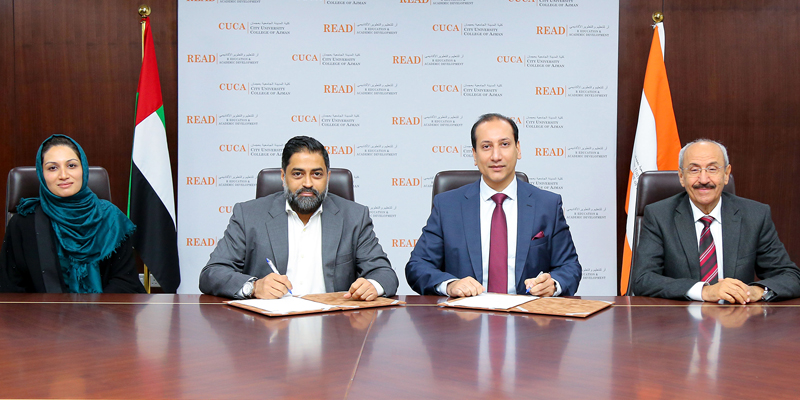


Danish Haidri, the founder and CEO of Jobs for Nationals (second left) signs a memorandum of understanding with the City University College of Ajman (CUCA) and City School in Ajman, UAE on Nov. 21, 2019. (Photo courtesy: CUCA)

Haidri’s platform was launched in 2016, but became fully operational in mid-2019. It supports the UAE government’s policy of Emiratization, which obliges companies and organizations to increase the number of Emirati citizens in their workforces, particularly in the private sector.

The policy, introduced in the past decade, is pivotal to the UAE Vision 2021 and transition from an oil-dependent to a knowledge-based economy.

“Companies were posting jobs on their own or generic websites, so shortlisting UAE nationals only was a gigantic task. The idea (of the new portal) was to connect employers, jobs and UAE national talent across all seven emirates on an exclusive platform with smart, engaging content and transparency,” Haidri said, adding that over 35,000 Emiratis and nearly 150 companies have already registered.

As his UEA enterprise was inspired by Saudis, Haidri’s next target is a dedicated job portal for Saudi nationals.

“I got this idea of creating a special platform for UAE nationals from Saudis, as they started a drive to provide jobs to Saudi nationals,” he said.

“Saudis have created a lot of opportunities under Crown Prince Muhammad bin Salman during the past few years, he said, explaining that his interest in the Kingdom is also personal, as he has spent most of his life in Saudi Arabia.

“I grew up there. So the next market I am looking at is Saudi Arabia, where we have already started searching for local partners,” Haidri said, expressing hope that in the next three months the portal will be ready.

Speaking about Pakistani expats, he said they have contributed a lot to both the UAE and Saudi Arabia, and there are many success stories of Pakistanis in these countries.

“Pakistanis are innovative people. They have shown it in both Gulf countries,” Haidri said, adding that the governments of the UAE and Saudi Arabia have also been supportive of their Pakistani residents.
Pakistan’s Afghan salvo risks turning ‘open war’ into long crisis

Updated 3 sec ago
Follow

Pakistan’s Afghan salvo risks turning ‘open war’ into long crisis

  • Nuclear-armed Pakistan has a formidable military of 660,000 active personnel, backed by a fleet of 465 combat aircraft
  • But the Taliban have the option to lean on insurgent groups like the TTP and the BLA to move beyond border skirmishes

KARACHI: Weeks after the Taliban’s lightning offensive in 2021 wrested control of Afghanistan from a US-led military coalition, Pakistan’s then intelligence chief flew into the capital Kabul for talks, where the serving lieutenant general told a reporter: “Don’t worry, everything will be okay.”

Five years on, Islamabad — long seen as a patron of the Taliban — is locked in its heaviest fighting with the group, which Pakistan’s Defense Minister Khawaja Muhammad Asif described on Friday (February 27) as an “open war.”

The turmoil means that a wide swathe of Asia — from the Gulf to the Himalayas — is now in flux, with the United States building up a military deployment against Afghanistan’s neighbor Iran even as relations between Pakistan and arch rival India remain on edge after four days of fighting last May.

At the heart of the conflict with Afghanistan is Pakistan’s accusation that the Afghan Taliban provides support to militant groups, including the Tehreek-e-Taliban Pakistan (TTP), that have wreaked havoc across inside the South Asian country.

The Afghan Taliban, which has previously fought alongside the TTP, denies the charge, insisting that Pakistan’s security situation is its internal problem.

The disagreement is a reflection of starkly incompatible positions taken by both sides, as Pakistan expected compliance after decades of support to the Taliban, which did not see itself beholden to Islamabad, analysts said.

“We all know that the government in Pakistan supported the Taliban, the Afghan Taliban for many years, in the 90s and the 2000s, and provided havens to them during the period where the US and NATO were in Afghanistan.

So there’s a very close relationship between the Taliban and Pakistan,” said Jennifer Brick Murtazashvili, a political scientist at the University of Pittsburgh and an Afghanistan expert.

“It’s really surprising and shocking to many of us to see how quickly this relationship deteriorated,” she said.

Although tensions have simmered along their rugged 2,600-km (1,615-mile) frontier for months, following clashes last October, Friday’s fighting is notable because of Pakistan’s use of warplanes to hit Taliban military installations instead of confining the attacks to the militants it allegedly harbors.

These include targets deep inside the country in Kabul, as well as the southern city of Kandahar, the seat of Taliban supreme leader Hibatullah Akhundzada, according to Pakistan military spokesman Lt. Gen. Ahmed Sharif Chaudhry.

The clashes are unlikely to end there.

“I think in the immediate aftermath, I think hostilities will subside. There will be, I hope there will be a ceasefire through mediation. But I do not see these tensions subsiding in the foreseeable future,” said Abdul Basit,  an expert on militancy and violent extremism at Singapore’s S. Rajaratnam School of International Studies.

Nuclear-armed Pakistan has a formidable military of 660,000 active personnel, backed by a fleet of 465 combat aircraft, several thousand armored fighting vehicles and artillery pieces.

Across the border, the Afghan Taliban has only around 172,000 active military personnel, a smattering of armored vehicles and no real air force.

But the battle-hardened group, which took on a phalanx of Western military powers in 2001 and outlasted them, has the option to lean on insurgents like the TTP and the Baloch Liberation Army (BLA), moving beyond border skirmishes.

Based in Pakistan’s largest and poorest province of Balochistan that borders both Iran and Afghanistan, the BLA has been at the center of a decades-long insurgency, which in recent years has staged large coordinated attacks.

Pakistan has long accused India of backing the insurgents, a charge repeatedly denied by New Delhi, which has retained a robust military deployment along the border since last May.

Although a raft of countries with influence — including China, Russia, Turkiye and Qatar — have indicated an openness to help mediate the conflict, all such efforts have been met with limited success so far.