ISLAMABAD: The Chairman of the China International Development Cooperation Agency (CIDCA), Luo Zhaohui, said Beijing will continue to work with Pakistan to fulfill commitments made under the framework of the China-Pakistan Economic Corridor and the Global Development Initiative, Pakistani state news agency APP reported on Friday.
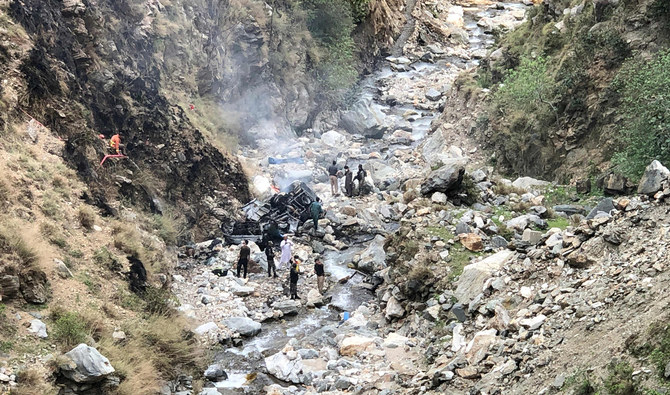
Luo’s statement comes a month after a suicide bomber rammed a vehicle into a convoy of Chinese engineers working on a hydropower project at Dasu in the northwestern Khyber Pakhtunkhwa province, killing five Chinese nationals and their Pakistani driver.
The assault on Mar. 26 was the third major attack in little over a week on China’s interests in the South Asian nation, where Beijing has invested more than $65 billion in infrastructure projects as part of its wider Belt and Road initiative.
Chinese contractors suspended work on three hydropower projects in view of security concerns after the March attack, government officials told media last month.
“China is ready to work with Pakistan to implement the consensus reached by the leaders of the two countries, further, deepen strategic mutual trust, and promote practical cooperation in various fields within the framework of the China-Pakistan Economic Corridor and the Global Development Initiative,” APP quoted Luo as saying.
“In his meetings with friends from various sectors during a recent visit to Pakistan, he hoped that friends from all walks of life would continue to exert their influence, and offer advice and suggestions for the development of bilateral relations.”
During the meetings, according to APP, Lou thanked Pakistani officials for “their long-standing contributions to China-Pakistan friendly cooperation, emphasizing the increasingly significant strategic importance of accelerating comprehensive cooperation between China and Pakistan and leading regional development trends.”
The Pakistani side expressed condolences over the Dasu attack and “highly praised the enduring traditional friendship” between Pakistan and China and their cooperation in various fields.
“They added that Pakistan will continue to support the development of Pakistan-China relations, advance exchanges on state governance, and expand friendly exchanges between the two countries in various sectors, including between governments, parliaments, business communities, think tanks, youth, and civil society,” APP said.
The Mar. 26 bombing followed a Mar. 20 attack on a strategic port used by China in the southwestern province of Balochistan, where Beijing has poured billions of dollars into infrastructure projects, and a Mar. 25 assault on a naval air base, also in the southwest. Both attacks were claimed by the Baloch Liberation Army (BLA), the most prominent of several separatist groups in Balochistan.
Dasu, the site of a major dam, has been attacked in the past, with a bus blast in 2021 killing 13 people, nine Chinese among them, although no group claimed responsibility, like the Mar. 26 bombing.
Pakistan is home to twin insurgencies, one mounted by religiously-motivated militants and the other by ethnic separatists who seek secession, blaming the government’s inequitable division of natural resources in southwestern Balochistan province.
Chinese interests are under attack primarily by ethnic militants seeking to push Beijing out of mineral-rich Balochistan, but that area is far from the site of the Mar. 26 bombing.


China says will continue investments in Pakistan after deadly suicide bombing
https://arab.news/bmrad
China says will continue investments in Pakistan after deadly suicide bombing

- On Mar. 26, suicide bomber hit a convoy of Chinese engineers working on Dasu hydropower project
- Five Chinese nationals and their Pakistani driver were killed in the attack in northwestern Pakistan

ADB, Pakistan sign over $300 million agreements to undertake climate resilience initiatives
- Pakistan ranks among nations most vulnerable to climate change and has seen erratic changes in weather patterns
- The projects in Sindh and Punjab will restore nature-based coastal defenses and enhance agricultural productivity
ISLAMABAD: The Pakistani government and the Asian Development Bank (ADB) have signed more than $300 million agreements to undertake two major climate resilience initiatives, Pakistan’s Press Information Department (PID) said on Tuesday.
The projects include the Sindh Coastal Resilience Sector Project (SCRP), valued at Rs50.5 billion ($180.5 million), and the Punjab Climate-Resilient and Low-Carbon Agriculture Mechanization Project (PCRLCAMP), totaling Rs34.7 billion ($124 million).
Pakistan ranks among nations most vulnerable to climate change and has seen erratic changes in its weather patterns. In 2022, monsoon floods killed over 1,700 people, displaced another 33 million and caused over $30 billion losses, while another 1,037 people were killed in floods this year.
The South Asian country is ramping up climate resilience efforts, with support from the ADB and World Bank, and investing in climate-resilient infrastructure, particularly in vulnerable areas.
“Both sides expressed their commitment to effectively utilize the financing for successful and timely completion of the two initiatives,” the PID said in a statement.
The Sindh Coastal Resilience Project (SCRP) will promote integrated water resources and flood risk management, restore nature-based coastal defenses, and strengthen institutional and community capacity for strategic action planning, directly benefiting over 3.8 million people in Thatta, Sujawal, and Badin districts, according to ADB.
The Punjab project will enhance agricultural productivity and climate resilience across 30 districts, improving small farmers’ access to climate-smart machinery, introducing circular agriculture practices to reduce residue burning, establishing testing and training facilities, and empowering 15,000 women through skills development and livelihood diversification.
Earlier this month, the ADB also approved $381 million in financing for Pakistan’s Punjab province to modernize agriculture and strengthen education and health services, including concessional loans and grants for farm mechanization, Science, Technology, Engineering and Mathematics (STEM) education, and nursing sector reforms.


