

Malaysia works with UN, Philippines to combat polio

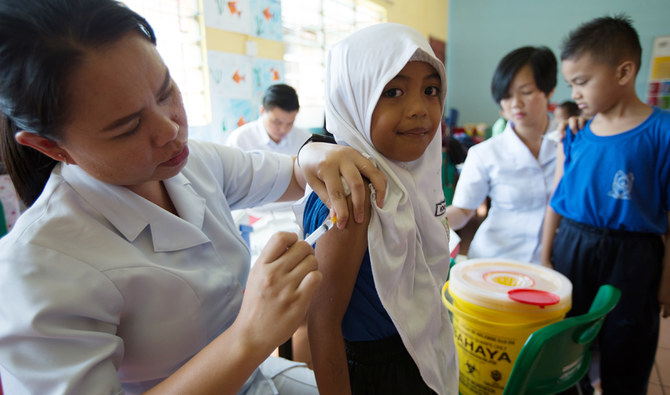
Malaysia announced on Monday that authorities were working round the clock in cooperation with international organizations and the Philippines to intensify a health campaign. (Shutterstock)
Short Url
Updated 17 December 2019
Follow

Malaysia works with UN, Philippines to combat polio

  • Authorities detect virus in three-month-old infant from Sabah

KUALA LUMPUR: In a bid to curb the spread of the polio virus in the country, Malaysia announced on Monday that authorities were working round the clock in cooperation with international organizations and the Philippines to intensify a health campaign.

“The Malaysian Ministry of Health (MOH) is also working closely with the World Health Organization (WHO) to get updates on the polio situation globally,” Dr. Noor Hisham bin Abdullah, director general of Malaysia’s Ministry of Health, said in his official blog on Monday.

He added that a “joint venture with the UN Children’s Fund (UNICEF) is being refined” for low-cost vaccines, specifically for non-citizen immunization programs in Sabah. 

Malaysia has been scrambling to deal with the re-emergence of the virus ever since it was detected in a three-month-old infant from Tuaran, Sabah, on Dec. 8, almost 27 years after it was completely eradicated from the country.

The infant is stable and is currently being treated at the isolation ward of a hospital, the ministry said.

The cause for the spread of polio is yet to be determined, but several are pointing fingers at the Philippines for the outbreak.

“The MOH will also strengthen bilateral cooperation with the Philippines, including immunization programs for children of nationals in Sabah,” Bin Abdullah said.

Sabah is a major tourist area in Malaysia, attracting close to 3.5 million tourists each year.

When contacted by Arab News on Monday, officials from the Malaysian Tourism Ministry were unavailable for comment.

The Sabah state government has already taken several critical measures to prevent the spread of the virus, including intensifying immunization activities for children in Sabah.

“To help prevent the spread, additional immunization activities will be provided to all children under the age of five in Sabah,” Bin Abdullah said.

Thus far, 59 children aged between two months and 15 years — including undocumented and non-citizens — have been vaccinated.

Additionally, the Malaysian authorities have increased awareness measures through media advocacy and health education to the public, as well as monitoring the health facilities in high-risk areas.

“Detection activity on Acute Flaccid Paralysis (AFP) cases that are showing symptoms of poliomyelitis in the areas around the case is being expanded to nearby and at-risk areas,” Bin Abdullah added.

“A total of 1,553 people were examined, and none of the AFP symptoms were detected.”

With push backs from so-called “anti-vaxxers” who dispute the effectiveness of vaccination, and calls from civil societies for mandatory vaccination, authorities are also urging parents to vaccinate their children immediately.

“The MOH wants to emphasize that the best way to prevent polio is through immunization. Infectious diseases such as polio do not recognize boundaries,” Bin Abdullah said.


AI reshaping the battle over the narrative of Maduro’s US capture

Updated 7 sec ago
Follow

AI reshaping the battle over the narrative of Maduro’s US capture

  • Since the US captured Venezuelan leader Nicolas Maduro in early January, pictures and videos chronicling the events have been crowded out by those generated with artificial intelligence
CARACAS: Since the US captured Venezuelan leader Nicolas Maduro in early January, pictures and videos chronicling the events have been crowded out by those generated with artificial intelligence, blurring the lines between fiction and reality.
The endless stream of content ranges from comedic memes to dramatic retellings.
In one, a courtroom illustration of Maduro in a New York courthouse springs to life and announces: “I consider myself a prisoner of war.”
In another, an AI-generated Maduro attempts to escape a US prison through an air duct, only to find himself in a courtroom with US President Donald Trump, where they dance with a judge and an FBI agent to a song by American rapper Ice Spice.
Maduro was captured alongside his wife Cilia Flores during US strikes in the Venezuelan capital of Caracas on January 3.
They have since been taken to a prison in New York where they are being held on drug trafficking charges.
While some have celebrated Maduro’s ouster, the “Chavismo” movement he leads — named after his predecessor Hugo Chavez — has worked to reframe what his fall means for Venezuela’s future.
- ‘ Confuse, combat, and silence’ -
Leon Hernandez, a researcher at Andres Bello Catholic University, told AFP that with AI’s rapid creation of content, we see development of “disinformation labs” that flood social media platforms.
“There were things that circulated that were not real during the capture (of Maduro), and things that circulated which were real that generated doubt,” Hernandez said.
“That was the idea: to create confusion and generate skepticism at the base level by distorting certain elements of real things.”
The goal, he added, is for the content to overwhelm audiences so they cannot follow it.
Even legacy media such as the Venezuelan VTV television channel are in on it, with the broadcaster playing an AI-animated video narrated by a child recounting Maduro’s capture.
“AI has become the new instrument of power for autocrats to confuse, combat, and silence dissent,” said Elena Block, a professor of political communication and strategy at the University of Queensland in Australia.
- ‘Greatest threat to democracy’ -
Block pointed out the use of cartoons, specifically, had been a medium of propaganda used in both authoritarian and democratic states.
Long before his arrest, Maduro was depicted as the illustrated superhero “Super Bigote” or “Super Mustache,” donning a Superman-like suit and fighting monsters like “extremists” and the “North American empire.”
The cartoon’s popularity spawned toys that have been carried by Maduro’s supporters during rallies advocating for his return.
And much like his predecessor, Maduro continued a practice of “media domination” to stave off traditional media outlets from airing criticism of Chavismo.
“With censorship and the disappearance or weakening of news media, social media has emerged as one of the only spaces for information,” Block said.
Maduro is not the only leader to use AI propaganda — Trump has frequently posted AI-generated pictures and videos of himself with “antagonistic, aggressive, and divisive language.”
“These digital and AI tools end up trivializing politics: you don’t explain it, you diminish it,” Block said. “AI today is the greatest threat to democracy.”