Rescuers search rubble of building destroyed by quake in southern Philippines

1 / 3
Police forensic investigators work over bodies retrieved from a collapsed building (background) in Padada town, Davao del Sur province on the southern island of Mindanao on Dec.16, 2019, following a 6.8-magnitude earthquak the day before. (AFP / Manman Dejeto)
2 / 3
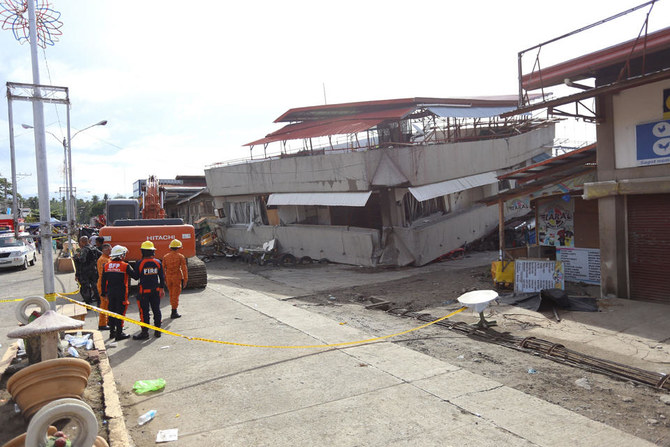
A collapsed building is seen in Padada town, Davao del Sur province on the southern island of Mindanao on Dec. 16, 2019, following a 6.8-magnitude earthquake the fday before. (AFP / Manman Dejeto)
3 / 3
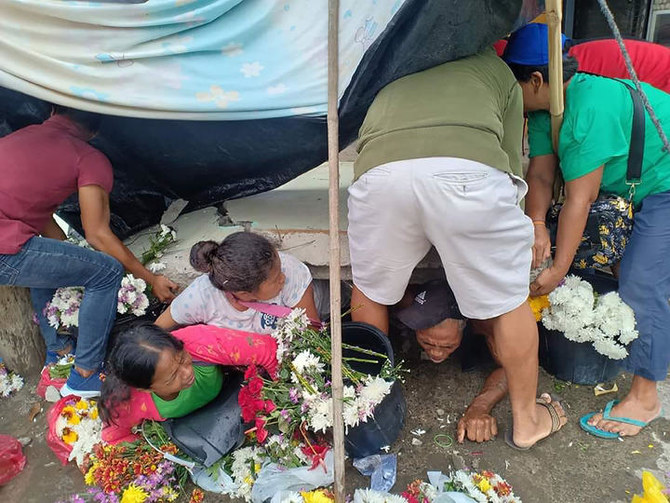
This handout photograph courtesy of Angelo John Jomao-as taken on Dec. 5, 2019 shows residents freeing trapped flower vendors from a portion of a collapsed wall at a public market, after a 6.8-magnitude earthquake struck Padada town, Davao del Sur province on the southern island of Mindanao. (AFP photo)
Short Url
Updated 16 December 2019
Follow

Rescuers search rubble of building destroyed by quake in southern Philippines

  • Authorities placed the death toll a two, including a woman in her 70s and a 6-year-old
  • Another 84 people were injured in the magnitude 6.9 quake, police say

DAVAO, Philippines: Search and rescue efforts continued Monday at a three-story building in the southern Philippines that collapsed in a strong earthquake.
The Bureau of Fire Protection said six people have been rescued from the rubble of the Southern Trade Shopping Center in Davao del Sur province’s Padada town since Sunday’s magnitude 6.9 quake.
Officials have yet to give an estimate of how many people may be inside the building, which housed a grocery story.
Army troops, police and firefighters were all involved in the search operation.
The Bureau of Fire Protection said the death toll from the quake had climbed to two, after a woman in her 70s was found to have had a heart attack during the quake. A 6-year-old was earlier reported killed after a wall collapsed.

Another 84 people were injured in the quake, officials said.
Television footage early on Monday showed fire and rescue personnel using torches to search the outside of the shopping center, a small two-story building, in darkness. Roads were blocked by rubble and mangled metal.
There were widespread power outages and minor damage to more than 300 homes and eight government buildings, according to the disaster agency’s report late on Sunday.
President Rodrigo Duterte and his family were in Davao City when the quake struck some 61 km (38 miles) away, but were not harmed.
Four towns and one city near the quake were still without power Monday, and school was canceled in a broad area to give time for inspections of the buildings.
The Davao region has been hit by several earthquakes in recent months, causing some deaths and scores of injuries and badly damaging houses, hotels, malls and hospitals.
The Philippine archipelago lies on the so-called Pacific “Ring of fire,” an arc of faults around the Pacific Ocean where most of the world’s earthquakes occur. It’s also lashed by about 20 typhoons and other severe storms each year, making the Southeast Asian nation of more than 100 million people one of the world’s most disaster-prone countries.


India, Arab League target $500bn in trade by 2030

Updated 54 min ago
Follow

India, Arab League target $500bn in trade by 2030

  • It was the first such gathering of India–Arab FMs since the forum’s inauguration in 2016
  • India and Arab states agree to link their startup ecosystems, cooperate in the space sector

NEW DELHI: India and the Arab League have committed to doubling bilateral trade to $500 billion by 2030, as their top diplomats met in New Delhi for the India–Arab Foreign Ministers’ Meeting. 

The foreign ministers’ forum is the highest mechanism guiding India’s partnership with the Arab world. It was established in March 2002, with an agreement to institutionalize dialogue between India and the League of Arab States, a regional bloc of 22 Arab countries from the Middle East and North Africa.

The New Delhi meeting on Saturday was the first gathering in a decade, following the inaugural forum in Bahrain in 2016.

India’s Foreign Minister S. Jaishankar said in his opening remarks that the forum was taking place amid a transformation in the global order.

“Nowhere is this more apparent than in West Asia or the Middle East, where the landscape itself has undergone a dramatic change in the last year,” he said. “This obviously impacts all of us, and India as a proximate region. To a considerable degree, its implications are relevant for India’s relationship with Arab nations as well.”

Jaishankar and his UAE counterpart co-chaired the talks, which aimed at producing a cooperation agenda for 2026-28.

“It currently covers energy, environment, agriculture, tourism, human resource development, culture and education, amongst others,” Jaishankar said.

“India looks forward to more contemporary dimensions of cooperation being included, such as digital, space, start-ups, innovation, etc.”

According to the “executive program” released by India’s Ministry of External Affairs, the roadmap agreed by India and the League outlined their planned collaboration, which included the target “to double trade between India and LAS to US$500 billion by 2030, from the current trade of US$240 billion.”

Under the roadmap, they also agreed to link their startup ecosystems by facilitating market access, joint projects, and investment opportunities — especially health tech, fintech, agritech, and green technologies — and strengthen cooperation in space with the establishment of an India–Arab Space Cooperation Working Group, of which the first meeting is scheduled for next year.

Over the past few years, there has been a growing momentum in Indo-Arab relations focused on economic, business, trade and investment ties between the regions that have some of the world’s youngest demographics, resulting in a “commonality of circumstances, visions and goals,” according to Muddassir Quamar, associate professor at the School of International Studies, Jawaharlal Nehru University.

“The focus of the summit meeting was on capitalizing on the economic opportunities … including in the field of energy security, sustainability, renewables, food and water security, environmental security, trade, investments, entrepreneurship, start-ups, technological innovations, educational cooperation, cultural cooperation, youth engagement, etc.,” Quamar told Arab News.

“A number of critical decisions have been taken for furthering future cooperation in this regard. In terms of opportunities, there is immense potential.”