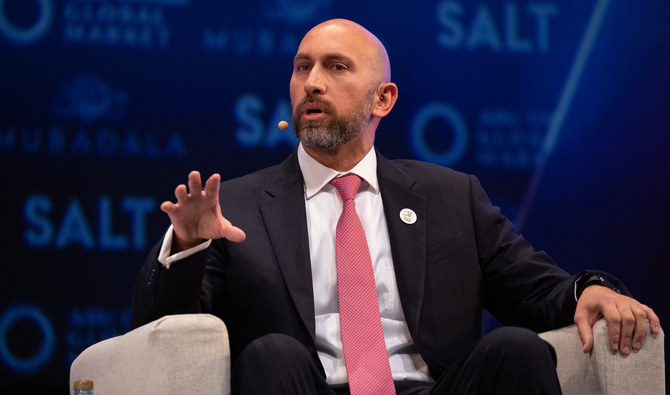
DUBAI: Governments need to ensure that they have an agile workforce to take on the jobs of tomorrow, the UAE’s minister of state for artificial intelligence (AI) said on the second day of the SALT conference in Abu Dhabi.
Omar Sultan Al-Olama did not mince words while talking about the future of the job market, during a discussion on “The implications of advanced AI.” He said: “Some people will be optimized by AI, and others will be replaced by it.”
Fields such as law, medicine and diagnostics will be significantly impacted by the technology in the next five years, he added.
Citing a report by the Institute for the Future, a Dubai-based think tank, he said 85 percent of the jobs that will exist in 2030 do not exist today.
As debate rages worldwide on whether AI is stealing or creating jobs, Al-Olama said technology will help improve and create jobs rather than displace employees.
As a case in point, he cited the launch of ATMs in the US in 1985, when the number of bank tellers was 485,000.
By the time the number of ATMs had risen to 352,000 in 2002, many people expected to see a drop in the number of tellers. Instead, it rose to 527,000.
However, that may no longer be the case today. “Bus and truck drivers are under the biggest threat of AI deployment,” Al-Olama said, adding that 16 million people could lose their jobs “if autonomous trucks became mainstream tomorrow.”
Taking part in the same panel discussion, Jamil Asfour, executive director of technology partnerships at the Abu Dhabi Investment Office, said while it is inevitable that each sector will be affected by AI, the speed of adoption will differ.
“If I could bet big on which sectors will be impacted by AI first, I’d say health care, transportation and the financial sector,” he added.
These sectors require automation, transparency and efficiency to manage their large volumes of data processing, Asfour said.
Al-Olama said there is an urgent need to invest in transformation of education systems, from the traditional teaching format of memorizing to a more agile system that meets the criteria of future jobs.
He described the limited class of AI-skilled talent today as “digital nomads” who are well-paid and in high demand.
“We need to understand that the type of talent working in this field is different to the talent found in other sectors. Digital nomads are highly skilled, educated individuals who can work virtually,” he said.
Countries that want to attract such talent must be able to offer them a good standard of life, easy mobility, the right infrastructure, the freedom to work and access to policymakers, said Al-Olama.
“If we look at the fundamental requirements for attracting this type of talent, I’d say the UAE is among the top countries,” he added.
As evidence, he said the UAE has been listed as the country with the “highest net inflow of AI talent” in a report published by the World Bank and LinkedIn.


![]()
![]()

Agile workforce needed for future job market, Abu Dhabi forum told

Short Url
https://arab.news/v5n7x
Agile workforce needed for future job market, Abu Dhabi forum told
- ‘Some people will be optimized by AI, and others will be replaced by it,’ says UAE minister
- Dubai-based think tank calculates that ‘85% of jobs that will exist in 2030 do not exist today’


Latest updates


© 2026 SAUDI RESEARCH & PUBLISHING COMPANY, All Rights Reserved And subject to Terms of Use Agreement.