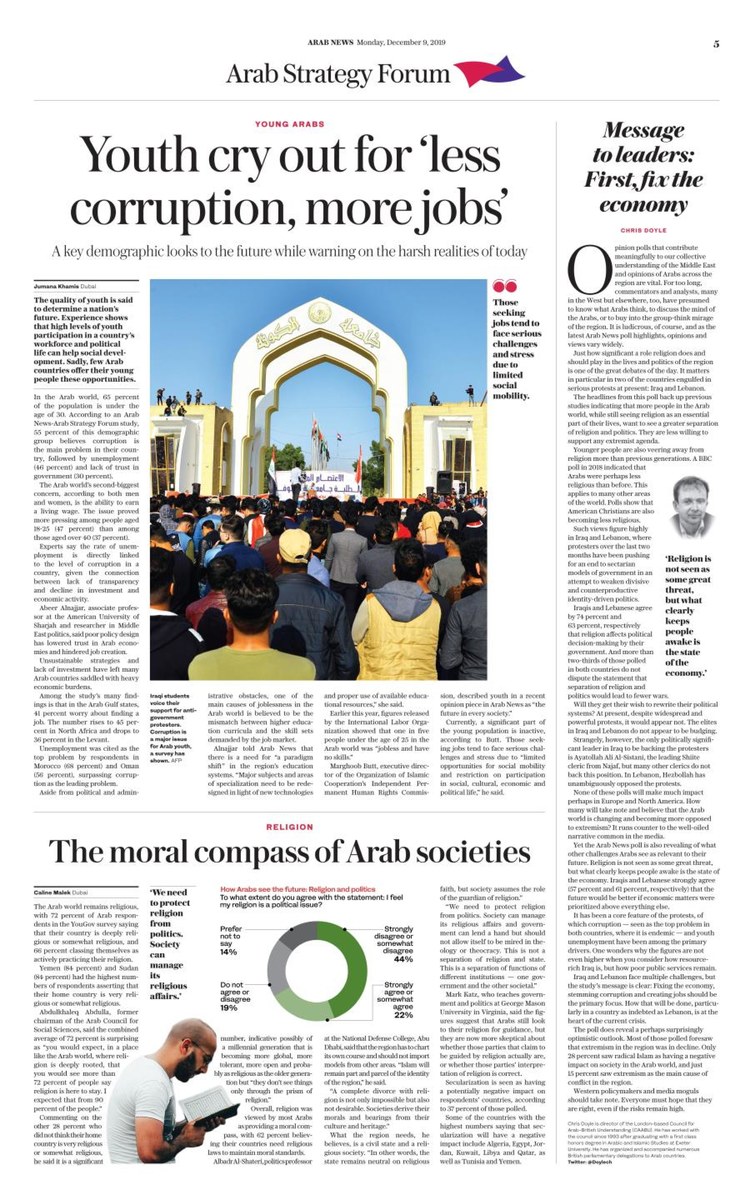
DUBAI: Corruption is considered by a large majority of Arabs to be one of the major problems facing their home country, according to an Arab News-Arab Strategy Forum public opinion research study.
The survey, conducted in 18 countries of the Middle East and North Africa (MENA) region, found that out of 3,079 respondents, a combined average of 57 percent said corruption is the leading problem in their home country. The study, which was carried out by YouGov, also found that Arabs see corruption as the leading cause of conflict in the Arab world.
Independent experts consider corruption, whether grand, petty or political, to be a leading factor behind the wave of protests sweeping the region.
Transparency International, the global coalition against corruption, said that “outrage over corruption and financial mismanagement by governments” has underpinned mass protests in Egypt, Iraq and Lebanon over the past two months.
Imad Salamey, associate professor of political science at the Lebanese American University, said corruption was “the source of a legitimacy deficit” that sparked the 2011 protest movements known as the Arab Spring.
Corruption is not an “isolated” phenomenon but widely prevalent in the region, Salamey said, adding that it is “a product of weak and unaccountable governments that lack institutional checks and balances.”
He cited Tunisia and Lebanon as examples of corrupt countries where “nepotistic networks” are linked to politicians.
#ArabStrategyForum: A majority of Iraqis and Lebanese believe religion is affecting their government's political decisions, and that separation of religion and politics would lead to less wars, suggests a YouGov pan-Arab poll. Watch the video for more of the survey results. pic.twitter.com/pPkHwcpB60
— Arab News (@arabnews) December 9, 2019
By contrast, he attributed Lebanon’s “rampant corruption” to the country’s political elite placing “incompetent followers (belonging to their own sects) in public offices in exchange for loyalties.”
However, Salamey argued that “yet more serious corruption is associated with political leaders who grant immunity to illicit networks involved in cross-border armed smuggling and drug harvesting.”
The YouGov study shows that nationals of economically challenged Arab states are the most worried about corruption, with 63 percent selecting it as a top concern.
In the GCC countries, just under half of respondents (48 percent) named corruption as the top problem, while in the Levant this rose to 57 percent and was still higher in North Africa (64 percent).
The findings suggest that corruption is seen as more blameworthy by people in struggling economies such as Egypt, Salamey said. The same cannot be said about the oil-rich states, he told Arab News, since these countries find it relatively easy to make good any losses caused by corruption.
Abeer Alnajjar, a professor at the American University of Sharjah and researcher in Middle East politics, described corruption as a “marriage of convenience” between business and politics in the MENA region.
Abuse of power for private gain has not only helped tip many countries into the category of fragile or failed states, but its ripple effect also causes considerable hardship to large segments of the population, including women and marginalized people.
“Corruption is feeding on the lack of political and economic accountability of Arab political and business leaders,” said Alnajjar.
Arab countries with transparency watchdogs designed to enforce accountability are no different in the sense that their political and economic structures are likely to be interconnected.
In the YouGov poll, 65 percent of respondents in Iraq and 53 percent in Lebanon listed corruption as one their country’s top problems.
The two nationalities were also the most conclusive in thinking that religion is affecting their country’s political decisions, with 75 percent in Iraq and 57 percent in Lebanon agreeing with the statement.
Talking about the two countries, Alnajjar said that both have suffered from sectarianism and other forms of political and religious polarization for decades.
“The good news,” she said, “is that people in Lebanon and Iraq have realized that sectarianism is just an instrument of the rich and the powerful to divert their attention from their real enemies — corrupt politicians and complacent business leaders.”