

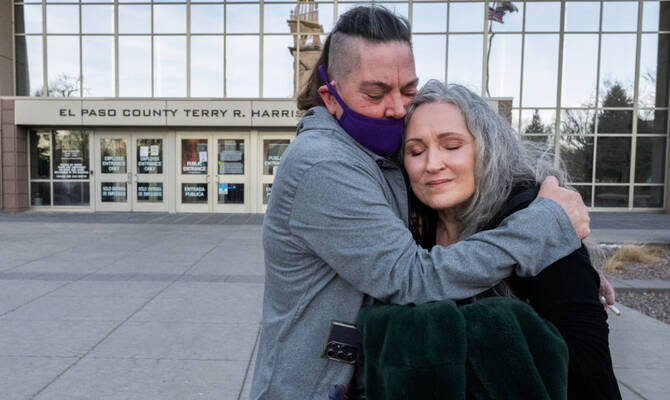
Colorado funeral home owner who abused nearly 200 corpses gets 40 years
Hallford’s attorney unsuccessfully sought a 30 year sentence, arguing that it was not a crime of violence
Updated 07 February 2026
AP
COLORADO SPRINGS: A Colorado funeral home owner who stashed 189 decomposing bodies in a building over four years and gave grieving families fake ashes was sentenced to 40 years in state prison on Friday.
During the sentencing hearing, family members told Judge Eric Bentley they have had recurring nightmares about decomposing flesh and maggots since learning what happened to their loved ones.
They called defendant Jon Hallford a “monster” and urged the judge to give him the maximum sentence of 50 years.
Bentley told Hallford he caused “unspeakable and incomprehensible” harm. “It is my personal belief that every one of us, every human being, is basically good at the core, but we live in a world that tests that belief every day, and Mr. Hallford your crimes are testing that belief,” Bentley said.
Hallford apologized before his sentencing and said he would regret his actions for the rest of his life. “I had so many chances to put a stop to everything and walk away, but I did not,” he said. “My mistakes will echo for a generation. Everything I did was wrong.”
Hallford’s attorney unsuccessfully sought a 30 year sentence, arguing that it was not a crime of violence and he had no prior criminal record.
His former wife, Carie Hallford, who co-owned the Return to Nature Funeral Home, is due to be sentenced April 24. She faces 25 to 35 years in prison.
Both pleaded guilty in December to nearly 200 counts of corpse abuse under an agreement with prosecutors.
During the years they were stashing bodies, the Hallfords spent lavishly. That included purchasing a GMC Yukon and an Infiniti worth over $120,000 combined, along with $31,000 in cryptocurrency, pricey goods from stores like Gucci and Tiffany & Co. and laser body sculpting.
Mexico fears more violence after army kills leader of powerful Jalisco cartel
Updated 1 sec ago
GUADALAJARA: School was canceled in several Mexican states and local and foreign governments alike warned their citizens to stay inside, as widespread violence erupted following the army’s killing of the powerful leader of the Jalisco New Generation Cartel. Nemesio Rubén Oseguera Cervantes, known as “El Mencho” was the boss of one of the fastest-growing criminal networks in Mexico, notorious for trafficking fentanyl, methamphetamine and cocaine to the United States and staging brazen attacks against government officials who challenged it. He was killed during a shoot-out in his home state of Jalisco as the Mexican military attempted to capture him. Cartel members responded with violence across the country, blocking roads and setting fire to vehicles. President Claudia Sheinbaum urged calm and authorities announced late Sunday they had cleared most of the more than 250 cartel roadblocks across 20 states. The White House confirmed that the US provided intelligence support to the operation to capture the cartel leader and applauded Mexico’s army for taking down a man who was one of the most wanted criminals in both countries. Mexico hoped the death of the world’s biggest fentanyl traffickers would ease Trump administration pressure to do more against the cartels, but many remained hunkered down and on edge as they waited to see the powerful cartel’s reaction. Many fear more violence Guadalajara, the capital of Jalisco state and Mexico’s second-largest city, was almost completely shut down on Sunday as fearful residents stayed home. Passengers arriving to the city’s international airport Sunday night were told it was operating with limited personnel because of the burst of violence. Jacinta Murcia, a 64-year-old nutrition products vendor, was among those nervously walking late Sunday night through the airport, where earlier in the day travelers sprinted and ducked behind chairs fearing violence. Most flights into the city were suspended on Sunday. Murcia anxiously scrolled through news stories on social media showing the face of “El Mencho” and sent messages to her children, who were tracking her location as she tried to travel across the city to her house after dark. “My plan today leaving the airport is to see if there are any taxis, but I’m scared of everything. That there are blockades, that there’s a curfew, that something could happen,” she said. “I’m all alone.” Authorities in Jalisco, Michoacan and Guanajuato reported at least 14 other people killed Sunday, including seven National Guard troops. Videos circulating on social media showed tourists in Puerto Vallarta walking on the beach with smoke rising in the distance. In another part of the airport a group of elderly Mexicans gathered, discussing how to get home. “We better all go together,” one said. “Go with God.” A blow against a cartel could be a diplomatic coup David Mora, Mexico analyst for International Crisis Group, said the capture and outburst of violence marks a point of inflection in Sheinbaum’s push to crack down on cartels and relieve US pressures. US President Donald Trump has demanded Mexico do more to fight the smuggling of the often-deadly drug fentanyl, threatening to impose more tariffs or take unilateral military action if the country does not show results. There were early signs that Mexico’s efforts were well received by the United States. US Amb. Ron Johnson recognized the success of the Mexican armed forces and their sacrifice in a statement late Sunday. He added that “under the leadership of President Trump and President Sheinbaum, bilateral cooperation has reached unprecedented levels.” But it may also pave the way for more violence as rival criminal groups take advantage of the blow dealt to the CJNG, Mora said. “This might be a moment in which those other groups see that the cartel is weakened and want to seize the opportunity for them to expand control and to gain control over Cartel Jalisco in those states,” he said. “Ever since President Sheinbaum has been in power, the army has been way more confrontational, combative against criminal groups in Mexico,” Mora said. “This is signaling to the US that if we keep cooperating, sharing intelligence, Mexico can do it, we don’t need US troops on Mexican soil.” ‘El Mencho’ was a major target Oseguera Cervantes, who was wounded in the operation to capture him Sunday in Tapalpa, Jalisco, about a two-hour drive southwest of Guadalajara, died while being flown to Mexico City, the Defense Department said in a statement. During the operation, troops came under fire and killed four people at the location. Three more people, including Oseguera Cervantes, were wounded and later died, the statement said. White House Press Secretary Karoline Leavitt said via X that the US government provided intelligence support for the operation. “‘El Mencho’ was a top target for the Mexican and United States government as one of the top traffickers of fentanyl into our homeland,” she wrote. She commended Mexico’s military for its work. The US State Department had offered a reward of up to $15 million for information leading to the arrest of El Mencho. The Jalisco New Generation Cartel is one of the most powerful and fastest growing criminal organizations in Mexico and began operating around 2009. In February 2025, the Trump administration designated the cartel as a foreign terrorist organization. Sheinbaum has criticized the “kingpin” strategy of previous administrations that took out cartel leaders, only to trigger explosions of violence as cartels fractured. While she has remained popular in Mexico, security is a persistent concern and since US President Donald Trump took office a year ago, she has been under tremendous pressure to show results against drug trafficking. The Jalisco cartel has been one of the most aggressive cartels in its attacks on the military — including on helicopters — and is a pioneer in launching explosives from drones and installing mines. In 2020, it carried out a spectacular assassination attempt with grenades and high-powered rifles in the heart of Mexico City against the then head of the capital’s police force and now federal security secretary.