- Government officials deny complicity as protesters twice this week besieged Dawn’s Islamabad bureau
- Attacks followed reporting by Dawn that London Bridge attacker was of “Pakistani origin”
KARACHI/ ISLAMABAD: The editor of Pakistan’s leading English language newspaper on Saturday said recent attacks by protesters on the daily’s offices were an “orchestrated campaign” against the country’s newspaper of record, which has a history of strained relations with authorities.
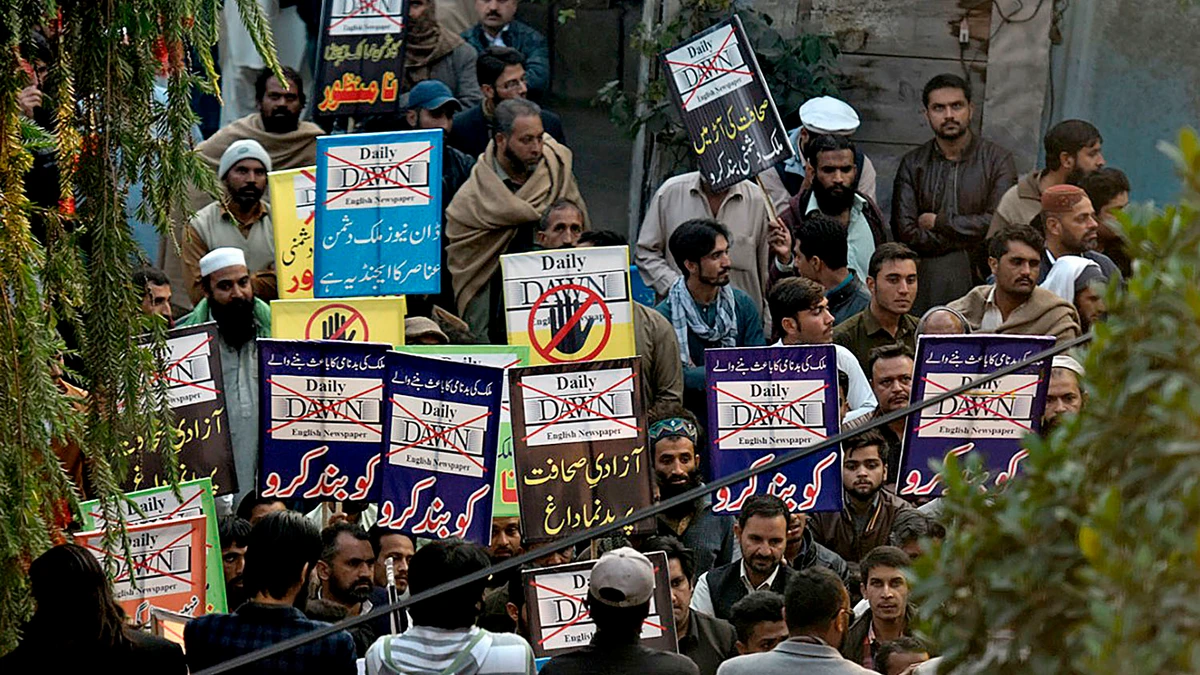
Protesters twice this week besieged Dawn's Islamabad bureau, chanting slogans against the media group and setting copies of the newspaper on fire for reporting that a man who killed two people in a stabbing spree on London Bridge last month was of “Pakistani origin.”
Critics, including a number of government officials, have since called the newspaper ‘unpatriotic’ and the report a mala fide attempt to link to Pakistan a man who was born and had spent his life in the United Kingdom.
Dawn editor Zaffar Abbas told Arab News London Bridge attacker Usman Khan was identified as being of Pakistani origin in the same way as London mayor Sadiq Khan or champion boxer Amir Khan, both of whom were born in the UK to British-Pakistani families.
"We were accused of writing something anti-state, as according to them [critics], the attacker had nothing to do with Pakistan,” Abbas said, adding that the news report had not suggested the attacker was radicalized in Pakistan or that Pakistan was complicit in the attack.
"Even in the past we had referred to people like the London Mayor Sadiq Khan or boxer Aamir Khan as of Pakistani origin, although they were born in Britain and are UK nationals,” Abbas said.
"In the larger context, this [protests] can be seen as yet another attempt to silence Dawn, and force it into self-censorship-- something that we have tried to resist so far," Abbas said.
A journalist working for Dawn was charged last year with treason after an interview with former Prime Minister Nawaz Sharif in which Sharif accused the military of aiding militants who had carried out the 2008 Mumbai terrorist attacks. Last month, Dawn’s Abbas was awarded the 2019 Press Freedom Award by the Committee to Protect Journalists.
On Saturday, the body of the 28-year-old London Bridge attacker was laid to rest in his ancestral village in Pakistan’s Azad Kashmir.
“All I can say is that after the latest development where the body of the London attacker was brought here and buried in an AJK village, this sinister campaign against Dawn should stop,” Abbas said.
"Prime Minister Imran Khan yesterday said he fully supports media freedom. We expect the prime minister to intervene in the matter, and in the light of the latest development, take measures to stop calls for violence.”
"We have no way to identify the protesters but to us, it looks like an orchestrated campaign against Dawn," Abbas said. "Everyone has a right to disagree with Dawn’s journalism, and even to protest against us. But calling us anti-state, making demands that we be hanged, burning our effigies, amounts to incitement to violence. This should immediately stop."
Government officials denied that the protests were planned or sponsored by the state or its agencies.
“The government has nothing to do with these protests. Why would the government do it? If anything happens which is not liked by the people, they come out to protest. This happens everywhere in the world, even in western countries,” ruling party senator Shibli Faraz, the leader of the house in Pakistan’s senate, said. “But again, I would say the protest should be peaceful.”
Earlier, Human Rights Minister Shireen Mazari said on Twitter that though she often disagreed with Dawn’s editorial line, she condemned the protests.
A government spokesman could not be reached for comment.