



PESHAWAR: Abdul Malik could not afford to send his teenage son to school and found him a low paying job at an automobile workshop in Tank, an underdeveloped district in Khyber Pakhtunkhwa (KP) province.
“It was impossible for me to send my son to school since I couldn’t afford the tuition fee,” 43-year-old Malik told Arab News. “In any case, I see thousands of educated people in this area who are jobless. Is there anyone who can give me the guarantee that my son will find a suitable job if he gets educated?”
Malik is not the only parent nervous about sending children to an education institute in this province. According to Khurshid Bano, coordinator Child Rights Movement, a network of civil society groups striving for the rights of children, about 1.8 million children in the province, excluding the newly merged tribal districts, remain out of school.

Adnan Khan, 13, can be seen working at an automobile workshop in Tank district of Khyber Pakhtunkhwa province on December 4, 2019. According to statistics, 1.8 million children in the province are not enrolled in schools. The staggering number does not include children belonging to the newly merged tribal districts. (AN Photo)
“These children are forced to work on streets,” she told a consultative meeting in Peshawar last week, adding that many of them faced physical and sexual abuse.
However, Ziaullah Bangash, adviser to the KP chief minister on education, told Arab News that the provincial administration had devised a multi-pronged strategy to gradually enroll all out-of-school children.
He continued that previous governments had left the education sector untouched, adding that the current KP government had intensified efforts to provide the required facilities at schools and recruit qualified teachers.
“We are about to initiate a second shift at government-run schools and rent more school buildings through public-private partnership,” Bangash maintained. “We have set a target for ourselves to enroll 0.8 million out-of-school children in KP and the newly merged tribal areas in the next two years.”
In addition, he said his department had extended invitation to some organizations working in the education sector to come forward and play their role.
Ibrash Pasha, an educationist, told Arab News that poverty and non-availability of schools in remote areas of the province, lack of entrepreneurial qualities within the education system and absence of awareness about the importance of literacy were some of the factors contributing to the increasing number of out-of-school children.
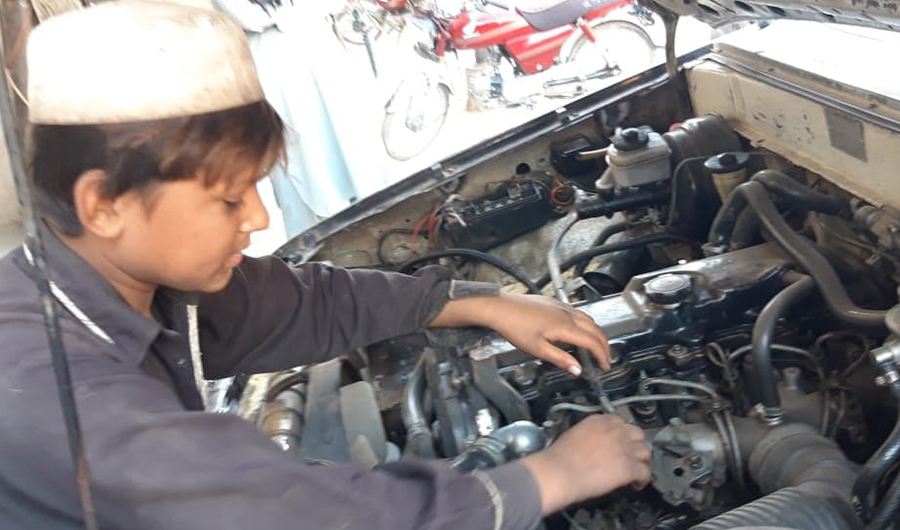
Nouman Ahmad, 14, can be seen working at an automobile workshop in Tank district of Khyber Pakhtunkhwa province on December 4, 2019. According to statistics, 1.8 million children in the province are not enrolled in schools. The staggering number does not include children belonging to the newly merged tribal districts. (AN Photo)
“The government and parents must be held equally responsible for such a sorry state of affairs. We need to develop alternative school systems to help children,” Pasha said.
However, Bano maintained it was the government’s responsibility to fix the situation and tackle the issue of child labor, adding that the present administration must implement Article 25-A of the constitution that promises compulsory and free education to children between the ages of five and 16.
Meanwhile, children like 13-year-old Falak Sher continue to do odd jobs where they are frequently exploited by their employers.
“I want to go to school,” he told Arab News, “but my father wanted me to work at the shop he owns. He told me that after getting trained as a professional carpenter, I will be able to shoulder bigger responsibilities in the future.”
Laila Shah Nawaz, who works with a non-governmental organization dealing with these issues, said that child labor was a common phenomenon in the province.
“We have reports that children from different parts of Shangla, Dir and Swat have been working at the coal mines in Balochistan,” she said. “We want the KP government to bring these children back.”
Nawaz urged the government to ban child labor and introduce measures to strengthen child protection system to prevent their exploitation.
When contacted, Sher’s father acknowledged the importance of education, though he added it was a lengthy process which was not always financially sustainable for poor families.
“We need to change our curriculum, enabling children to get advanced skills and equipping them with problem solving abilities,” Pasha added.


