

Trump pulls back on designating Mexico cartels as ‘terror’ groups

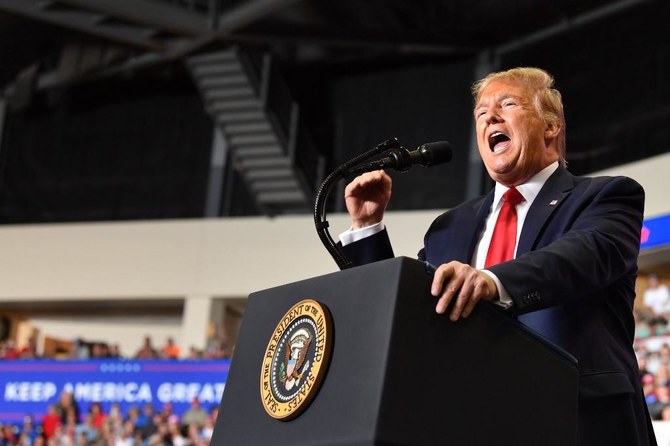
US president Trump called for a ‘war’ on the cartels last month after the killings of nine women and children from a US-Mexican Mormon community. (AFP)
Updated 07 December 2019
Follow

Trump pulls back on designating Mexico cartels as ‘terror’ groups

  • Donald Trump called for a ‘war’ on the cartels after the killings of nine women and children from a US-Mexican Mormon community
  • The case of the slain Mormons has cast a spotlight on drug cartel-fueled violence in Mexico

WASHINGTON: US President Donald Trump on Friday pulled back on his stated plans to designate Mexican drug cartels as terror groups, saying he was doing so at the request of his counterpart Andres Manuel Lopez Obrador.
Last month, Trump called for a “war” on the cartels after the killings of nine women and children from a US-Mexican Mormon community, but south of the common border, his plans were seen as unwanted meddling.
Mexican officials asked for clarification, and said they wanted to make progress on efforts to stem the flow of weapons and money from the United States to criminal gangs in Mexico.


Foreign Minister Marcelo Ebrard had reacted more forcefully, saying: “Mexico will never allow any action that means a violation of its national sovereignty.”
While Trump said in a tweet Friday evening that “all necessary work has been completed to declare Mexican Cartels terrorist organizations,” he said he was putting a hold on the move out of respect for Lopez Obrador.
“We will temporarily hold off this designation and step up our joint efforts to deal decisively with these vicious and ever-growing organizations!” the Republican president tweeted.
Trump noted that the leftist Lopez Obrador was a “man who I like and respect, and has worked so well with us.”
Ebrard hailed Trump’s decision in a tweet, writing that “cooperation has won and there will be good results.”
The case of the slain Mormons has cast a spotlight on drug cartel-fueled violence in Mexico — and Lopez Obrador’s struggles to rein it in.
The victims, including twin eight-month-old babies, were killed as they drove on a remote road between the states of Sonora and Chihuahua, in northern Mexico, a lawless region disputed by warring drug cartels.


US immigration officials grilled by Congress over Trump crackdown

Updated 2 sec ago
Follow

US immigration officials grilled by Congress over Trump crackdown

  • Trump administration officials faced a barrage of criticism and tough questions from Democratic lawmakers over the major crackdown on migrants in multiple US cities
  • Rodney Scott hailed efforts on the southern US frontier, saying CBP ‘spent the last year rebuilding what was an intentionally broken border’
WASHINGTON: The heads of US immigration agencies faced heavy criticism in Congress Tuesday as they defended President Donald Trump’s mass deportation drive and fielded questions about the fatal shootings of two protesters in Minneapolis.
Trump acknowledged in the wake of the Minneapolis killings that a “softer touch” may be needed on immigration, and his administration announced concessions including the withdrawal of hundreds of officers from the Midwestern city.
But the issue remains far from resolved, with Democrats demanding changes to the way the Department of Homeland Security (DHS) conducts its immigration sweeps and threatening to block its funding, while Trump’s administration vows to maintain its deportation efforts, with backing from Republican lawmakers.
“The president tasked us with mass deportation, and we are fulfilling that mandate,” Todd Lyons, the acting head of Immigration and Customs Enforcement (ICE), said in his opening remarks during the Tuesday hearing on DHS oversight.
He testified alongside Rodney Scott, the head of US Customs and Border Protection (CBP), and Citizenship and Immigration Services director Joseph Edlow.
Scott hailed efforts on the southern US frontier, saying CBP “spent the last year rebuilding what was an intentionally broken border” and that “the United States... enjoys the most secure border in our nation’s history.”
The Trump administration officials faced a barrage of criticism and tough questions from Democratic lawmakers over the major crackdown on migrants in multiple US cities, which Republican representatives largely defended.
“This administration and the agencies represented before us have shown a complete and utter disregard for the law and the Constitution,” Democratic Representative Tim Kennedy said.
Representative Eli Crane, a Republican, pushed back on criticism of immigration enforcement, accusing Democrats of seeking to “demonize ICE and Homeland Security.”

‘Days, not weeks’

In Minneapolis, thousands of federal agents have in recent weeks conducted raids in what the administration claims are targeted operations against criminals.
Minnesota Governor Tim Walz said Tuesday that he expects the crackdown — which has seen detentions of broad categories of immigrants and sometimes citizens — to end soon.
“We’re very much in a ‘trust but verify’ mode. But it’s my expectation... that we are talking days, not weeks and months, of this occupation,” Walz said.
The operations have sparked mass protests in Minneapolis, and the fatal shootings of US citizens Renee Good and Alex Pretti less than three weeks apart last month led to a wave of outrage.
When Democratic Representative Eric Swalwell asked Tuesday if Lyons would apologize to Good and Pretti’s families over the Trump administration’s initial description of them as “domestic terrorists,” he declined, saying he would not comment on active investigations.
Opposition Democrats have been calling for sweeping reforms to ICE operations, including ending mobile patrols, prohibiting agents from concealing their faces, and requiring warrants.
Democratic leaders in Congress are also threatening to block the 2026 funding bill for DHS. The White House has indicated it is willing to negotiate, but its response has failed to satisfy opposition lawmakers so far.
“Republicans shared an outline of a counterproposal, which included neither details nor legislative text,” House Minority Leader Hakeem Jeffries and Senate Minority Leader Chuck Schumer said in a statement.
They denounced the White House response as “incomplete and insufficient in terms of addressing the concerns Americans have about ICE’s lawless conduct,” and said they were awaiting further details.
If negotiations fail, DHS could face a funding shortfall starting Saturday. CBP and ICE operations could continue using funds approved by Congress last year, but other sub-agencies such as federal disaster organization FEMA could be affected.