Trump to designate Mexican cartels as ‘terror’ groups

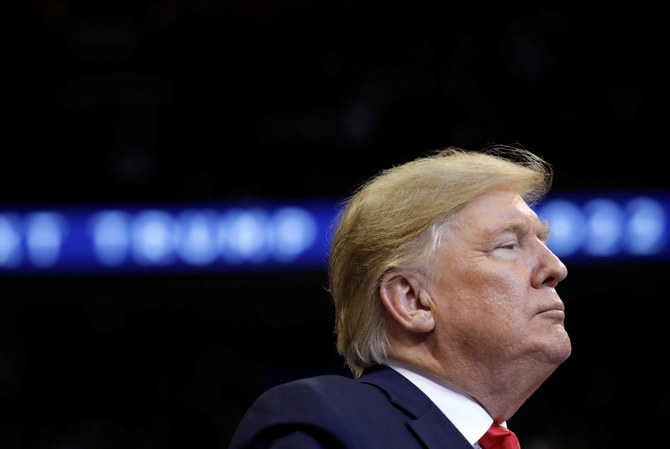
US President Donald Trump called for a ‘war’ on the Mexican cartels in early November. (Reuters)
Updated 27 November 2019
Follow

Trump to designate Mexican cartels as ‘terror’ groups

  • The move comes after Trump called for a ‘war’ on the cartels in early November
  • ‘Designation is not that easy; you have to go through a process and we are well into that process’

WASHINGTON: US President Donald Trump said in an interview posted online Tuesday that he planned to designate Mexican drug cartels as terror groups.
The move comes after Trump called for a “war” on the cartels in early November when nine women and children from a Mormon community in northern Mexico were killed in a hail of gunfire. The victims were dual US-Mexican citizens.
“Are you going to designate those cartels in Mexico as terror groups and start hitting them with drones?” asked Bill O’Reilly, a conservative media personality, in an interview posted on his personal website.
“I don’t want to say what I’m going to do, but they will be designated,” Trump answered.
He added: “I will be designating the cartels... absolutely. I have been working on that for the last 90 days.
“Designation is not that easy; you have to go through a process and we are well into that process.”
Trump’s remarks on Mexico came from a short sample of a longer interview available for paid subscribers on the O’Reilly website.
Mexican authorities reacted swiftly, with the foreign ministry saying that it has contacted US officials “to understand the meaning and scope of the remarks.”
Mexico will also “seek a high-level meeting as soon as possible to present Mexico’s position” and hear Washington’s views, the foreign ministry said in an official translation of their statement.
Mexico will seek talks to “make progress with reducing the flow of arms and money from the United States to organized crime in Mexico, in addition to precursor chemicals and drug precursors that cross Mexican territory en route to the United States,” the statement read.
Mexico has long complained about the flow of weapons bought in the United States and smuggled south of the border.
Foreign Minister Marcelo Ebrard’s reaction was more forceful on Twitter.
“Mexico will never allow any action that means a violation of its national sovereignty,” he wrote.
He said that Mexican officials had already made their views known to Washington “as well as our resolution to deal with transnational organized crime.”
The case of the slain Mormons has cast a spotlight on drug cartel-fueled violence in Mexico and leftist President Andres Manuel Lopez Obrador’s struggles to rein it in.
The victims, including twin eight-month-old babies, were killed as they drove on a remote road between the states of Sonora and Chihuahua, in northern Mexico, a lawless region disputed by warring drug cartels.
Mexican officials say a drug cartel called La Linea (The Line) may have mistaken the victims for members of a rival gang. Relatives, however, believe the families were deliberately targeted.
US Mormons emigrated to Mexico in the late 19th century, fleeing persecution for their traditions, including polygamy.
Now breakaways from the official Church of Jesus Christ of Latter-day Saints, which banned polygamy in 1891, they have lived in Mexico for generations.


Shooter kills 9 at Canadian school and residence

Updated 11 February 2026
Follow

Shooter kills 9 at Canadian school and residence

  • The shooter was found dead with an apparent self-inflicted gunshot wound
  • A total of 27 people were wounded in the shooting, including two with serious injuries

TORONTO: A shooter killed nine people and wounded dozens more at a secondary school and a residence in a remote part of western Canada on Tuesday, authorities said, in one of the deadliest mass shootings in the country’s history.
The suspect, described by police in an initial emergency alert as a “female in a dress with brown hair,” was found dead with an apparent self-inflicted gunshot wound, officials said.
The attack occurred in Tumbler Ridge, British Columbia, a picturesque mountain valley town in the foothills of the Rockies.
A total of 27 people were wounded in the shooting, including two with serious injuries, the Royal Canadian Mounted Police said in a statement.
Prime Minister Mark Carney said he was “devastated” by the “horrific acts of violence” and announced he was suspending plans to travel to the Munich Security Conference on Wednesday, where he had been set to hold talks with allies on transatlantic defense readiness.
Police said an alert was issued about an active shooter at Tumbler Ridge Secondary School on Tuesday afternoon.
As police searched the school, they found six people shot dead. A seventh person with a gunshot wound died en route to hospital.
Separately, police found two more bodies at a residence in the town.
The residence is “believed to be connected to the incident,” police said.
At the school, “an individual believed to be the shooter was also found deceased with what appears to be a self?inflicted injury,” police said.
Police have not yet released any information about the age of the shooter or the victims.
“We are devastated by the loss of life and the profound impact this tragedy has had on families, students, staff, and our entire town,” the municipality of Tumbler Ridge said in a statement.
Tumbler Ridge student Darian Quist told public broadcaster CBC that he was in his mechanics class when there was an announcement that the school was in lockdown.
He said that initially he “didn’t think anything was going on,” but started receiving “disturbing” photos about the carnage.
“It set in what was happening,” Quist said.
He said he stayed in lockdown for more than two hours until police stormed in, ordering everyone to put their hands up before escorting them out of the school.
Trent Ernst, a local journalist and a former substitute teacher at Tumbler Ridge, expressed shock over the shooting at the school, where one of his children has just graduated.
He noted that school shootings have been a rarity occurring every few years in Canada compared with the United States, where they are far more frequent.
“I used to kind of go: ‘Look at Canada, look at who we are.’ But then that one school shooting every 2.5 years happens in your town and things... just go off the rails,” he told AFP.

‘Heartbreak’ 

While mass shootings are extremely rare in Canada, last April, a vehicle attack that targeted a Filipino cultural festival in Vancouver killed 11 people.
British Columbia Premier David Eby called the latest violence “unimaginable.”
Nina Krieger, British Columbia’s minister of public safety, said it was “one of the worst mass shootings in our province’s and country’s history.”
The Canadian Olympic Committee, whose athletes are competing in the 2026 Winter Games in Italy, said Wednesday it was “heartbroken by the news of the horrific school shooting.”
Ken Floyd, commander of the police’s northern district, said: “This has been an incredibly difficult and emotional day for our community, and we are grateful for the cooperation shown as officers continue their work to advance the investigation.”
Floyd told reporters the shooter was the same suspect police described as “female” in a prior emergency alert to community members, but declined to provide any details on the suspect’s identity.
The police said officers were searching other homes and properties in the community to see if there were additional sites connected to the incident.
Tumbler Ridge, a quiet town with roughly 2,400 residents, is more than 1,100 kilometers (680 miles) north of Vancouver, British Columbia’s largest city.
“There are no words sufficient for the heartbreak our community is experiencing tonight,” the municipality said.