

Pro-paramilitary demonstrators flood Iraqi protest camp

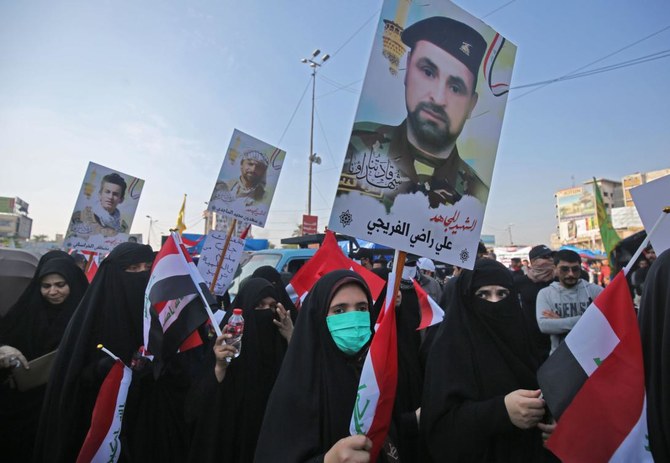
Iraqi supporters of the Hashed Al-shaabi armed network, carry pictures of fighters killed in fighting against jihadists, as they demonstrate in the capital Baghdad's Tahrir Square on December 5, 2019. (AFP)
Updated 05 December 2019
Follow

Pro-paramilitary demonstrators flood Iraqi protest camp

  • The men arrived in Tahrir (Liberation) Square in apparently coordinated marches from different parts of the capital

BAGHDAD: Anti-government protesters say at least 15 people have suffered stab wounds in Baghdad’s Tahrir Square, the epicenter of their movement, after political parties and Iran-backed militia groups briefly joined them, raising fears of infiltration by authorities.
Lawmakers convened a parliament session Thursday to amend laws governing compensation to include victims of military operations, according to the session agenda seen by The Associated Press.
There were over a dozen knife attacks by the late afternoon when protesters aligned with political parties and Iran-backed militias withdrew from Tahrir, three demonstrators and a witness said. There were no fatalities.
Another protester who requested anonymity said the attacks, “might have been perpetrated by the parties or someone who wants to ignite problems with the parties.”

Several thousand men backing a paramilitary force close to Iran flooded the Iraqi capital’s main protest camp on Thursday, worrying anti-government demonstrators who have denounced Tehran’s role in their country.
The men arrived in Tahrir Square in apparently coordinated marches from different parts of the capital, waving sticks, Iraqi flags and the logo of the Hashed Al-Shaabi armed network.
Some carried portraits of Hashed fighters killed in fighting against extremists as well as pictures of the country’s top Shiite cleric, Grand Ayatollah Ali Sistani.
The Hashed had backed the Iraqi government but after a dramatic intervention by Sistani last week, it dropped its support. The embattled prime minister, Adel Abdel Mahdi, resigned at the weekend.
Many units within the Shiite-majority force have been trained or equipped by Iran.
The demonstrators occupying the square for weeks have explicitly criticized Iran for backing an Iraqi political elite they see as corrupt and inept.
They have insisted that all current figures in power are tainted with graft and have been wary of political parties seeking to coopt the youth-dominated movement.
The new arrivals on Thursday mixed in with thousands of other protesters in the square, who appeared worried although no confrontation or skirmishes took place.
“They’ve ruined it,” one protester said, as another muttered, “It’s going to get messy.”
Mass rallies have rocked the capital and Shiite-majority south since early October, first denouncing government graft and a lack of jobs before moving to broader demands for deep-rooted regime change.
Nearly 430 people have been killed and 20,000 wounded since demonstrations erupted, according to an AFP toll compiled from medics, police and a national commission.
The victims’ families have been demanding justice for their loved ones, and many of them hit the streets of Iraq’s southern Diwaniyah on Thursday.
They joined thousands of other protesters, mostly teachers and students taking part in a general strike, AFP’s correspondent said.
“The authorities are putting off the issue of who killed our sons and brothers in the protests,” said Assaad Malek, whose brother died in protest-related violence.
“They should take a tough stance and severely punish the officers and SWAT forces who killed my brother,” he added.
A verdict for security force members accused of violence against protesters in Diwaniyah was scheduled for Thursday, but the session was indefinitely postponed.
In the southern hotspot of Nasiriyah, hundreds hit the main protest camp in the city center, joined by delegations from the province’s powerful tribes.
Tribal dignitaries intervened last week to tamp down tensions between protesters and security forces after more than two dozen people were killed in a bloody crackdown.


Syrian government and SDF agree to de-escalate after Aleppo violence

Updated 37 min 40 sec ago
Follow

Syrian government and SDF agree to de-escalate after Aleppo violence

  • Turkiye views the US-backed SDF, which controls swathes of northeastern Syria, as a ⁠terrorist organization and has warned of military action if the group does not honor the agreement

DAMASCUS: Syrian government forces and the Kurdish-led Syrian Democratic Forces agreed to de-escalate on Monday evening in the northern city of Aleppo, after a wave of attacks that both sides blamed on each other left at least two civilians dead and several wounded.
Syria’s state news agency SANA, citing the defense ministry, said the army’s general command issued an order to stop targeting the SDF’s fire sources. The SDF said in a statement later that it had issued instructions to stop responding ‌to attacks ‌by Syrian government forces following de-escalation contacts.

HIGHLIGHTS

• SDF and Syrian government forces blame each other for Aleppo violence

• Turkiye threatens military action if SDF fails integration deadline

• Aleppo schools and offices closed on Tuesday following the violence

The Syrian health ministry ‌said ⁠two ​people ‌were killed and several were wounded in shelling by the SDF on residential neighborhoods in the city. The injuries included two children and two civil defense workers. The violence erupted hours after Turkish Foreign Minister Hakan Fidan said during a visit to Damascus that the SDF appeared to have no intention of honoring a commitment to integrate into the state’s armed forces by an agreed year-end deadline.
Turkiye views the US-backed SDF, which controls swathes of northeastern Syria, as a ⁠terrorist organization and has warned of military action if the group does not honor the agreement.
Integrating the SDF would ‌mend Syria’s deepest remaining fracture, but failing to do ‍so risks an armed clash that ‍could derail the country’s emergence from 14 years of war and potentially draw in Turkiye, ‍which has threatened an incursion against Kurdish fighters it views as terrorists.
Both sides have accused the other of stalling and acting in bad faith. The SDF is reluctant to give up autonomy it won as the main US ally during the war, which left it with control of Islamic ​State prisons and rich oil resources.
SANA, citing the defense ministry, reported earlier that the SDF had launched a sudden attack on security forces ⁠and the army in the Sheikh Maqsoud and Ashrafiyah neighborhoods of Aleppo, resulting in injuries.
The SDF denied this and said the attack was carried out by factions affiliated with the Syrian government. It said those factions were using tanks and artillery against residential neighborhoods in the city.
The defense ministry denied the SDF’s statements, saying the army was responding to sources of fire from Kurdish forces. “We’re hearing the sounds of artillery and mortar shells, and there is a heavy army presence in most areas of Aleppo,” an eyewitness in Aleppo told Reuters earlier on Monday. Another eyewitness said the sound of strikes had been very strong and described the situation as “terrifying.”
Aleppo’s governor announced a temporary suspension of attendance in all public and private schools ‌and universities on Tuesday, as well as government offices within the city center.