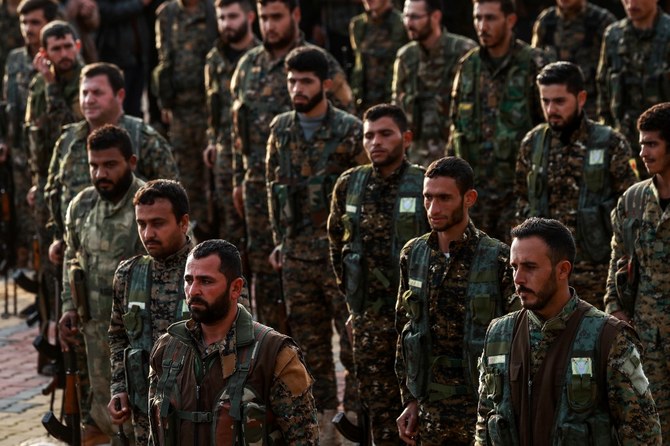
ANKARA: NATO leaders forced Turkish President Recep Tayyip Erdogan into a humiliating climbdown on Wednesday over his demand that the alliance designate Kurdish YPG fighters in Syria terrorists.
Erdogan had earlier been accused of political blackmail after he threatened to veto NATO’s defense plan for the Baltics and Poland unless he got his way on the YPG.
But at the conclusion of the alliance’s 70th anniversary summit in London on Wednesday, NATO Secretary-General Jens Stoltenberg said Turkey had agreed to approve the plan.
Whether to designate the YPG “a threat” or “a terror group” had not even been discussed at the leaders’ meeting, and disagreements over the issue should not undermine the gains made in the global fight against terrorism, Stoltenberg said. “Despite differences, the allies keep uniting around their core mission, which is protecting each other.”
Many in Turkey wondered what Erdogan had obtained in return for withdrawing his veto, but Lithuanian President Gitanas Nauseda denied any quid pro quo, and welcomed the plan as “a huge achievement for the whole region.”
Burak Bilgehan Ozpek, a political scientist from TOBB University in Ankara, told Arab News: “Removing the blockage is a good decision, but just before the summit Erdogan seemed to be trying to use the NATO forum to solve Turkey’s own foreign policy challenges, which was totally wrong.”
If such tactics ever influenced NATO’s decision-making processes, the alliance could no longer be considered purely a military defense project, instead becoming a mechanism for political wrangling between member countries, Ozpek said.
In the summit’s final declaration, NATO said: “Terrorism in all its forms and manifestations remains a persistent threat to us all. State and non-state actors challenge the rules-based international order.”
That will interest Turkish decision-makers, said Karol Wasilewski, an analyst at the Polish Institute of International Affairs in Warsaw. The aim of Erdogan’s veto gambit was “probably to break Turkey’s isolation over the Syrian issue,” he told Arab News.
“If Turkey … gets at least an assurance that the allies will tone down their criticism of the Syrian operation, or maybe even consider minor financial support for the safe zone, Turkey could argue that the bargain paid off,” he said.

Erdogan in NATO climbdown over Kurds
- Erdogan withdrew his demand that the alliance designate Kurdish YPG fighters in Syria terrorists
- Turkish president had threatened to veto NATO’s defense plan for the Baltics and Poland unless
10 countries warn of ‘catastrophic’ Gaza situation
- Foreign ministers of Britain, Canada, France, and others call on Israel to urgently address 'catastrophic' humanitarian situation in Gaza
- Nations call for opening of crossings into the territory to boost flow of humanitarian aid
LONDON: The foreign ministers of 10 nations on Tuesday expressed “serious concerns” about a “renewed deterioration of the humanitarian situation” in Gaza, saying the situation was “catastrophic.”
The warning came a day after US President Donald Trump warned Palestinian militant group Hamas there would be “hell to pay” if it fails to disarm in Gaza, as he presented a united front with Israeli Prime Minister Benjamin Netanyahu.
“As winter draws in, civilians in Gaza are facing appalling conditions with heavy rainfall and temperatures dropping,” the ministers of Britain, Canada, Denmark, Finland, France, Iceland, Japan, Norway, Sweden and Switzerland said in a joint statement released by the UK’s Foreign Office.
“1.3 million people still require urgent shelter support. More than half of health facilities are only partially functional and face shortages of essential medical equipment and supplies. The total collapse of sanitation infrastructure has left 740,000 people vulnerable to toxic flooding,” the statement added.
Trump’s comments on Monday also downplayed reports of tensions with Netanyahu over the second stage of the fragile Gaza ceasefire.
The president, speaking at a news conference with Netanyahu in Florida, said Israel had “lived up” to its commitments and that the onus was on Hamas.
The foreign ministers in their statement said they welcomed the progress that had been made to end the bloodshed in Gaza and secure the release of Israeli hostages.
“However we will not lose focus on the plight of civilians in Gaza,” they said, calling on the government of Israel to take a string of “urgent and essential” steps.
These included ensuring that international NGOs could operate in Gaza in a “sustained and predictable” way.
“As 31 December approaches, many established international NGO partners are at risk of being deregistered because of the government of Israel’s restrictive new requirements,” the statement said.
It also called for the UN and its partners to be able to continue their work in Gaza and for the lifting of “unreasonable restrictions on imports considered to have a dual use.”
This included medical and shelter equipment.
- ‘Vital supplies’ -
The ministers also called for the opening of crossings to boost the flow of humanitarian aid into Gaza.
While welcoming the partial opening of the Allenby crossing, they said other corridors for moving goods remained closed or severely restricted for humanitarian aid, including Rafah.
“Bureaucratic customs processes and extensive screenings are causing delays, while commercial cargo is being allowed in more freely,” the statement said.
“The target of 4,200 trucks per week, including an allocation of 250 UN trucks per day, should be a floor not a ceiling. These targets should be lifted so we can be sure the vital supplies are getting in at the vast scale needed,” it added.
The Gaza ceasefire in October is considered one of the major achievements of Trump’s first year back in power, and Washington and regional mediators have hoped to keep their foot on the gas.
The Axios news site said Trump seeks to make announcements as soon as January on an interim government and an international force.
But Trump on Monday gave few details beyond saying that he hoped “reconstruction” could begin soon in the Palestinian territory, devastated by Israeli attacks in response to Hamas’s October 7, 2023 attacks.
The disarmament of Hamas however continued to be a sticking point, with its armed wing again saying that it would not surrender its arms.
The warning came a day after US President Donald Trump warned Palestinian militant group Hamas there would be “hell to pay” if it fails to disarm in Gaza, as he presented a united front with Israeli Prime Minister Benjamin Netanyahu.
“As winter draws in, civilians in Gaza are facing appalling conditions with heavy rainfall and temperatures dropping,” the ministers of Britain, Canada, Denmark, Finland, France, Iceland, Japan, Norway, Sweden and Switzerland said in a joint statement released by the UK’s Foreign Office.
“1.3 million people still require urgent shelter support. More than half of health facilities are only partially functional and face shortages of essential medical equipment and supplies. The total collapse of sanitation infrastructure has left 740,000 people vulnerable to toxic flooding,” the statement added.
Trump’s comments on Monday also downplayed reports of tensions with Netanyahu over the second stage of the fragile Gaza ceasefire.
The president, speaking at a news conference with Netanyahu in Florida, said Israel had “lived up” to its commitments and that the onus was on Hamas.
The foreign ministers in their statement said they welcomed the progress that had been made to end the bloodshed in Gaza and secure the release of Israeli hostages.
“However we will not lose focus on the plight of civilians in Gaza,” they said, calling on the government of Israel to take a string of “urgent and essential” steps.
These included ensuring that international NGOs could operate in Gaza in a “sustained and predictable” way.
“As 31 December approaches, many established international NGO partners are at risk of being deregistered because of the government of Israel’s restrictive new requirements,” the statement said.
It also called for the UN and its partners to be able to continue their work in Gaza and for the lifting of “unreasonable restrictions on imports considered to have a dual use.”
This included medical and shelter equipment.
- ‘Vital supplies’ -
The ministers also called for the opening of crossings to boost the flow of humanitarian aid into Gaza.
While welcoming the partial opening of the Allenby crossing, they said other corridors for moving goods remained closed or severely restricted for humanitarian aid, including Rafah.
“Bureaucratic customs processes and extensive screenings are causing delays, while commercial cargo is being allowed in more freely,” the statement said.
“The target of 4,200 trucks per week, including an allocation of 250 UN trucks per day, should be a floor not a ceiling. These targets should be lifted so we can be sure the vital supplies are getting in at the vast scale needed,” it added.
The Gaza ceasefire in October is considered one of the major achievements of Trump’s first year back in power, and Washington and regional mediators have hoped to keep their foot on the gas.
The Axios news site said Trump seeks to make announcements as soon as January on an interim government and an international force.
But Trump on Monday gave few details beyond saying that he hoped “reconstruction” could begin soon in the Palestinian territory, devastated by Israeli attacks in response to Hamas’s October 7, 2023 attacks.
The disarmament of Hamas however continued to be a sticking point, with its armed wing again saying that it would not surrender its arms.
© 2025 SAUDI RESEARCH & PUBLISHING COMPANY, All Rights Reserved And subject to Terms of Use Agreement.